Can I determine the phase angle of this equation by using the sin function?

Click For Summary
The discussion centers on determining the phase angle of a displacement equation in simple harmonic motion (SHM) using sine and cosine functions. The user correctly identifies the equations for displacement but finds discrepancies in results when comparing them numerically. It is clarified that both sine and cosine functions can represent the same motion with different phase angles, but calculations must be done in radians for accuracy. The conversation emphasizes the importance of careful calculation to avoid errors in determining the phase. Understanding the relationship between sine and cosine is crucial for solving SHM problems effectively.
nuclearfireball_42
Messages
9
Reaction score
2
Homework Statement
The graph of displacement vs time for a small mass m at the end of a spring is shown in Fig. 14-30. At t = 0, x = 0.43 cm.
(a) If m = 9.5 g, find the spring constant, k.
(b) Write the equation for displacement x as a function of time.
Relevant Equations
x(t) = Asin(ωt + φ)

x(t) = Acos(ωt - φ)
I've got the answer for (a). It's k = 0.78 N/m.

I'm having problems with (b). I know that the equation of displacement in this case should either be :

x(t) = Asin(ωt + φ)

or

x(t) = Acos(ωt - φ)

where A = amplitudeFrom what I understand, both the equation above should give the same result as the sine and cosine functions are the reason for the different signs before the phase angle. But the author of the book wrote the second equation (the one with the cos function) to be the answer. Thinking that my answer which is in the form of the first equation could just be an alternative of the second, I checked the result of the functions numerically and I found them to be different . Is it something to do with my calculation or is my understanding just wrong?

The picture of the graph :
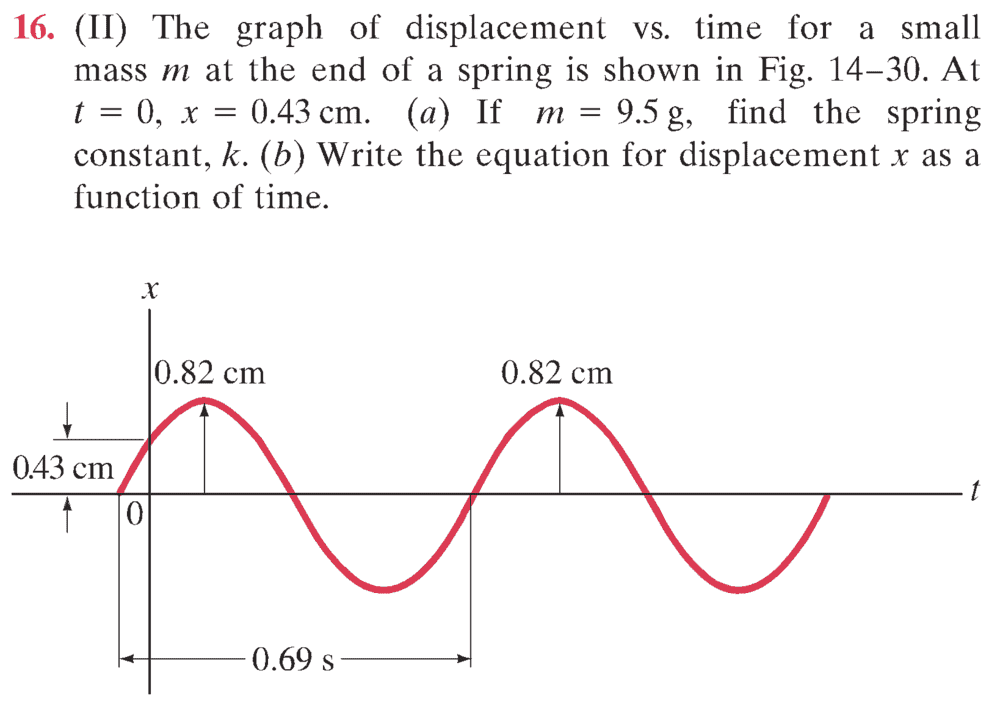
graph.png
 
Physics news on Phys.org
Your understanding is correct, so you must have made a mistake in the calculations. Note that:
$$\sin(x + \frac {\pi}{2}) = \cos(x)$$
Hence, any sine or cosine function can always be written either way with a different phase.
 
PeroK said:
Your understanding is correct, so you must have made a mistake in the calculations. Note that:
$$\sin(x + \frac {\pi}{2}) = \cos(x)$$
Hence, any sine or cosine function can always be written either way with a different phase.
This might be a dumb question but I have to calculate in radians mode in the calculator right to find x?
 
nuclearfireball_42 said:
This might be a dumb question but I have to calculate in radians mode in the calculator right to find x?

Always in radians for SHM.
 
  • Like
Likes nuclearfireball_42
nuclearfireball_42 said:
This might be a dumb question but I have to calculate in radians mode in the calculator right to find x?
In solving the SHM differential equation, use is made of the standard equations ##\frac{d\sin(x)}{dx}=\cos(x)## etc. Those equations are only valid in radians. If working in degrees you would have to include a constant factor.
 
... both equations should give the same result, as the sine and cosine functions are the reason for the different signs before the phase angle. ... author of the book wrote the second equation (the one with the cos function) to be the answer. Thinking that my answer which is in the form of the first equation could just be an alternative of the second, I checked the result of the functions numerically and I found them to be different . Is it something to do with my calculation...
If you show your calculations, we might be able to tell.
When you use sin instead of cos, the magnitude of the phase will usually change, not just the sign.
 
The book claims the answer is that all the magnitudes are the same because "the gravitational force on the penguin is the same". I'm having trouble understanding this. I thought the buoyant force was equal to the weight of the fluid displaced. Weight depends on mass which depends on density. Therefore, due to the differing densities the buoyant force will be different in each case? Is this incorrect?

Similar threads

  • · Replies 1 ·
Replies
1
Views
1K
  • · Replies 10 ·
Replies
10
Views
2K
Replies
6
Views
5K
  • · Replies 23 ·
Replies
23
Views
5K
  • · Replies 6 ·
Replies
6
Views
2K
  • · Replies 3 ·
Replies
3
Views
25K
Replies
2
Views
6K
  • · Replies 7 ·
Replies
7
Views
7K
  • · Replies 8 ·
Replies
8
Views
5K
  • · Replies 7 ·
Replies
7
Views
2K