Can I Simplify a Block Diagram by Making Multiple G5 Blocks?

Click For Summary
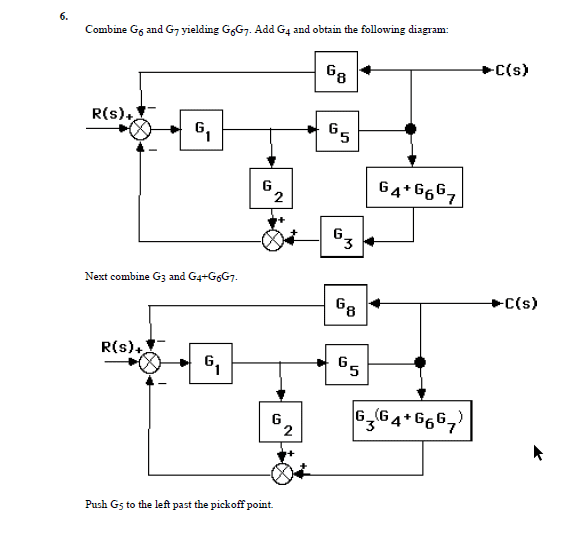
The discussion revolves around the complexities of simplifying a block diagram involving G5, G3, G4, G6, G7, G8, and C(s). Participants emphasize the importance of understanding the definitions of series and parallel connections, noting that misapplying these concepts can lead to incorrect results. There is debate about whether G5 can be treated as both in series and parallel with other blocks, particularly regarding its relationship with G8 and C(s). One participant suggests that creating multiple G5 blocks could simplify the transfer function by eliminating rational expressions. Ultimately, the conversation highlights the nuanced relationships between the blocks and the potential for confusion in their arrangement.
mech-eng
Messages
825
Reaction score
13
I would like to ask why cannot I think G5 in series with G3(G4+G6G7) and then after muliplying them why I cannot think of G5*G3(G4+G6G7) in parallel to G2 so sum G2 and G5*G3(G4+G6G7) ?

c.png

Thank you.
 
Last edited:
Engineering news on Phys.org
If you do that, what happens to G8 and C(s)?

G5 would be at the other side, by the way.
 
mech-eng said:
I would like to ask why cannot I think G5 in series with G3(G4+G6G7) and then after muliplying them why I cannot think of G5*G3(G4+G6G7) in parallel to G2 so sum G2 and G5*G3(G4+G6G7) ?
.
I suggest you review the definitions of serial and parallel and see how they apply in this case. It's completely clear from the definitions that what you want to be series isn't series.
 
mfb said:
If you do that, what happens to G8 and C(s)? G5 would be at the other side, by the way.

If you do that I would ignore the multiplication of G8 and G5 so the result would be incorrect. I cannot think of what happens to the C(s) ? Is that the same thing for G(8) i.e ignorance of multiplication? But problem is that is G5 also series with C(s) so when multiply G5 with G8 and (G4 +G6G7) should I also multiply G5 with C(s) ?

Thank you.
 
Last edited:
phinds said:
I suggest you review the definitions of serial and parallel and see how they apply in this case. It's completely clear from the definitions that what you want to be series isn't series.

I try to still understand. Because there is a common point between G5, G8 and (G4 + G6G7), G5 cannot be only series with (G4 + G6G7) and the signal G5 is going to both G8 and (G4 + G6G7) so G5 is both series with them. When I do this result is correct but I think simpler.

Thank you.
 
You can make multiple G5 blocks, but I don't think that makes it simpler.
 
mfb said:
You can make multiple G5 blocks, but I don't think that makes it simpler.

But if I do that, I can get rid of rational expressions so I can write transfer function easily.

Thank you.
 

Similar threads

  • · Replies 2 ·
Replies
2
Views
2K
  • · Replies 13 ·
Replies
13
Views
4K
  • · Replies 4 ·
Replies
4
Views
3K
Replies
1
Views
6K
  • · Replies 4 ·
Replies
4
Views
5K
  • · Replies 7 ·
Replies
7
Views
2K
Replies
4
Views
2K
  • · Replies 11 ·
Replies
11
Views
4K
  • · Replies 1 ·
Replies
1
Views
3K
  • · Replies 3 ·
Replies
3
Views
1K