Can Laser Propulsion with the EM Drive and Prisms Actually Work?

Click For Summary

Discussion Overview

The discussion centers around the feasibility of using laser propulsion combined with the EM drive and prisms to achieve thrust in space. Participants explore theoretical aspects, practical challenges, and alternative ideas related to propulsion mechanisms.

Discussion Character

  • Exploratory
  • Technical explanation
  • Debate/contested

Main Points Raised

  • Some participants propose using two lasers to bounce off prisms to create thrust, questioning the viability of this approach.
  • Others argue that while electromagnetic waves can provide thrust, the power requirements are significant, and using onboard lasers may not be efficient.
  • One participant suggests that firing lasers directly out of the back would achieve the same momentum transfer without the complications of using prisms.
  • A participant mentions that the momentum change from the drive is limited to the momentum in the beam exiting the craft, implying that additional bounces do not contribute to thrust.
  • Another idea raised involves the potential use of CO2 exhaled by astronauts as a propulsion mechanism, although this is met with skepticism regarding its practicality.
  • Concerns are expressed about the effectiveness of collecting CO2 for propulsion, with questions about how momentum would be imparted in such a scenario.
  • Technical challenges related to the efficiency of reflections and absorption at the prism reflectors are noted, suggesting that ideal conditions may not be achievable.

Areas of Agreement / Disagreement

Participants express a range of views on the proposed laser propulsion method, with no consensus reached on its feasibility. There are competing ideas regarding the use of prisms versus direct laser firing, as well as differing opinions on the utility of CO2 for propulsion.

Contextual Notes

Discussions highlight limitations related to the assumptions about momentum transfer and the efficiency of various propulsion methods. The conversation also reflects a lack of clarity on the practical implementation of the proposed ideas.

Who May Find This Useful

Individuals interested in propulsion technologies, space exploration, and theoretical physics may find this discussion relevant.
Misha2010
Messages
2
Reaction score
0
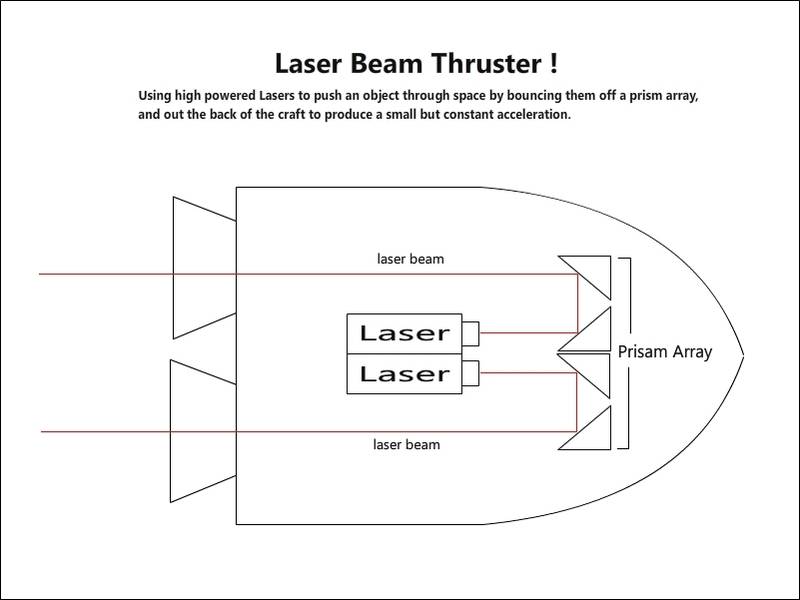
I just had this thought while watching a video about the EM drive...basically using 2 lasers to bounce them off prisms inside an object to push the craft through space at a small but constant acceleration...could someone explain why this would not work?...please see attached image :)

Laser_Thruster_zpss2yotioh.jpg
 
Science news on Phys.org
Hi and welcome to PF
Using a beam of EM waves is a possibility for obtaining thrust but it requires a vast amount of power. An on board laser isn't good value as you don't need such a well collimated beam and you can get more power out of other sources.
PS you may as well fire the lasers straight out of the back. It would achieve the same amount of momentum transfer (Newton's Third Law and reaction) and wouldn't involve heating up the prism reflectors.
 
  • Like
Likes   Reactions: davenn
sophiecentaur said:
Hi and welcome to PF
Using a beam of EM waves is a possibility for obtaining thrust but it requires a vast amount of power. An on board laser isn't good value as you don't need such a well collimated beam and you can get more power out of other sources.
PS you may as well fire the lasers straight out of the back. It would achieve the same amount of momentum transfer (Newton's Third Law and reaction) and wouldn't involve heating up the prism reflectors.

yea I realize you wouldn't get much thrust, but these kind of devices never would, like a solar sail...plus the idea for using prisms would be to get a double bounce effect...but you would probably have to angle the second prisms, so you get more fwd push than sideways push...but anyway...i'm an animator, i just wanted to understand why this wouldn't work! :)
 
Misha2010 said:
to get a double bounce effect.
The drive can only deliver the same amount of momentum change as the momentum in the beam that's leaving out of the back. All the other 'bounces' cancel each other out. Shame but that's Newton for you.
There are a lot of discussions about this topic on PF and elsewhere and sometimes the Physics isn't always well understood. But, as you are hardly likely to be investing all your money in such a system, it's not that desperate.
Cheers
 
Misha2010 said:
I just had this thought while watching a video about the EM drive...basically using 2 lasers to bounce them off prisms inside an object to push the craft through space at a small but constant acceleration...could someone explain why this would not work?...please see attached image :)

View attachment 203483
Hi,
I also just had a thought!
What happens to the CO2 that the astronauts breath out? If this was collected, then perhaps it could be used to propel the craft?
[I did say I had a thought, but not that I had thought it through:) ]
Camerart.
 
camerart said:
What happens to the CO2 that the astronauts breath out?

you should read up on space flight :wink:

you would have found they use CO2 scrubbers to get back breathable oxygen/air
 
Hi S,
I did say I hadn't thought it through :smile:
Thinking back, I used to service oxygen producing machines, which included CO2 scrubbers.
I'm sure they recycle almost everything.
C.
 
camerart said:
If this was collected, then perhaps it could be used to propel the craft?
davenn said:
you would have found they use CO2 scrubbers to get back breathable oxygen/air

But there's a more fundamental problem. How does collecting CO2 propel the craft? Do the astronauts blow it out the back? (Make a wish everyone!) You need to impart momentum somehow.
 
  • Like
Likes   Reactions: davenn
Hi,
Yes, anything blown or thrown "out the back", will push the craft forward, CO2, Computers etc.
(So far I don't think wishing helps)
C.
 
  • #10
Misha2010 said:
...plus the idea for using prisms would be to get a double bounce effect...
One of the bounces is canceled by the recoil of the laser. With ideal refection it would be the same as simply pointing the laser back. But in reality it's worse, due to partial absorption at the reflector.
 
  • Like
Likes   Reactions: sophiecentaur

Similar threads

  • · Replies 3 ·
Replies
3
Views
2K
Replies
27
Views
4K
  • · Replies 4 ·
Replies
4
Views
3K
  • · Replies 2 ·
Replies
2
Views
2K
  • · Replies 15 ·
Replies
15
Views
3K
  • · Replies 3 ·
Replies
3
Views
6K
  • · Replies 9 ·
Replies
9
Views
6K
  • · Replies 20 ·
Replies
20
Views
5K
  • · Replies 9 ·
Replies
9
Views
4K
Replies
3
Views
2K