Can light near a black hole travel in -t in external coords?

Click For Summary

Discussion Overview

The discussion revolves around the behavior of light cones near a black hole, specifically in the context of Schwarzschild black holes and the implications of different coordinate systems on the representation of light paths. Participants explore whether light can exhibit a negative time component in the coordinate frame of a distant observer.

Discussion Character

  • Debate/contested
  • Technical explanation
  • Conceptual clarification

Main Points Raised

  • Some participants note that diagrams depicting light cones near a black hole can show varying behaviors, with some suggesting light can have a negative time component in certain coordinate systems.
  • Others argue that all diagrams presented are correct but utilize different coordinate systems, leading to different interpretations of light cone behavior.
  • There is uncertainty about the validity of the first two diagrams in relation to Schwarzschild coordinates, with some suggesting they may not correspond to any known coordinates.
  • Participants express concern that the diagrams do not clearly indicate the coordinate systems used, which may lead to misunderstandings.
  • Some participants propose that the diagrams could be interpreted as using Cartesian representations of Schwarzschild coordinates, despite potential inaccuracies regarding the behavior of the metric at the horizon.
  • There is a suggestion that the first three diagrams might be related to Kruskal–Szekeres coordinates, although this is contested by another participant who clarifies the characteristics of Kruskal coordinates.

Areas of Agreement / Disagreement

Participants do not reach a consensus on the validity of the diagrams or the coordinate systems they represent. Multiple competing views remain regarding the interpretation of light cones near black holes.

Contextual Notes

Participants highlight that the appearance of light cones is highly dependent on the choice of coordinates, and there is a lack of clarity regarding the specific coordinates used in the diagrams discussed.

TGlad
Messages
136
Reaction score
1
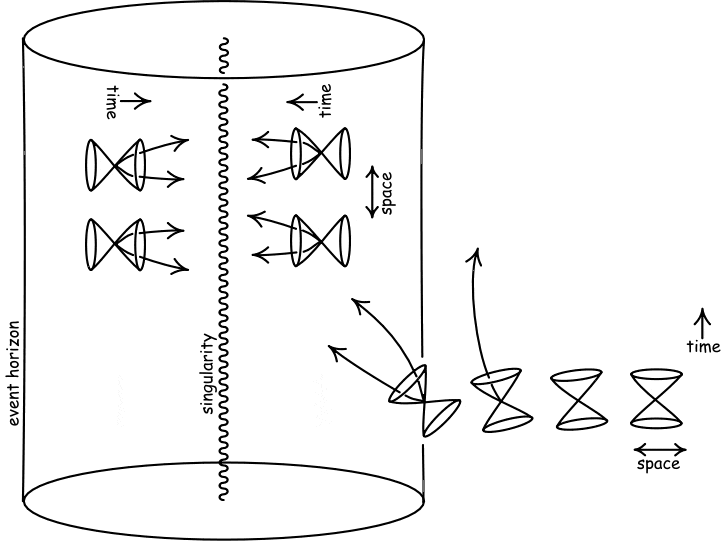
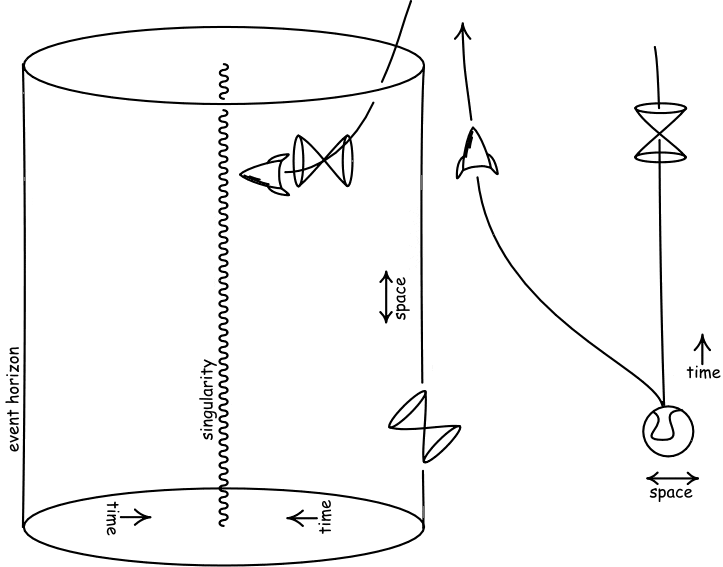
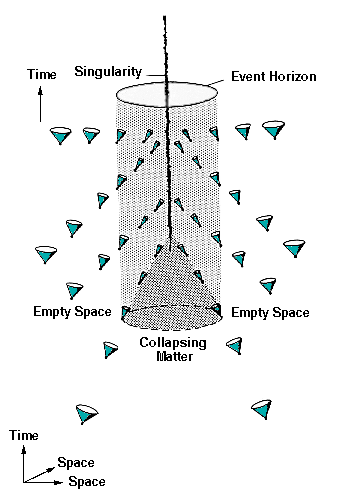
Many diagrams show light cones tipping over when closer to a black hole singularity, such that emitted light can have a downwards (negative time) component in the distant observer coordinate frame. e.g this diagram:
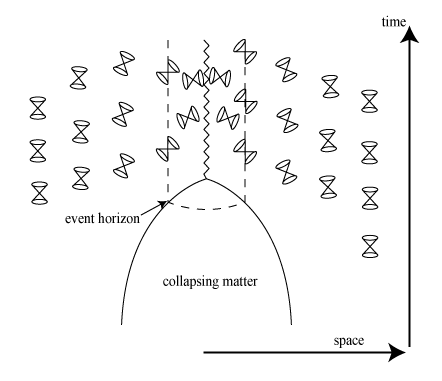
lightcone-bh.gif

or this one:
bh_lightcones_st.gif

or this one:
bh_falling_st.gif


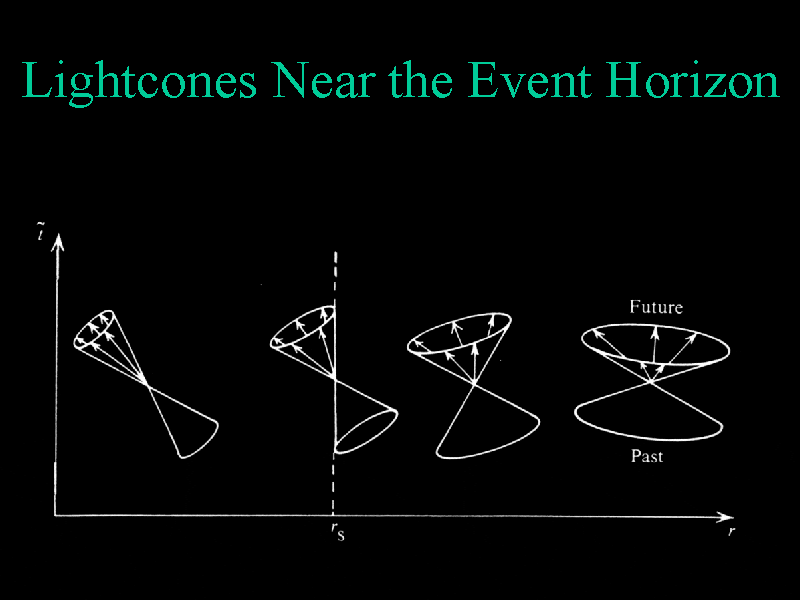
However, other diagrams show that the light cone gets narrower towards the singularity, such that it looks like it emissions never have a downwards component:
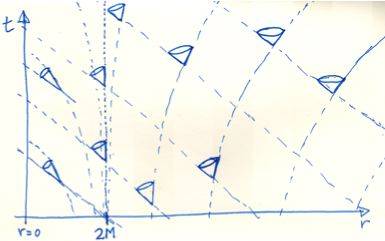
cones3.jpg

blackhole.gif

eventho2.gif


So my question is, which version is correct? (for a Schwarzschild black hole, using coordinates of an observer at infinity). Can the light cone ever have a -t component in the distant observer's t coordinate?
 

Attachments

  • lightcone-bh.gif
    lightcone-bh.gif
    9.2 KB · Views: 2,392
  • bh_lightcones_st.gif
    bh_lightcones_st.gif
    26.1 KB · Views: 1,708
  • bh_falling_st.gif
    bh_falling_st.gif
    22.6 KB · Views: 1,046
  • cones3.jpg
    cones3.jpg
    11.3 KB · Views: 831
  • blackhole.gif
    blackhole.gif
    16.3 KB · Views: 1,000
  • eventho2.gif
    eventho2.gif
    20.6 KB · Views: 1,535
Physics news on Phys.org
TGlad said:
Many diagrams

Please give a source for these diagrams.
 
All of them are correct, just using different coordinates.
 
Orodruin said:
All of them are correct, just using different coordinates.

I'm not sure the first two diagrams correspond to any coordinates that I'm aware of for Schwarzschild spacetime. The third one seems almost correct for Schwarzschild coordinates, but the light cone placed on the horizon is wrong: it should be squashed to a single line.

The rest of the diagrams look like either Eddington-Finkelstein or Painleve coordinates.
 
PeterDonis said:
I'm not sure the first two diagrams correspond to any coordinates that I'm aware of for Schwarzschild spacetime. The third one seems almost correct for Schwarzschild coordinates, but the light cone placed on the horizon is wrong: it should be squashed to a single line.
I think that even if we do not know of any such coordinates, they could in principle be defined. I may be wrong of course. My main point was that how the diagrams look will depend on the choice of coordinates.

What I find misleading in all cases are the general time and space arrows that seem to indicate those directions are always time/space.
 
Orodruin said:
I think that even if we do not know of any such coordinates, they could in principle be defined.

That may be, but it would be really nice if the articles that showed these diagrams would say what coordinates they are actually using. I strongly suspect that at least the first three diagrams were not constructed using actual coordinate charts, but just by handwaving.
 
PeterDonis said:
That may be, but it would be really nice if the articles that showed these diagrams would say what coordinates they are actually using. I strongly suspect that at least the first three diagrams were not constructed using actual coordinate charts, but just by handwaving.
I can explain the first three as drawing Schwarzschild coordinates as if they Cartesian, with 't' coordinate (whatever its meaning in different parts of the chart) vertical, putting interior and exterior on the same chart, and ignoring the misbehavior of the metric on the horizon. Whether you approve of such a practices is another question ...

[oops: I didn't see Peter's earlier post - yes, in SC coordinates the cones would narrow towards being lines near either side of the horzion. However, close to the singularity, which is what I was looking at, they are fine.]
 
Last edited:
PeterDonis said:
I'm not sure the first two diagrams correspond to any coordinates that I'm aware of...
The rest of the diagrams look like either Eddington-Finkelstein or Painleve coordinates

That makes sense. Maybe the first three are somehow Kruskal–Szekeres coordinates.
Anyway, thanks for the information, I think that is useful enough for my level of understanding.
 
  • #10
TGlad said:
Maybe the first three are somehow Kruskal–Szekeres coordinates.

They're not; in Kruskal coordinates the horizon would be a 45-degree line, not vertical, and the singularity would be a hyperbola at the top of the diagram.
 
  • #11
PeterDonis said:
They're not; in Kruskal coordinates the horizon would be a 45-degree line, not vertical, and the singularity would be a hyperbola at the top of the diagram.
Like this:
Kruskal_with_light_cone.png
 

Attachments

  • Kruskal_with_light_cone.png
    Kruskal_with_light_cone.png
    4 KB · Views: 820

Similar threads

  • · Replies 22 ·
Replies
22
Views
2K
  • · Replies 20 ·
Replies
20
Views
3K
  • · Replies 1 ·
Replies
1
Views
1K
  • · Replies 10 ·
Replies
10
Views
2K
  • · Replies 51 ·
2
Replies
51
Views
2K
  • · Replies 7 ·
Replies
7
Views
2K
  • · Replies 15 ·
Replies
15
Views
3K
  • · Replies 37 ·
2
Replies
37
Views
6K
  • · Replies 24 ·
Replies
24
Views
3K
  • · Replies 7 ·
Replies
7
Views
4K