Can Negative Current Occur in Simple Circuit Designs?

  • Thread starter Thread starter sherrellbc
  • Start date Start date
Click For Summary

Discussion Overview

The discussion centers around the possibility of negative current in simple circuit designs, particularly focusing on the current I3 in a specified circuit configuration. Participants explore theoretical scenarios, assumptions about voltage levels, and the implications of different circuit elements.

Discussion Character

  • Debate/contested
  • Conceptual clarification
  • Technical explanation

Main Points Raised

  • Some participants argue that I3 can never be negative in the given circuit due to the voltage levels established by the battery and resistors, suggesting that current will always flow in the indicated direction.
  • Others propose that if the reference node is changed, or if different circuit elements such as a voltage source or current source are introduced, it may be possible for I3 to be negative.
  • One participant mentions that the concept of positive or negative current is a matter of perspective, particularly in node analysis where current directions can be defined arbitrarily.
  • Another participant suggests that even if I3 is initially assumed to flow in the wrong direction, Kirchhoff's principles will yield a negative value for I3 in the arithmetic solution, reinforcing the importance of mathematical rigor.

Areas of Agreement / Disagreement

Participants generally disagree on whether I3 can be negative, with some firmly asserting it cannot occur under the given conditions, while others present scenarios where it could be possible. The discussion remains unresolved with multiple competing views.

Contextual Notes

Participants express uncertainty regarding the definitions of current direction and the implications of different circuit elements, indicating that assumptions about the circuit configuration significantly influence their conclusions.

sherrellbc
Messages
83
Reaction score
0
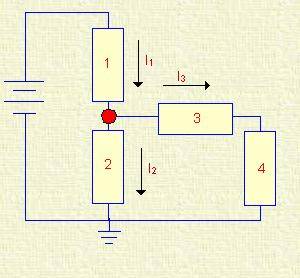
I've seen this simple circuit design many times when the text is illustrating different points. Sometimes, again for illustrative purposes, the text may say that I3 is negative. When would this ever happen? If I3 were negative, the node between components 3 & 4 would have to be lower than ground, and, further, the red extraordinary node would have to be lower yet. It seems intuitive to me to conclude that the voltage at the node in red will never be at a lower potential than ground in this design. If I3 is negative, it would seem obvious to me that I2 must also be negative (with polarity defined as is it) - but when could this be the case?

Perhaps I3 could be negative if different node is selected as the reference, but as it stands I cannot see a way that this claim would ever be true.
ciHq6ix.jpg
 
Engineering news on Phys.org
IN my mind, I3 can never be negative in this circuit.

Lets say the battery is 20 volts and 10 volts drop across that first resistor. YOu are then left with 10 volts at the red node. No matter how you slice it, current is going to travel in the shown direction just because that voltage will always be higher than the negative side of the battery.

You could say that I3 is negative if the arrow pointed the other way, but that's it.
 
psparky said:
IN my mind, I3 can never be negative in this circuit.

Lets say the battery is 20 volts and 10 volts drop across that first resistor. YOu are then left with 10 volts at the red node. No matter how you slice it, current is going to travel in the shown direction just because that voltage will always be higher than the negative side of the battery.

You could say that I3 is negative if the arrow pointed the other way, but that's it.

Eactly. Although, I did not intend to post this picture implying the elements are resistors. I had forgotten that european resistor symbols are rectangles.
 
sherrellbc said:
Eactly. Although, I did not intend to post this picture implying the elements are resistors. I had forgotten that european resistor symbols are rectangles.

Doesnt matter, I just pictured them as loads.

You might be able to stop the current with a capacitor or diode, but the current can't reverse direction in I3.
 
Unless they're using electron flow for current.
 
If you are doing a node analysis for the red dot - it is ( may be ) simpler to have all of the currents flowing into - or out of the red dot - EG I1+I2+I3 = 0A ... so you may draw the arrows how you like.

My point being - that the issue of positive or negative is a matter of perspective.
 
sherrellbc said:
... I did not intend to post this picture implying the elements are resistors...
Is there any restriction on what they could be? If element 4 is a voltage source, a sufficiently charged capacitor, or a current source, it is possible for i3 to be negative.
 
My guess would be it is simply to demonstrate that, even if you initially assume I3 in wrong direction, Kirchoff's principles will cause the arithmetic solution give you the correct answer - a negative number for I3.

My high school electronics teacher pounded this point into us boys so we'd develop rigor (and faith) in our math .

old jim
 

Similar threads

  • · Replies 1 ·
Replies
1
Views
1K
  • · Replies 26 ·
Replies
26
Views
3K
  • · Replies 6 ·
Replies
6
Views
2K
  • · Replies 4 ·
Replies
4
Views
9K
  • · Replies 1 ·
Replies
1
Views
3K
Replies
10
Views
2K
  • · Replies 13 ·
Replies
13
Views
7K
  • · Replies 9 ·
Replies
9
Views
2K
Replies
9
Views
4K
  • · Replies 12 ·
Replies
12
Views
17K