Can Resolving Forces Differently Lead to Contradictory Equations?

Click For Summary

Discussion Overview

The discussion revolves around a mechanics problem involving the relationship between two forces, T and P, and the different methods used to express T in terms of P. Participants explore the implications of their approaches and the conditions under which their equations hold true, focusing on the concepts of vector resolution and equilibrium.

Discussion Character

  • Debate/contested
  • Mathematical reasoning
  • Conceptual clarification

Main Points Raised

  • One participant describes their friend's method of resolving the vertical component of force T, leading to the equation T = Psecθ.
  • The same participant presents their own method, resolving P instead, resulting in T = Pcosθ, which they find paradoxical.
  • Another participant argues that additional constraints are necessary to express P in terms of T, such as the absence of vertical acceleration.
  • Some participants assert that the problem cannot be solved using the presented methods because T and P are not aligned, and both vertical and horizontal components must be considered.
  • There is a discussion about the implications of horizontal acceleration and the need for equilibrium, with a participant noting that T must be greater than P due to its additional horizontal component.

Areas of Agreement / Disagreement

Participants express differing views on the validity of the methods used to resolve the forces, with some asserting that the problem cannot be solved as presented. There is no consensus on the correctness of the equations derived or the methods employed.

Contextual Notes

Participants highlight the importance of considering both vertical and horizontal components in vector resolution. The discussion also notes the lack of complete information regarding the problem setup, which affects the ability to derive a definitive relationship between T and P.

HvB99
Messages
3
Reaction score
0
Hi ! So a friend and I were solving some mechanics problems in class today. And we came across a pretty funny mathematical paradox. So basically we tackled the problem in different ways...but we ended up with different equations...and none of us could prove the other wrong !
So here goes...
The Problem:
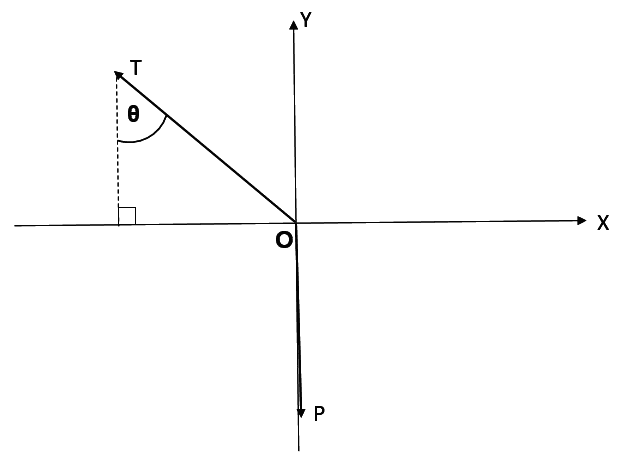
upload_2015-11-19_19-15-31.png

The question...a very simple one really :
"Express T in terms of P"
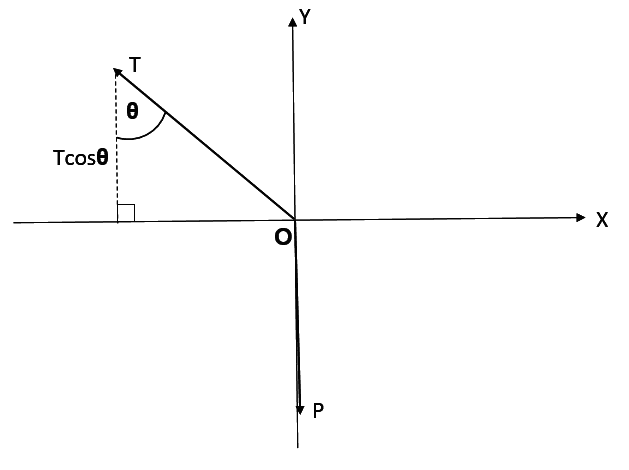
1) His method...(or as he describes it "The Human Method")
upload_2015-11-19_19-17-47.png

He resolved vertical component of the force T, ie. Tcosθ
Then he equated vertical components saying P = Tcosθ... therefore T = Psecθ

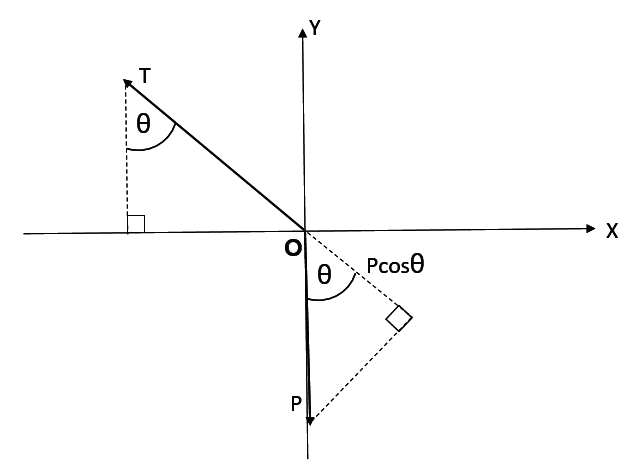
2)My way...
Note: This was part of a much complex problem... I'm not possessed to go through sooooo much trouble for such a small thing...and well...if i hadn't i wouldn't have found this...anyway
upload_2015-11-19_19-29-18.png

I resolved P instead,
and got that T = Pcosθ...the exact opposite

SO...the big question is ...
T = Pcosθ vs. T = Psecθ

Now ... i know practically speaking I might be wrong ...because according to me T < P ...however T would have to be greater ...since its offsetting the downward vertical force of P and has a leftward horizontal component...but then again ...can't you make the same argument about resolving P ??

I know .. I've been blabbering a lot...but it really seems mind boggling !
Mathematically both seem correct XDUpdate : There isn't any vertical acceleration !

-HvB99
 
Last edited:
Physics news on Phys.org
You cannot express P in terms of T without some additional constraint information. For example, the condition that there is no vertical acceleration or something similar.
 
there is no paradox. you can't solve this problem with this method because T and P is not in same line. one vector can't generate a plane.the first one you don't consider the vertical force of T and the second one you don't consider sinx of P. if you want to express vectors, you need 2 vectors to describe the other one.
 
DaleSpam said:
You cannot express P in terms of T without some additional constraint information. For example, the condition that there is no vertical acceleration or something similar.

Yes...there isn't ...this was known...but i forgot to mention it...sorry!
 
hesher said:
there is no paradox. you can't solve this problem with this method because T and P is not in same line. one vector can't generate a plane.the first one you don't consider the vertical force of T and the second one you don't consider sinx of P. if you want to express vectors, you need 2 vectors to describe the other one.

I'm sorry... but the other component...the one that isn't accounted for...as you said ...is the one causing a horizontal acceleration, since it is unbalanced( only that component ) ...

I merely equated the components of the two forces that were in the same direction.
 
How about the horizontal acceleration? What do you know about it?

By the way, with just these two forces you cannot have and equilibrium.
And it is good practice to state the problem completely before jumping to (or expecting) a "solution".
 
HvB99 said:
however T would have to be greater ...since its offsetting the downward vertical force of P and has a leftward horizontal component...
Given the additional information on the acceleration this is exactly correct. The vertical component of T is equal to P, and additionally T has a horizontal component that P does not.
 

Similar threads

  • · Replies 2 ·
Replies
2
Views
2K
  • · Replies 3 ·
Replies
3
Views
2K
  • · Replies 4 ·
Replies
4
Views
2K
  • · Replies 41 ·
2
Replies
41
Views
4K
  • · Replies 6 ·
Replies
6
Views
2K
  • · Replies 3 ·
Replies
3
Views
2K
  • · Replies 35 ·
2
Replies
35
Views
5K
  • · Replies 8 ·
Replies
8
Views
3K
  • · Replies 20 ·
Replies
20
Views
2K
  • · Replies 1 ·
Replies
1
Views
2K