Can Thin Rods Bend More Easily Than Thick Rods?

Faiq
Messages
347
Reaction score
16
Suggest why a thin rod can bend more than thick rod without breaking
 
on Phys.org
Faiq said:
Suggest why a thin rod can bend more than thick rod without breaking

If you look at the equation for stress: F/A, a thicker rod would have more stress for the same force. Thus it would bend less without breaking.

This is just using the equation, I don't know why.
 
For the same bending angle, the stress is less in the thinner bar.
The breaking stress is a material characteristic so it is the same for two bars made from the same material.
 
They are asking in terms of extensions (I wrote the same answer and got it wrong)
 
Extensions and compressions are also less in a thin rod. They are proportional to the distance from the neutral axis.
But how can be "wrong" to discuss it in terms of stress?
 
You haven't really explained why the stress is lower in the thinner rod with just that answer. You should really mention that the stress is lower for a given bending angle because the strain is lower, and this is because of the distance from the neutral axis.
 
  • Like
Likes   Reactions: billy_joule
The tensile strain at the outside of the bend is equal to the ratio t/R, where t is the distance from the neutral axis and R is the radius of curvature. So, in a thin rod having the same radius of curvature as a thick rod, the distance from the neutral axis at the outside of the bend is less and the tensile strain is less.
 
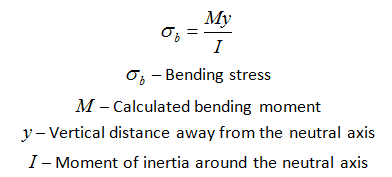
Because the bending stress depends on the distance between it's neutral axis (which is in the center for common shapes in the case of pure bending). So a thicker rod will experience larger maximum bending stress than a slim one when subject to forces of the same magnitude.
stress3.png
 
DanielSauza said:
Because the bending stress depends on the distance between it's neutral axis (which is in the center for common shapes in the case of pure bending). So a thicker rod will experience larger maximum bending stress than a slim one when subject to forces of the same magnitude.
stress3.png
M/I is the same thing as the elastic modulus E divided by the radius of curvature. So as I said in my post, for the same radius of curvature, with two rods of the same material, the thicker one will have a larger bending stress because it has material elements further from the neutral axis.
 
  • #10
Faiq said:
Suggest why a thin rod can bend more than thick rod without breaking
same reason why a arc of small radius subtends a larger angle at center than a arc of same length and larger radius
 
  • #11
hackhard said:
same reason why a arc of small radius subtends a larger angle at center than a arc of same length and larger radius
Please elaborate on how this answers the OPs question in terms of the stress required to cause the rod to break.
 

Similar threads

  • · Replies 23 ·
Replies
23
Views
2K
  • · Replies 29 ·
Replies
29
Views
4K
  • · Replies 1 ·
Replies
1
Views
2K
  • · Replies 6 ·
Replies
6
Views
1K
  • · Replies 9 ·
Replies
9
Views
3K
  • · Replies 21 ·
Replies
21
Views
9K
  • · Replies 12 ·
Replies
12
Views
3K
  • · Replies 6 ·
Replies
6
Views
2K
  • · Replies 2 ·
Replies
2
Views
2K
  • · Replies 1 ·
Replies
1
Views
4K