Can Two Laser Beams with Different Phases Interfere?

Click For Summary
SUMMARY

The discussion centers on the interference of laser beams with different phases and frequencies. It is established that lasers are not purely monochromatic and possess a frequency spread, which affects their coherence. Interference occurs when two waves have nearly identical frequencies and stable phase relationships, typically when generated from the same source. The coherence length and coherence time are critical factors in determining whether interference patterns can be observed.

PREREQUISITES
  • Understanding of electromagnetic wave properties
  • Knowledge of laser coherence length and coherence time
  • Familiarity with wave interference principles
  • Basic mathematics for wave function analysis
NEXT STEPS
  • Research the concept of coherence length in lasers
  • Explore the mathematical modeling of wave interference patterns
  • Learn about the effects of frequency spread in laser beams
  • Investigate advanced laser types with long coherence times
USEFUL FOR

Physicists, optical engineers, and anyone studying wave mechanics and laser technology will benefit from this discussion.

danielhaish
Messages
152
Reaction score
10
I read in the internet that the reason that two laser can't Interference because they most likely have difference phase.
but electromagnetic wave are just change in the electromagnetic filed that goes up and down ,
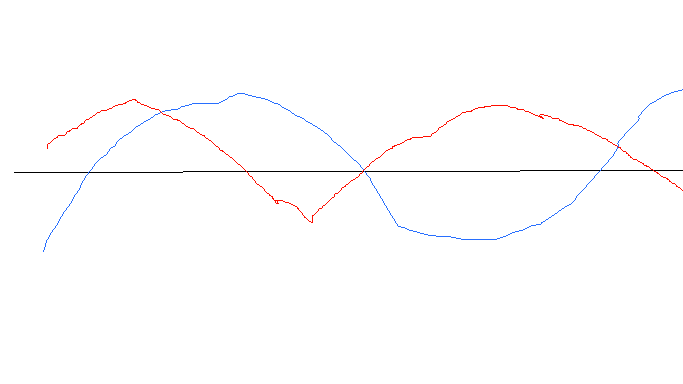
so mathematically they may Interference little let say that the there is two wave that looks like this
untitled.png

we can see that the electromagnetic max and min points distance wave would be difference when the both wave are both in the same space so after they would pass each other this change would cancel ?.
and what if they would be point to the same place does the frequency of the wave change ?.
and if the change do cancel when they pass each other how can laser from the same source Interference.
maybe it more fit to the description of light as matter so the photon doesn't change so the electromagnetic filed change only in the specific point so how can two photon form the same source
Interference.
so maybe it because that if the photon come from the same source then they move at the same path always so the change in the electromagnetic filed saves
 
Last edited:
Science news on Phys.org
danielhaish said:
I read in the internet
We need a better reference than this in order to intelligently discuss what was said.
 
  • Like
Likes   Reactions: berkeman
There are a number of things going on. First, lasers aren't purely monochromatic - they're narrower band than anything else, but they have some frequency spread. Also, they aren't perfectly coherent. They have a coherence length, which is the typical distance across the beam where they remain more or less coherent, and a coherence time, which is the length of time for which you can predict the phase at a point given the phase there now.

Your diagram is for idealised lasers with an infinite coherence time and zero bandwidth. With such things, yes, you could get interference from different lasers. It might be possible to get interference with super-high quality lasers with very long coherence times and narrow bandwidths (never seen it done, but haven't looked either), but not your average laser.
 
  • Like
Likes   Reactions: DaveE, danielhaish and jbriggs444
Ibix said:
There are a number of things going on. First, lasers aren't purely monochromatic - they're narrower band than anything else, but they have some frequency spread. Also, they aren't perfectly coherent. They have a coherence length, which is the typical distance across the beam where they remain more or less coherent, and a coherence time, which is the length of time for which you can predict the phase at a point given the phase there now.

Your diagram is for idealised lasers with an infinite coherence time and zero bandwidth. With such things, yes, you could get interference from different lasers. It might be possible to get interference with super-high quality lasers with very long coherence times and narrow bandwidths (never seen it done, but haven't looked either), but not your average laser.
but also if they have difference wave length they would still effect each other . I mean if two levels of two wave that effect the electromagnetic filed meet each other wouldn't them effect each other ?
 
jbriggs444 said:
We need a better reference than this in order to intelligently discuss what was said.
it local source sorry
 
danielhaish said:
but also if they have difference wave length they would still effect each other . I mean if two levels of two wave that effect the electromagnetic filed meet each other wouldn't them effect each other ?
The electric and magnetic fields add together, sure. But you don't get time-independent patterns unless the frequencies are the same and the phase relationships are stable.
 
  • Like
Likes   Reactions: danielhaish
danielhaish said:
I read in the internet that the reason that two laser can't Interference because they most likely have difference phase.
but electromagnetic wave are just change in the electromagnetic filed that goes up and down ,
so mathematically they may Interference little let say that the there is two wave that looks like this
View attachment 269637
we can see that the electromagnetic max and min points distance wave would be difference when the both wave are both in the same space so after they would pass each other this change would cancel ?.
and what if they would be point to the same place does the frequency of the wave change ?.
and if the change do cancel when they pass each other how can laser from the same source Interference.
maybe it more fit to the description of light as matter so the photon doesn't change so the electromagnetic filed change only in the specific point so how can two photon form the same source
Interference.
so maybe it because that if the photon come from the same source then they move at the same path always so the change in the electromagnetic filed saves
Any two waves will interfere, but if they have different frequencies the interference pattern will be moving all the time, usualy too fast to see. It will repeat itself at the difference frequency. If, however, the frequencies are locked, then the inteference pattern will be stationary. If one source then has a fixed phase shift then of course the pattern will be changed or displaced. If two locked sources have random phase variations - we might say the time coherence is reduced - then the interference pattern will be noisy, and in an extreme case might not be discernible.
 
  • Like
Likes   Reactions: DaveE, danielhaish and Ibix
Others have describe this, but here's my explanation:

The phase of wave interaction is usually only useful if it is a consistent value. That means that the waves have nearly EXACTLY the same frequency (frequency is the rate of change of phase, BTW). That almost always means the two waves were generated from the same source.

Yes any two waves will interfere with each other. This is just a consequence of the fact that the amplitude of the EM fields is the sum of the waves that are present at any point in space and time. If the frequencies aren't the same then this interference changes so quickly you can only observe the average result. Since visible light has frequencies of 1014 - 1015 Hz. This means that for an interference effect to be stable for 1 second then light frequencies (or wavelengths) must only differ by 1 part in 1017 or so.
 
  • Like
Likes   Reactions: danielhaish
Graph ## sin(2\pi f t) + sin[2\pi (f+\Delta f) t] ## on software like excel with ## \Delta f << f ## and you will see your interference pattern.
 
  • Like
Likes   Reactions: danielhaish
  • #10
so if I see it right the reason
DaveE said:
Others have describe this, but here's my explanation:

The phase of wave interaction is usually only useful if it is a consistent value. That means that the waves have nearly EXACTLY the same frequency (frequency is the rate of change of phase, BTW). That almost always means the two waves were generated from the same source.

Yes any two waves will interfere with each other. This is just a consequence of the fact that the amplitude of the EM fields is the sum of the waves that are present at any point in space and time. If the frequencies aren't the same then this interference changes so quickly you can only observe the average result. Since visible light has frequencies of 1014 - 1015 Hz. This means that for an interference effect to be stable for 1 second then light frequencies (or wavelengths) must only differ by 1 part in 1017 or so.
so if understand all answer the reason it can't be done it because they have difference frequency so in every max point in the low frequency wave there is many max point in the high frequency wave so it would looks like that
Untitled.png

does this diagram describe it correctly and also does to wave with high frequency have higher max point?
 
  • #11
danielhaish said:
so if I see it right the reason

so if understand all answer the reason it can't be done it because they have difference frequency so in every max point in the low frequency wave there is many max point in the high frequency wave so it would looks like that
View attachment 269689
does this diagram describe it correctly and also does to wave with high frequency have higher max point?
Yes, that's right. You can just add the values of the two curves at any point to see the result. You could also try this with two waves with the same frequency but shifted so they don't line up (different phase) to see what the interference looks like. Start with two waves of the same height to get the most dramatic results.

The frequency of light isn't the same as the intensity of light. This is a slightly tricky subject in physics though. People will give you confusing answers about how light is more like particles than waves, or more like waves than particles, depending on who you are talking to and how advanced their treatment of the subject is. For now, you can just model the light as waves with different amplitudes and different frequencies which are not necessarily related to each other.
 
  • Like
Likes   Reactions: danielhaish

Similar threads

  • · Replies 6 ·
Replies
6
Views
1K
  • · Replies 2 ·
Replies
2
Views
1K
  • · Replies 10 ·
Replies
10
Views
2K
  • · Replies 71 ·
3
Replies
71
Views
10K
  • · Replies 11 ·
Replies
11
Views
1K
  • · Replies 4 ·
Replies
4
Views
2K
  • · Replies 3 ·
Replies
3
Views
2K
  • · Replies 1 ·
Replies
1
Views
2K
  • · Replies 3 ·
Replies
3
Views
2K
  • · Replies 10 ·
Replies
10
Views
3K