Can We Measure Diffraction Intensity Using Huygens' Principle?

  • Context: High School 
  • Thread starter Thread starter jaumzaum
  • Start date Start date
  • Tags Tags
    Huygens Principle
Click For Summary

Discussion Overview

The discussion revolves around the application of Huygens' Principle to understand diffraction, particularly in the context of laser beams and apertures. Participants explore how diffraction intensity can be measured at different sections of a wavefront and the implications of aperture size on diffraction visibility.

Discussion Character

  • Exploratory
  • Technical explanation
  • Debate/contested

Main Points Raised

  • One participant questions whether the intensity of the new wavefront can be determined at the middle and extremities, considering the effects of diffraction when light passes through a small aperture.
  • Another participant asserts that in a plane perpendicular to a laser beam in a vacuum, one would only see the source and not the beam due to diffraction.
  • A participant raises a question about the size of the aperture relative to the wavelength, suggesting that the definition of "small" may need clarification.
  • One participant describes the energy distribution around the central beam, noting that while the central portion carries most of the intensity, there are minor lobes of energy that diminish significantly with distance from the beam.
  • Another participant discusses the implications of using a laser and how the beam would behave when passing through an aperture, emphasizing the need for a wider beam to achieve similar diffraction patterns as seen in ripple tank demonstrations.
  • A participant draws an analogy with radio antennas to illustrate how diffraction patterns can be understood through the arrangement of sources and their phase relationships.

Areas of Agreement / Disagreement

Participants express differing views on the visibility of laser beams due to diffraction and the implications of aperture size. There is no consensus on the exact nature of intensity distribution or the conditions under which diffraction becomes significant.

Contextual Notes

Participants reference various diagrams and examples, such as ripple tank images, to illustrate their points, but the discussion remains focused on theoretical implications rather than definitive conclusions.

jaumzaum
Messages
433
Reaction score
33
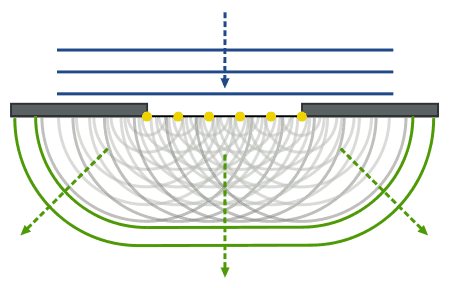
Hi. I was studying Huygens Principle and I learned that diffraction usually occurs more when the slit is comparable in size with the wavelength, and this image does not leave my head:
1595567399518.png


We can see that the "middle" part of the wavefront keeps traveling in the same direction, but the wavefront in the extremities starts to propagate as spheres. My question is, can we determine the intensity of some cross section of this "new" wavefront
A. in the middle
B. in the extremities

I'm having this questions because I was wondering why lasers are collimated, as the light leaves a small aperture. Is the aperture big enough so that no diffraction can be seen? But eventhough no diffraction can be seen, it still occur right? For example, if I am in a plane perpendicular to the beam, and the laser is in the vacuum, will I still be able to see the beam due to diffraction? What will be the intensity of the light seen?
 
Science news on Phys.org
jaumzaum said:
For example, if I am in a plane perpendicular to the beam, and the laser is in the vacuum, will I still be able to see the beam due to diffraction?

No. You could just see the source.
 
jaumzaum said:
the light leaves a small aperture
Roughly how many wavelengths is the aperture? Is that actually a small number?
 
jaumzaum said:
Hi. I was studying Huygens Principle and I learned that diffraction usually occurs more when the slit is comparable in size with the wavelength, and this image does not leave my head:View attachment 266770

We can see that the "middle" part of the wavefront keeps traveling in the same direction, but the wavefront in the extremities starts to propagate as spheres. My question is, can we determine the intensity of some cross section of this "new" wavefront
A. in the middle
B. in the extremities

I'm having this questions because I was wondering why lasers are collimated, as the light leaves a small aperture. Is the aperture big enough so that no diffraction can be seen? But eventhough no diffraction can be seen, it still occur right? For example, if I am in a plane perpendicular to the beam, and the laser is in the vacuum, will I still be able to see the beam due to diffraction? What will be the intensity of the light seen?
This diagram is very misleading. The actual energy lying outside the central portion is very small. Close to the aperture we have a parallel beam, surrounded by some small blobs of energy. If you are a long way from the aperture, we see a central diverging beam surrounded with many lesser fringes. The first of these is roughly 1% of the intensity, the next 0.25% and then getting gradually less until when we get to 90 degrees from the beam the intensity is only 10^-5. If you look at the aperture from here I think you will see glowing edges, assuming your eye has a large aperture.
The laser beam diverges at small angle when measured at large distances and is surrounded by a succession of minor lobes as I have described. If the laser hits a screen we see the main lobe surrounded by circular fringes gradually fading away.
 
  • Like
Likes   Reactions: jaumzaum
jaumzaum said:
I'm having this questions because I was wondering why lasers are collimated, as the light leaves a small aperture. Is the aperture big enough so that no diffraction can be seen?
I think this may be the 'nub' of your question. You start with that (good) diagram of diffraction through a fairly wide slot. That assumes uniform illumination across the slot and this photo of a ripple tank shows the same effect well.
1595627595400.png

It's a rare example of a really good ripple tank image. Someone went to a fair bit of trouble to get it right and posted it in Wikipedia and it not only shows the shape of the wavefront but also the amplitude. Much stronger along the middle than where it spreads out at the sides.

Moving on to using a laser in the equivalent light demonstration, an unmodified beam from a laser would (as yo say) only illuminate the middle portion and the original beam would be virtually untouched by the aperture. To get the equivalent result with light as with the ripple tank produced, you would need to spread the pencil beam out and then focus it at infinity so that the edges of the widened laser beam spread well out beyond the aperture.

I will make my usual remark about how straightforward it can be to consider Radio Antennae when trying to understand diffraction. The diagram below shows the pattern of a row of four sources, co-phased and a crude version of the infinite number of Huygens sources. The pattern is bidirectional in this case but , of course, all the light ends up in the rough direction of the incident beam. A wider array (more elements) produces a narrower beam. Filling in the gaps between the elements to, say λ/4 or λ/8 etc gets closer and closer to the Huygens infinite set of sources.

broadside.jpg
 

Similar threads

  • · Replies 17 ·
Replies
17
Views
3K
  • · Replies 2 ·
Replies
2
Views
2K
  • · Replies 5 ·
Replies
5
Views
2K
  • · Replies 15 ·
Replies
15
Views
6K
  • · Replies 7 ·
Replies
7
Views
3K
Replies
12
Views
2K
  • · Replies 5 ·
Replies
5
Views
2K
  • · Replies 1 ·
Replies
1
Views
3K
  • · Replies 5 ·
Replies
5
Views
2K
  • · Replies 7 ·
Replies
7
Views
3K