Can You Solve This Capacitor Circuit Problem Using Q=CV?

Click For Summary
The discussion revolves around solving a capacitor circuit problem using the equation Q=CV. Participants emphasize the importance of showing an attempt at a solution to receive effective help. The equation relates charge (Q), capacitance (C), and voltage (V), which are crucial for understanding capacitor behavior in circuits. Engaging with the problem through initial calculations or reasoning is encouraged to facilitate better assistance. Overall, providing a starting point is essential for collaborative problem-solving in physics.
EDCJZ
Messages
1
Reaction score
0
New poster has been reminded to show their work on schoolwork problems.
Homework Statement
Help me please
Relevant Equations
Q=CV
Homework Statement: Help me please
Homework Equations: Q=CV
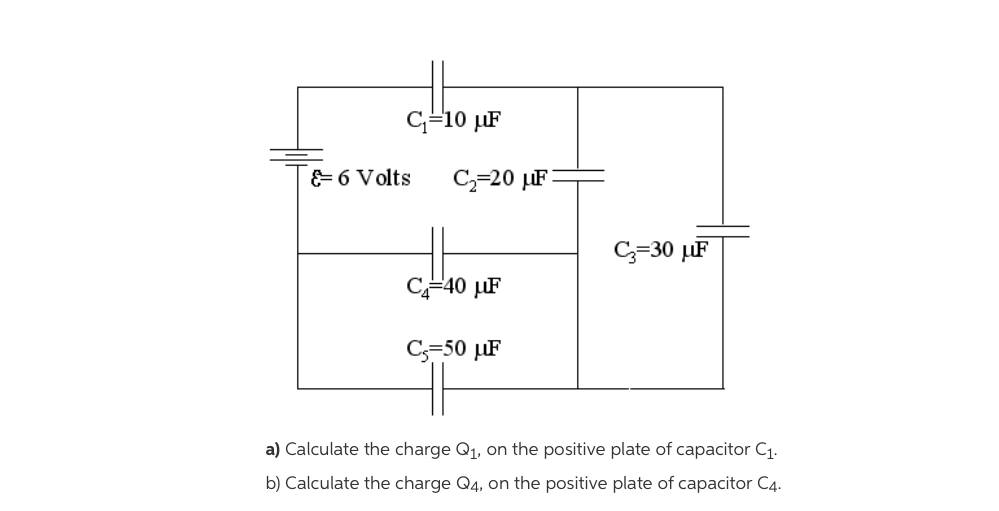
5CC6ED3D-B8D4-4D9D-A267-972315EC2B0B.jpeg
 
Last edited by a moderator:
Physics news on Phys.org
To get some help, you'll first have to provide an attempt at a solution.
 
The book claims the answer is that all the magnitudes are the same because "the gravitational force on the penguin is the same". I'm having trouble understanding this. I thought the buoyant force was equal to the weight of the fluid displaced. Weight depends on mass which depends on density. Therefore, due to the differing densities the buoyant force will be different in each case? Is this incorrect?

Similar threads

  • · Replies 15 ·
Replies
15
Views
885
Replies
9
Views
2K
  • · Replies 6 ·
Replies
6
Views
3K
  • · Replies 16 ·
Replies
16
Views
2K
Replies
6
Views
1K
  • · Replies 4 ·
Replies
4
Views
4K
  • · Replies 7 ·
Replies
7
Views
4K
Replies
11
Views
3K
  • · Replies 21 ·
Replies
21
Views
3K
Replies
11
Views
3K