Can't understand integral limits in question

  • Thread starter Thread starter sa1988
  • Start date Start date
  • Tags Tags
    Integral Limits
Click For Summary

Homework Help Overview

The discussion revolves around understanding the limits of integration in a problem involving a three-dimensional integral, specifically related to a geometric shape described as a "pyramid in the corner." Participants express confusion regarding the integration variable and the upper bounds of the integral.

Discussion Character

  • Exploratory, Assumption checking, Problem interpretation

Approaches and Questions Raised

  • Participants explore different interpretations of the integral limits, questioning how to properly set them up. There is discussion about the relationship between the variables and the geometric representation of the problem.

Discussion Status

Some participants have provided insights into how to approach the integral, suggesting that integrating over one variable at a time can simplify the process. There is acknowledgment of different integral expressions that yield the same result, and while some numerical solutions have been reached, the focus remains on understanding the limits and setup of the integral.

Contextual Notes

Participants note the challenge posed by the lack of clear upper bounds for the integration variable and reflect on their initial setups, indicating a learning process regarding the interpretation of the problem.

sa1988
Messages
221
Reaction score
23
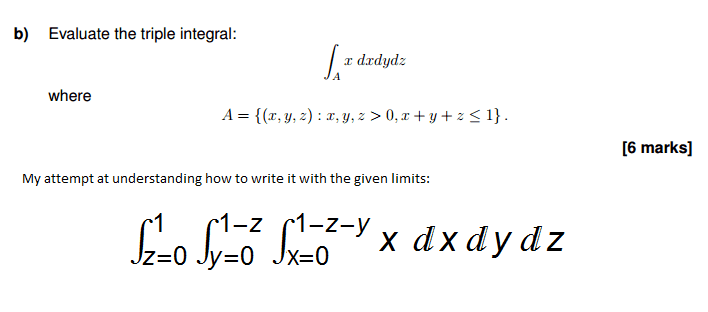
Just a quick one - Have I deciphered the wording of this question properly?

All necessary info is in the embedded image.

To me the limits describe a typical 'pyramid in the corner', but the fact it's an integral over the function 'x' is confusing me. Do I just go with it and generate an answer at the end?
2d0l6bs.png
 
Physics news on Phys.org
That's going to be difficult, because when integrating over x you don't know the upper bound !
Pyramid in the corner is the picture I get too. I have even sketched it. I notice that when x is known, I know what the integral over the other two represents.

If you want to write the integral properly, it would be a good thing to distinguish between bounds and integration variables. Much clearer. ([edit] In this case not necessary, I realize)
 
BvU said:
That's going to be difficult,

Well the integral I wrote does come out with a numerical solution. I just don't know if I wrote the correct integral or not. :confused:
 
Well the integral I wrote does come out with a numerical solution
Ah, I see. You are quite right.

However, if you pick an x, ànd a y, you can easily integrate over z: ##\int_{z=0}^{1-x-y} dz## yielding a simpler expression. Then over y (yielding a triangle area) then finally over x.

So, :redface: my nitwit "distinguish" comment is superfluous and I nitwittedly wanted to improve on an integral expression that wasn't wrong in the first place.
 
BvU said:
Ah, I see. You are quite right.

However, if you pick an x, ànd a y, you can easily integrate over z: ##\int_{z=0}^{1-x-y} dz## yielding a simpler expression. Then over y (yielding a triangle area) then finally over x.

Hmm, I can't see a major world of difference between my ##\int_{x=0}^{1-z-y} dx## and your ##\int_{z=0}^{1-x-y} dz## ?

Ah well, as long as I was correct with my interpretation of the question, and as long as it came to a good answer, I'm happy!

Edit: Oh wait I see it now. If I save the dx integral till last, I'll have far less algebraic havoc to deal with as I go through. Great, all understood, cheers!
 
You mean ##\int_{x=0}^{1-z-y} {\bf x}\, dx## ?

We agree it's the same thing, but I liked to write it as
$$ I = \int_{x=0}^1\, x\, \left ( \int_{y=0}^{1-x} \left ( \int_{z=0}^{1-x-y} dz \right ) dy \right ) dx =\int_{x=0}^1\, x\, \left ( \int_{y=0}^{1-x} 1-x-y \ dy \right ) dx = \int_{x=0}^1\, x\, \left ({1\over 2}(1-x)^2\right )\, dx $$I ended up with 5/24, and you ?
 
BvU said:
You mean ##\int_{x=0}^{1-z-y} {\bf x}\, dx## ?

Ah yeah that's what I meant, sorry I left out the x .

We agree it's the same thing, but I liked to write it as
$$ I = \int_{x=0}^1\, x\, \left ( \int_{y=0}^{1-x} \left ( \int_{z=0}^{1-x-y} dz \right ) dy \right ) dx =\int_{x=0}^1\, x\, \left ( \int_{y=0}^{1-x} 1-x-y \ dy \right ) dx = \int_{x=0}^1\, x\, \left ({1\over 2}(1-x)^2\right )\, dx $$I ended up with 5/24, and you ?

Hmm I get 1/24? I've punched it into mathematica a few different ways and get the same answer with that too.
 
Roles have reversed! You correctly correct my 5/24. It should be 1/24.
Time to move on to the next exercise...
 
Haha, fantastic. Well my main issue was understanding the limits set out in the question, and it turns out everything was ok in the end. Solving it was just a bonus. Thanks!

Oh and I looked back at the method I set out in the original post, and I don't even know why I had the limits set up that way around. Ok it worked but taking dz first should have been obvious! Ah well, living and learning.
 

Similar threads

Replies
24
Views
3K
  • · Replies 4 ·
Replies
4
Views
2K
  • · Replies 2 ·
Replies
2
Views
2K
  • · Replies 2 ·
Replies
2
Views
2K
  • · Replies 9 ·
Replies
9
Views
2K
  • · Replies 2 ·
Replies
2
Views
1K
  • · Replies 2 ·
Replies
2
Views
2K
  • · Replies 1 ·
Replies
1
Views
2K
  • · Replies 21 ·
Replies
21
Views
2K
Replies
3
Views
4K