Centroid Question: Understanding & Measuring Distance

  • Thread starter Thread starter Ry122
  • Start date Start date
  • Tags Tags
    Centroid
Click For Summary

Homework Help Overview

The discussion revolves around understanding a problem related to finding the centroid of a shape, specifically in the context of how the position of the centroid relates to the dimensions of the shape, denoted by L. Participants are exploring the interpretation of the question and the implications of the centroid's position.

Discussion Character

  • Exploratory, Assumption checking, Problem interpretation

Approaches and Questions Raised

  • Participants are attempting to clarify the question's requirements, particularly whether the centroid is assumed to be at the origin and how that affects the interpretation of the shape's dimensions. There are discussions about the two parts of the question regarding the position of the center of mass and the conditions under which it lies within the shape.

Discussion Status

There is an active exploration of the problem with multiple interpretations being discussed. Some participants are providing guidance on addressing the question's parts, emphasizing the need to focus on the first part regarding the centroid's position before moving on to the second part.

Contextual Notes

Participants note that the problem does not assume the centroid is at the origin and highlight that the centroid must lie within the convex hull of the shape, which raises questions about the values of L that affect this positioning.

Ry122
Messages
563
Reaction score
2
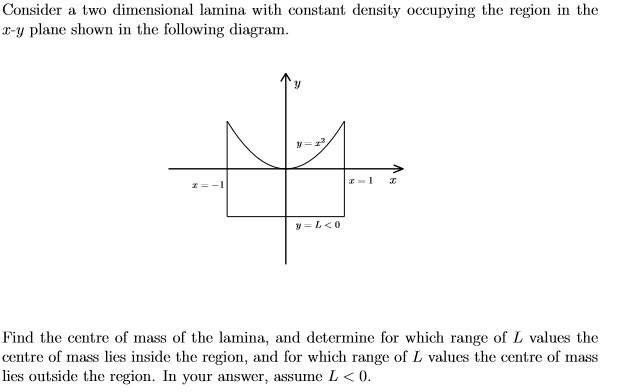
I'm having trouble understanding what this question is actually asking for. Is it assuming the centroid to be the origin and asking how far the bottom of the shape extends downwards for the origin to be the centroid?
z84dCnC.jpg
 
Physics news on Phys.org
Ry122 said:
I'm having trouble understanding what this question is actually asking for. Is it assuming the centroid to be the origin and asking how far the bottom of the shape extends downwards for the origin to be the centroid?
No, I don't think so. To the best of my interpretation of the question, it contains two parts:
(1) Given this shape, find out the position of the centre of mass (in terms of L).
(2) From that answer, determine the range of values of L such that the centre of mass lies in the shape itself (i.e. [itex]L \leq y_{c} \leq 0[/itex])
 
Ry122 said:
I'm having trouble understanding what this question is actually asking for. Is it assuming the centroid to be the origin and asking how far the bottom of the shape extends downwards for the origin to be the centroid?
Not exactly that, but if you were to answer that question it would be a short step to answering the last part of the given question. Wouldn't help so much with the first part though, so address that first.
 
The figure is described completely and you are asked to find the centroid. So, no, the problem does not assume the centroid is at the origin! The centroid of a region always lies within it convex hull but for some values of L, the centroid might lie just above the origin, outside the figure itself.
 

Similar threads

Replies
27
Views
4K
Replies
1
Views
2K
  • · Replies 9 ·
Replies
9
Views
2K
Replies
7
Views
3K
  • · Replies 7 ·
Replies
7
Views
2K
  • · Replies 8 ·
Replies
8
Views
2K
  • · Replies 2 ·
Replies
2
Views
3K
  • · Replies 2 ·
Replies
2
Views
2K
  • · Replies 17 ·
Replies
17
Views
6K
  • · Replies 1 ·
Replies
1
Views
19K