CFD analysis of a turbine, interpreting torque values

Click For Summary
SUMMARY

This discussion focuses on interpreting torque values from CFD analysis of a Kaplan turbine. The torque values are presented as x, y, and z components, with the z component indicating the rotation direction. The participants clarify that the x and y components contribute to tilting the turbine, while the z component is crucial for determining rotation and power calculations. The unexpected torque values suggest a potential issue with symmetry in the turbine's design.

PREREQUISITES
  • Understanding of CFD (Computational Fluid Dynamics) principles
  • Familiarity with torque components in three-dimensional space
  • Knowledge of Kaplan turbine mechanics
  • Basic vector addition and its application in torque analysis
NEXT STEPS
  • Research "CFD analysis of turbine performance" for deeper insights
  • Study "Torque vector analysis in fluid dynamics" for advanced understanding
  • Explore "Kaplan turbine design and symmetry considerations" to identify design flaws
  • Learn about "surface goals in CFD simulations" to understand their implications
USEFUL FOR

Engineers, fluid dynamics researchers, and turbine designers seeking to enhance their understanding of torque interpretation in CFD analyses of turbines.

Jeviah
Messages
16
Reaction score
0
Homework Statement
Use CFD to determine the characteristics of a turbine.
Relevant Equations
N/A
Hello, I am using CFD to analyse a Kaplan turbine and am unsure on how to interpret the torque values as they come as x, y and z components. My understanding is that the z component in this case will determine the rotation direction depending on whether it is positive or negative however I am unsure how to interpret the x and y components, my thinking is that I would use vector addition to find the resulting magnitude of torque with the z component determining whether the part is rotating clockwise or anticlockwise? or would a have to do something different?
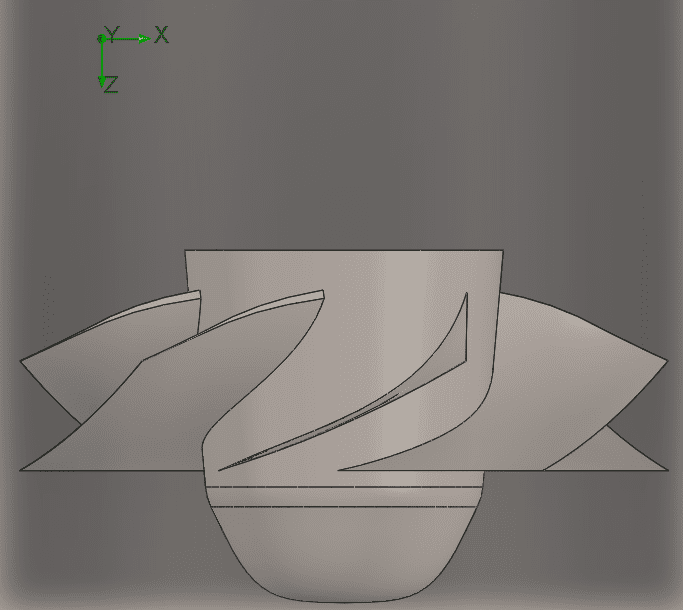
241200


Current torque values:
195.3 (x component)
-60.2 (y component)
-6.9 (z component)
 
Physics news on Phys.org
There is something wrong here: from symmetry I would say ##\tau_x = \tau_y = 0## for an even number of blades. The ##\tau_z## should all be in one and the same direction and add up constructively.
So to see ##|\tau_z|## as the smallest value is unexpected !

The sign is negative, I assume because your flow is in the ##+z## direction ?
 
BvU said:
There is something wrong here: from symmetry I would say ##\tau_x = \tau_y = 0## for an even number of blades. The ##\tau_z## should all be in one and the same direction and add up constructively.
So to see ##|\tau_z|## as the smallest value is unexpected !

The sign is negative, I assume because your flow is in the ##+z## direction ?

Correct my low is in the z+ direction. It seems I have got incorrect information somewhere when asking about torque...
So to clarify the torque value which determines the rotation and therefore power etc is the z component? So on any orientation you would take the torque value from the rotating axis for calculations?

Just for a better understanding as well would I be correct in saying the the X and Y components are essentially trying to tilt the whole turbine?
 
Jeviah said:
Correct my low is in the z+ direction. It seems I have got incorrect information somewhere when asking about torque...
So to clarify the torque value which determines the rotation and therefore power etc is the z component? yes
So on any orientation you would take the torque value from the rotating axis for calculations?

Just for a better understanding as well would I be correct in saying the the X and Y components are essentially trying to tilt the whole turbine? yes
Torque is around an axis and points along that axis of rotation.
 
BvU said:
Torque is around an axis and points along that axis of rotation.

Thank you very much for the quick reply.
One final question about how CFD works, am I correct in saying that when using surface goals, the surface goal will only record the torque applied to said surface by the fluid, opposed to including bodies attached to it?
For example a surface goal on an axle will only record the torque generated directly by the fluid, it won't include how the torque from the blades will actually alter it
 
Sorry, I have no idea -- you'll have to ask the program's customer support.
 

Similar threads

  • · Replies 2 ·
Replies
2
Views
2K
  • · Replies 25 ·
Replies
25
Views
2K
  • · Replies 1 ·
Replies
1
Views
2K
  • · Replies 11 ·
Replies
11
Views
2K
  • · Replies 9 ·
Replies
9
Views
6K
  • · Replies 3 ·
Replies
3
Views
2K
  • · Replies 5 ·
Replies
5
Views
6K
Replies
1
Views
6K
  • · Replies 2 ·
Replies
2
Views
2K