Chain on a slope remains still if its end points are of equal height?

Click For Summary

Discussion Overview

The discussion revolves around the behavior of a chain on a slope, specifically addressing whether the chain remains still when its endpoints are at equal heights. Participants explore the forces acting on the chain, the role of gravitational acceleration, and the implications of treating forces as scalars versus vectors. The scope includes theoretical reasoning and mathematical modeling related to dynamics and forces on inclined planes.

Discussion Character

  • Exploratory
  • Technical explanation
  • Debate/contested
  • Mathematical reasoning

Main Points Raised

  • Some participants question why the gravitational acceleration vector is not fully considered in the calculation of force, suggesting that the direction of the acceleration should be included in the force calculations.
  • Others propose that the chain cannot move if its center of mass is not moving, raising questions about the net vertical force acting on the chain.
  • A participant calculates the net vertical force and presents a specific function related to the chain's configuration, indicating that this force may not be zero.
  • Some argue that only the tangential component of weight is relevant for the chain's motion, suggesting that other components are canceled by the normal force.
  • Another participant discusses the implications of treating forces as scalars, arguing that this approach may not be valid in all cases, particularly when considering the varying slopes along the chain.
  • A participant presents an example to illustrate the limitations of treating tension as a scalar, emphasizing the need to consider vector components in certain scenarios.
  • Concerns are raised about the validity of the solution provided in the initial post, with suggestions that it may not hold under specific conditions, such as when the endpoints of the chain have the same slope.

Areas of Agreement / Disagreement

Participants express differing views on the treatment of forces and the conditions under which the chain remains still. There is no consensus on whether the initial solution is correct, and multiple competing perspectives are presented regarding the role of vector components in force calculations.

Contextual Notes

Participants highlight limitations in the assumptions made about the forces acting on the chain, particularly regarding the treatment of forces as scalars and the implications of varying slopes along the chain. The discussion remains open-ended with unresolved mathematical steps and conditions.

Happiness
Messages
686
Reaction score
30
Screen Shot 2016-05-30 at 5.00.54 am.png


Let ##\vec{a}## be the gravitational acceleration along the curve.
Then ##|\vec{a}|=a=-g\sin\theta## and
##\vec{a}=a_x\,\vec{i}+a_y\,\vec{j}=-g\sin\theta\cos\theta\,\vec{i}-g\sin^2\theta\,\vec{j}##

My question is why does the solution below ignore the direction of ##\vec{a}## and calculate ##F## as ##F=\int a\,dm## instead of calculating ##\vec{F}## as ##\vec{F}=\int a_x\,dm\,\vec{i}+\int a_y\,dm\,\vec{j}##?

Solution:
Screen Shot 2016-05-30 at 5.01.19 am.png
 
Physics news on Phys.org
Can the chain move if its center of mass is not moving? Will the center of mass of the chain move downwards if there is no net vertical force on it? How would you go about calculating that net vertical force?
 
Nugatory said:
Can the chain move if its center of mass is not moving? Will the center of mass of the chain move downwards if there is no net vertical force on it? How would you go about calculating that net vertical force?

No and no.

Net vertical force = ##\vec{F_y}=\int a_y\,dm\,\vec{j}##
##=\int -g\sin^2\theta\,dm\,\vec{j}##
##=\int\frac{-gf'^2}{1+f'^2}\rho\sqrt{1+f'^2}\,dx\,\vec{j}##
##=-g\rho\int\frac{f'^2}{\sqrt{1+f'^2}}\,dx\,\vec{j}##

##\int\frac{f'^2}{\sqrt{1+f'^2}}\,dx## is a function of ##x##. Let's call it ##H(x)##.

Then ##\vec{F_y}=-g\rho\big(H(b)-H(a)\big)\,\vec{j}##, which may not be zero.

For example, suppose ##f(x)=-x^4-2x^3+11x^2+12x##, which has a root at ##x=0## and another one at ##x=3##. Let ##u=f'^2=(-4x^3-6x^2+22x+12)^2##.

Then ##\int_0^3\frac{f'^2}{\sqrt{1+f'^2}}\,dx=71.9##, calculated using
http://www.wolframalpha.com/input/?i=u=(-4x^3-6x^2+22x+12)^2,+integrate+u/sqrt(1+u)+dx+from+x=0+to+x=3
 
Last edited:
All you care about is the component of weight tangential to the curve, given by ##g \sin\theta dm##. Any other component will be canceled by the normal force.
Happiness said:
##\vec{a}=a_x\,\vec{i}+a_y\,\vec{j}=-g\sin\theta\cos\theta\,\vec{i}-g\sin^2\theta\,\vec{j}##
By breaking that tangential component into x and y components you are just making it harder to calculate. I haven't tried it, but done properly you should get the same result.
 
Doc Al said:
All you care about is the component of weight tangential to the curve, given by ##g \sin\theta dm##. Any other component will be canceled by the normal force.

By breaking that tangential component into x and y components you are just making it harder to calculate. I haven't tried it, but done properly you should get the same result.

As you said, the net force ##dF## on a mass element ##dm## is ##g\sin\theta\,dm##. But force is a vector. So we should be considering ##\vec{dF}## together with its direction. The direction of ##\vec{dF}## is different for every mass element because the slope of the curve is different in different places in general.

I don't get why the solution treats force as a scalar and calculates ##F=\int dF## instead of ##\vec{F}=\int\vec{dF}=\int dF_x\,\vec{i}+\int dF_y\,\vec{j}##.
 
  • Like
Likes   Reactions: poseidon721
I found out, I believe, the reason why sometimes we can "treat force as a scalar". I then argued that we can't do so in the first post and hence the answer given is wrong. Please correct me if I am wrong.

The example below (attached) also treats force, in this case tension, as a scalar instead of as a vector, when it writes the equation
##T(\theta+d\theta)\leq T(\theta)+\mu N_{d\theta}##. --- (1)

I believe the correct equation (considering components in the tangential direction) should be
##T(\theta+d\theta)\cos\frac{d\theta}{2}\leq T(\theta)\cos\frac{d\theta}{2}+\mu N_{d\theta}##. --- (2)

However, since ##d\theta## is small, ##\cos\,d\theta\approx 1##. And so equation (2) reduces to equation (1).

This means that we could "treat force as a scalar" if we consider the tensions between adjacent mass elements.

Let Figure 1.3 (attached below) represents the mass element of the motionless chain in the first post. (The mass element is shown as the arc in the figure.) The curve on which the chain lies is arbitrary. So Figure 1.3 should be rotated accordingly when analyzing different mass elements in various parts of the chain.

For each mass element to be at rest, the normal reaction force would adjust itself so that it balances the radial component (the one perpendicular to the slope) of the weight of the mass element ##(mg\cos\theta##, where ##\theta## is the angle the slope makes with the horizontal##)## and the radial components of the two tensions ##(T\sin\frac{d\theta}{2})##. The radial components of the two tensions change according to their tangential components as they are related by a factor of ##\tan\frac{d\theta}{2}##, while their tangential components would adjust themselves to balance ##mg\sin\theta##, the tangential component of the weight of the mass element.

While the direction of the tensions are fixed by the slope of the curve, the magnitude of the tensions can be freely adjusted so as to balance ##mg\sin\theta##. For the next mass element, the magnitude of one of the tension is fixed because of the action-reaction law, but we can still freely adjust the magnitude of the other tension to balance ##mg\sin\theta##. This is true until we reach the mass element at the end of the chain, which is only experiencing one tension. Thus, this "treating force as a scalar" method fails, I believe, and the solution given in post #1 is not correct.

The "treating force as a scalar" method holds for the example below because all mass elements, including the mass elements at the ends of the rope, experience two tensions. (The ends of the rope are the points where the rope first touches the pole and where it last leaves the pole, and need not be the actual physical ends of the rope.)

We may make the method work for the chain in post #1 by changing the question such that a tension is applied to each end of the chain. Let's call the tensions ##T_1## and ##T_2##. Following the given solution in post #1 (and also that in the example below), ##T_1## and ##T_2## must have the same magnitude. The chain would remain motionless if we remove ##T_1## and ##T_2## provided they are pointing in opposite directions. This is achieved if the endpoints have the same slope. So we expect the solution given in post #1 to be correct if the endpoints have the same slope (and the same height).

Consider ##f=3x^5-5x^4+x^3+x^2## with the endpoints ##(0, 0)## and ##(1, 0)##, which have zero slope. However, it's calculated that ##\vec{F_x}## and ##\vec{F_y}## are not zero. What's wrong?

##\vec{F_x}=-g\rho\int_0^1\frac{f'}{\sqrt{1+f'^2}}\,dx\,\vec{i}=-0.00589g\rho\,\vec{i}##
http://www.wolframalpha.com/input/?i=v=(15x^4-20x^3+3x^2+2x),+integrate+v/sqrt(1+v^2)+dx+from+x=0+to+x=1

##\vec{F_y}=-g\rho\int_0^1\frac{f'^2}{\sqrt{1+f'^2}}\,dx\,\vec{j}=-0.121g\rho\,\vec{j}##
http://www.wolframalpha.com/input/?i=v=(15x^4-20x^3+3x^2+2x),+integrate+v^2/sqrt(1+v^2)+dx+from+x=0+to+x=1

But nonetheless they are values close to zero (compared to ##\vec{F_y}=-71.9g\rho\,\vec{j}## in post #3 where the endpoints do not have the same slope).

Is this because the "treating force as a scalar" method (and hence the conclusion that the chain is motionless) is only an approximation as the method approximates ##\cos\,d\theta\approx 1## in equation (2)?

For the case where the curve has the zero slope at its endpoints, in order for the mass element at each endpoint (which is horizontal) to be at rest when ##T_1## and ##T_2## (which are the applied forces at each ends of the chain) are equal in magnitude and opposite in direction, we would require that ##F_1## and ##F_2## (the internal forces) are also equal in magnitude and opposite in direction, where ##F_1## is the tension exerted on the mass element at the left endpoint by its adjacent mass element and ##F_2## is the tension similarly defined for the mass element at the right endpoint. But this seems unlikely to be satisfied for an arbitrary curve (arbitrary except for condition of having zero slope at its endpoints). Nonetheless, ##F_1=F_2## when the curve is symmetrical. Thus, could it be that the "treating force as a scalar" method is an approximation that becomes exact (for ##\vec{F_x}##) when the curve becomes symmetrical?
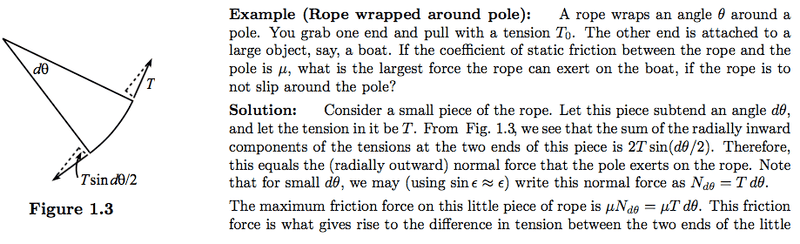
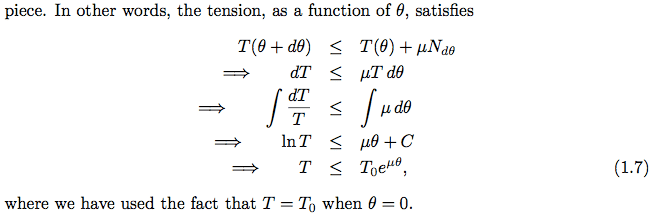
Screen Shot 2016-06-01 at 11.02.51 pm.png

Screen Shot 2016-06-01 at 11.03.07 pm.png

Note that ##\theta## has a different meaning in the example above vs that in the motionless chain, where ##\theta## is the angle the slope makes with the horizontal. In the example above, integration is with respect to ##\theta## but in the motionless chain, it is done with respect to ##x##.

The following is not needed for my question, but it's included for completeness.
Screen Shot 2016-06-02 at 12.58.42 am.png
 
Last edited:
  • Like
Likes   Reactions: poseidon721
You can't break up the force into $$g\sin\theta\cos\theta$$ and $$g\sin\theta\cos\theta$$ because there is tension gradient. By Rolle's theorem there is a portion of the chain with zero slope and if you consider a mass element the tension gradient has a net vertical component.
You can integrate along the chain to show that the tension at the beginning = tension at the end in the x direction I think.
 
Last edited by a moderator:
"The direction of dF→ is different for every mass element because the slope of the curve is different in different places in general."

That may be true, but it is also true that in order for the endpoints to be at the same height, all of the forces each mass element may have pulling to the left, will have corresponding ones pulling to the right. Think of it this way: If you broke the arbitrary curve down to infinitesimal bits and then re-arranged the bits by height, smoothly rising to the apex and then back to the origin, you'd have a symmetric curve--and any arbitrary curve with endpoints at the same height and the same distance apart would yield that same curve.

Instead of chain, picture a ball launched at a certain height and blown by a gusty wind over the time of its flight, and then caught at the same height it was launched at. Its vertical launch speed will equal its downward speed at catch time. That is straight ballistics. The ball will have some horizontal speed as an unequal force (the wind) acted on it in the horizontal plane. The chain, on the other hand, has no unequal forces acting on it other than gravity pulling it downward. Any force acting to pull it to the right because of the slope at any infinitesimal spot, will have some corresponding spot causing a leftward pull--and they will cancel out.

Only if the endpoints were NOT at the same height would you have any net horizontal forces.
 

Similar threads

  • · Replies 17 ·
Replies
17
Views
3K
  • · Replies 11 ·
Replies
11
Views
2K
Replies
3
Views
2K
Replies
1
Views
1K
  • · Replies 3 ·
Replies
3
Views
14K
  • · Replies 5 ·
Replies
5
Views
1K
  • · Replies 1 ·
Replies
1
Views
4K
  • · Replies 8 ·
Replies
8
Views
3K
  • · Replies 9 ·
Replies
9
Views
2K