Cheapest equipment to boil water at 60℃

Click For Summary

Discussion Overview

The discussion revolves around methods to boil water at approximately 60℃ using inexpensive equipment. Participants explore various setups, including vacuum chambers and syringes, while addressing the principles of vapor pressure and boiling points under reduced pressure.

Discussion Character

  • Exploratory
  • Technical explanation
  • Debate/contested
  • Experimental/applied

Main Points Raised

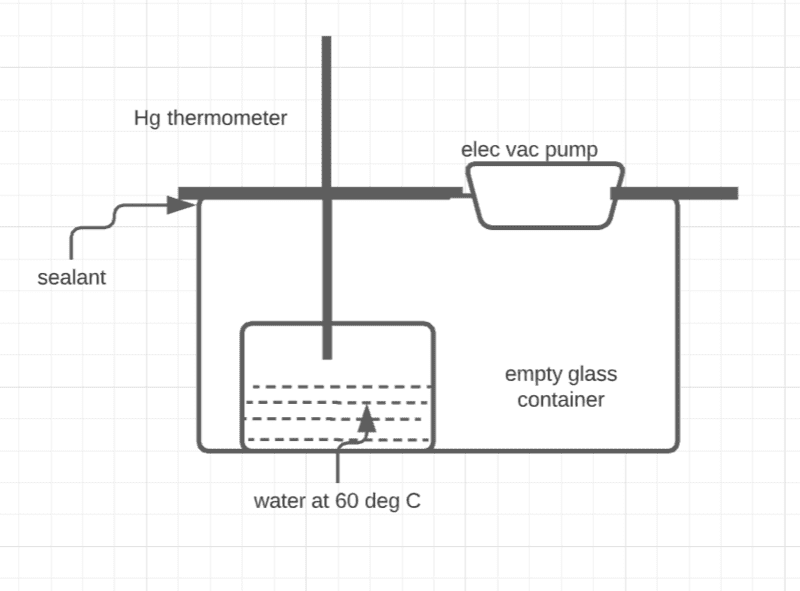
  • One participant describes a setup involving a glass container, a beaker of water at 60℃, a thermometer, and an electric vacuum pump to create a partial vacuum.
  • Another suggests using a "Vacuum Chamber Stainless Steel Kit" for degassing, emphasizing the need for a thick clear lid and compatibility with higher temperatures.
  • A participant proposes using a hypodermic syringe as a low-cost alternative, noting the challenge of measuring temperature during boiling.
  • There is a suggestion to boil water in a closed container and gradually let air in to maintain a temperature of 60℃, while avoiding pressures that could lead to danger.
  • Concerns are raised about maintaining the temperature and avoiding positive pressure in the setup, with suggestions for safe vacuum sealing techniques.
  • One participant shares a personal experience of successfully demonstrating boiling at room temperature using a vacuum desiccator, noting the cooling effect as water boils.
  • Another participant mentions the use of a heated water bath to keep the syringe submerged for temperature measurement.
  • Questions arise regarding the rationale for boiling water specifically at 60℃, with some participants speculating it may be arbitrary.

Areas of Agreement / Disagreement

Participants express a variety of methods and setups, with no clear consensus on the best approach. Several ideas are contested, and uncertainties about the effectiveness and safety of different methods remain unresolved.

Contextual Notes

Participants highlight limitations in measuring temperature accurately in certain setups, and there are unresolved concerns regarding the safety of maintaining low pressures and temperatures in homemade apparatuses.

Who May Find This Useful

This discussion may be of interest to educators, hobbyists, or anyone exploring experimental setups for demonstrating principles of thermodynamics and phase changes in liquids.

KedarMhaswade
Messages
35
Reaction score
6
TL;DR
How do we create a partial vacuum to boil water at about 60℃?
Water (any liquid) in a closed container boils when the vapor pressure of water (a property that depends on its temperature) equals the surrounding pressure. The vapor pressure of water at 60℃ is about ##1.99\times10^{4}## which is roughly 150 mm Hg.This principle is so simple, and yet, it is rather difficult to demonstrate effectively at home (with cheap equipment the links to which I have posted to below). I have thought of doing this experiment in the following (perhaps simplistic) manner (see the Figure).
1632292733419.png

  1. Take a glass container and place a beaker of water at about 60℃ in it.
  2. Insert a thermometer and an electric vacuum pump in a lid and seal that lid to the container with some sealant like M-seal.
  3. Operate the pump to create partial vacuum.
I'd like the kids to see the water boil at about 60℃. My questions:

  1. I believe it should work, but are there any obvious flaws in my setup?
  2. Any tips to maximize the probability of success?

 
Science news on Phys.org
The "Vacuum Chamber Stainless Steel Kit" used for Degassing Urethane are listed on eBay.
They have a thick clear lid. Check they will operate at 70 deg C, and include a vacuum pump.
 
  • Like
Likes   Reactions: KedarMhaswade
Being the world's biggest cheapskate, I would recommend a hypodermic syringe. Here's the video that came up first when I googled:


These are called "flavor injectors" at the local grocery store I shop at. They cost about $5.
 
  • Like
Likes   Reactions: russ_watters, Drakkith, KedarMhaswade and 1 other person
KedarMhaswade said:
Summary:: How do we create a partial vacuum to boil water at about 60℃?

Operate the pump to create partial vacuum.
Using a pump will cost money (if you don't already have one). To produce a low pressure you can do what the old Steam Engineers used to do. Boil some water in a closed container. Seal the container with a thermometer inside it. Gradually let air in until the temperature drops to 60C and then re-seal. The water will still be boiling if the pressure is around 0.2 Atmospheres. Job done.
Best to do this with a large container so the 60C temperature will be maintained for a reasonable while. If you add heat (low power is probably enough) the water will stay boiling and condensing on the outside of the container. This is just the same process as boiling water in a normal pan where the ambient pressure is 1 Atmosphere. A bit of skill would be needed to maintain the 60C and you need to avoid the temperature exceeding anywhere near 100C or the pressure in the container will be positive and potentially dangerous.
 
sophiecentaur said:
A bit of skill would be needed to maintain the 60C and you need to avoid the temperature exceeding anywhere near 100C or the pressure in the container will be positive and potentially dangerous.
The advantage of the "Urethane Degassing" containers is that the transparent lid rests in place on a silicon rubber seal. Positive pressure is therefore not possible.

You can implement a similar safe vacuum seal on another container. Make sure the cover is not screwed on. It must be held in place by the vacuum, so it will lift if subjected to any internal pressure.
 
Baluncore said:
The advantage of the "Urethane Degassing" containers is that the transparent lid rests in place on a silicon rubber seal. Positive pressure is therefore not possible.

You can implement a similar safe vacuum seal on another container. Make sure the cover is not screwed on. It must be held in place by the vacuum, so it will lift if subjected to any internal pressure.
That's interesting and shows that Engineers think about things when they design stuff!. But my concern was with someone who seems to fancy doing an experiment starting from scratch. I was stating the obvious but no harm in that when there's an accident waiting to happen. The idea in my head was to have a rubber bung with a short taper, in a hole with a similar taper. A 90 degree taper and a massive area sounds even better.
 
  • Like
Likes   Reactions: Baluncore
OmCheeto said:
Being the world's biggest cheapskate, I would recommend a hypodermic syringe. Here's the video that came up first when I googled:


These are called "flavor injectors" at the local grocery store I shop at. They cost about $5.

This is pretty good. The only problem is that it's not easy to measure the temperature of the water as it boils in the syringe. As the demonstrator "claims" (of course, the claim may be true), the water actually cools down as it boils (owing to the latent heat that it loses as the steam extracts it from the water itself)! It would be cool ;-) if one could see that on a thermometer. So, I am enticed to try my own setup after I give the valve + syringe setup a try.
 
KedarMhaswade said:
it's not easy to measure the temperature of the water as it boils in the syringe.
Standard trick is to use a heated water bath at 60C and keep the syringe under the water.
 
  • Like
Likes   Reactions: OmCheeto
KedarMhaswade said:
This is pretty good. The only problem is that it's not easy to measure the temperature of the water as it boils in the syringe. As the demonstrator "claims" (of course, the claim may be true), the water actually cools down as it boils (owing to the latent heat that it loses as the steam extracts it from the water itself)! It would be cool ;-) if one could see that on a thermometer. So, I am enticed to try my own setup after I give the valve + syringe setup a try.
That would be an interesting maths problem: Find out the conditions in a syringe that you would need to generate an easily noticeable temperature change.

My guess is that the syringe would have to be very large, or the amount of water would have to be very small.
I'm also guessing that air in the apparatus would mess things up a bit.
 
  • #10
I created a boiling display machine exactly as you have pictured. It worked fantastic. I used a vacuum desiccator, and a refrigeration grade vacuum pump.
The boiling temperature of the water is a function of the vacuum achieved by the pump. When I demonstrated it, the water would be at room temperature. When I started the pump, the water would start to boil. As there is no heat added to the vessel, and the liquid requires heat to boil, it would extract the heat from itself. As the water boils, its temperature drops. In my demonstration unit, it would take about 10 minutes of boiling before the temperature dropped to the freezing temperature, and Ice would form on the surface. it was and amazing demonstration for the principles of saturation temperature pressure relationships.
 
  • Like
Likes   Reactions: sophiecentaur and KedarMhaswade
  • #11
GerryD said:
I created a boiling display machine exactly as you have pictured. It worked fantastic. I used a vacuum desiccator, and a refrigeration grade vacuum pump.
The boiling temperature of the water is a function of the vacuum achieved by the pump. When I demonstrated it, the water would be at room temperature. When I started the pump, the water would start to boil. As there is no heat added to the vessel, and the liquid requires heat to boil, it would extract the heat from itself. As the water boils, its temperature drops. In my demonstration unit, it would take about 10 minutes of boiling before the temperature dropped to the freezing temperature, and Ice would form on the surface. it was and amazing demonstration for the principles of saturation temperature pressure relationships.
That's cool! Could you add a picture?
 
  • #12
sophiecentaur said:
Standard trick is to use a heated water bath at 60C and keep the syringe under the water.
Just the part up to the water level, right? The rest in ambient air for condensation?
 
  • #13
OmCheeto said:
That would be an interesting maths problem: Find out the conditions in a syringe that you would need to generate an easily noticeable temperature change.

My guess is that the syringe would have to be very large, or the amount of water would have to be very small.
I'm also guessing that air in the apparatus would mess things up a bit.
You can get big plastic syringes about an inch in diameter cheap at any pharmacy.
 
  • #14
Is there a reason you want to boil water at 60 degrees or is than an arbitrary number less than 100 degrees?
 
  • #15
bob012345 said:
Is there a reason you want to boil water at 60 degrees or is than an arbitrary number less than 100 degrees?
Oh, yeah, just an arbitrary number less than 100. Any other number would also do. (Sorry for a late reply!)
 
  • #16
bob012345 said:
Just the part up to the water level, right? The rest in ambient air for condensation?
To deal with the condensation, why not have two interconnected chambers - one with a heat source (water bath at 60C) and another 'condenser', kept cold. This could operate pretty much continuously - or until all the water had boiled off and moved to the condenser. The boiling point would be controlled by adjusting the pressure with an external warm syringe (you wouldn't want condensation inside the syringe). If you want a demonstration then this would work itself for a fairly long time (a tap could isolate the syringe once the right pressure is arrived at. This could use all school lab stuff.
 

Similar threads

  • · Replies 5 ·
Replies
5
Views
2K
  • · Replies 114 ·
4
Replies
114
Views
33K
Replies
8
Views
5K
  • · Replies 8 ·
Replies
8
Views
3K
  • · Replies 8 ·
Replies
8
Views
8K
  • · Replies 26 ·
Replies
26
Views
3K
  • · Replies 6 ·
Replies
6
Views
2K
Replies
20
Views
2K
  • · Replies 9 ·
Replies
9
Views
11K
  • · Replies 43 ·
2
Replies
43
Views
13K