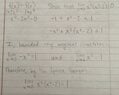
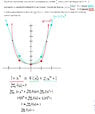
Albert Einstein1 Messages 3 Reaction score 0 Thread starter Sep 4, 2021 #1 I am not entirely sure if I solved this problem correctly. Please let me know if my reasoning is flawed. Thank you and I appreciate your help greatly. Attachments C81A8208-41D5-4B0B-8574-30C16FD7F3C3.jpeg 42 KB · Views: 167 50D89683-48F0-4EC5-9C90-EB3D3BB43619.jpeg 285.8 KB · Views: 187
I am not entirely sure if I solved this problem correctly. Please let me know if my reasoning is flawed. Thank you and I appreciate your help greatly.
Albert Einstein1 Messages 3 Reaction score 0 Sep 5, 2021 #2 Albert Einstein said: I am not entirely sure if I solved this problem correctly. Please let me know if my reasoning is flawed. Thank you and I appreciate your help greatly. Attachments 1CC00144-1DF9-4A5D-95B4-E3D42947A0F3.jpeg 110.5 KB · Views: 166
Albert Einstein said: I am not entirely sure if I solved this problem correctly. Please let me know if my reasoning is flawed. Thank you and I appreciate your help greatly.
HOI Messages 921 Reaction score 2 Oct 20, 2021 #3 In the first, post your "bounding" is wrong. $x^2(x^2- 2)$ is less than or equal to $-x^2$. For the second, yes, that is correct.
In the first, post your "bounding" is wrong. $x^2(x^2- 2)$ is less than or equal to $-x^2$. For the second, yes, that is correct.