Chlorophyll in Acetone Spectrophotometry Help

  • Thread starter Thread starter mishima
  • Start date Start date
  • Tags Tags
    Acetone
Click For Summary

Discussion Overview

The discussion revolves around the challenges faced in constructing an absorbance spectrum for chlorophyll in acetone using an older spectrophotometer. Participants explore issues related to calibration, absorbance readings, and potential experimental adjustments.

Discussion Character

  • Exploratory
  • Technical explanation
  • Debate/contested
  • Experimental/applied

Main Points Raised

  • One participant describes their setup using a Spectronic 20 spectrophotometer and expresses difficulty in calibrating absorbance readings, particularly in the 600 nm range.
  • Another participant suggests that the inability to reach zero absorbance could indicate a blockage or malfunction in the detector, proposing various troubleshooting steps.
  • There is a discussion about the nature of UV light and its relation to the observed fluorescence of chlorophyll, with some participants noting that the peak absorbance near 430 nm could be significant.
  • Suggestions are made to improve the experiment, including using red food coloring for comparison, ensuring cuvette transparency, and minimizing disturbances during measurements.
  • A participant mentions that even with a blank cuvette, they cannot calibrate to 100% transmission at higher wavelengths, indicating potential issues with the spectrophotometer itself.

Areas of Agreement / Disagreement

Participants express multiple competing views regarding the calibration issues and the potential causes of the high absorbance readings. There is no consensus on the underlying problem with the spectrophotometer or the best approach to resolve it.

Contextual Notes

Participants note limitations in their experimental setup, including the potential need for equipment servicing and the importance of maintaining consistent environmental conditions during measurements.

mishima
Messages
576
Reaction score
43
Hi, I have an older spectrophotometer (Spectronic 20) I've been trying to get up and running mostly just for fun, but also to learn more about spectrophotometry in general.

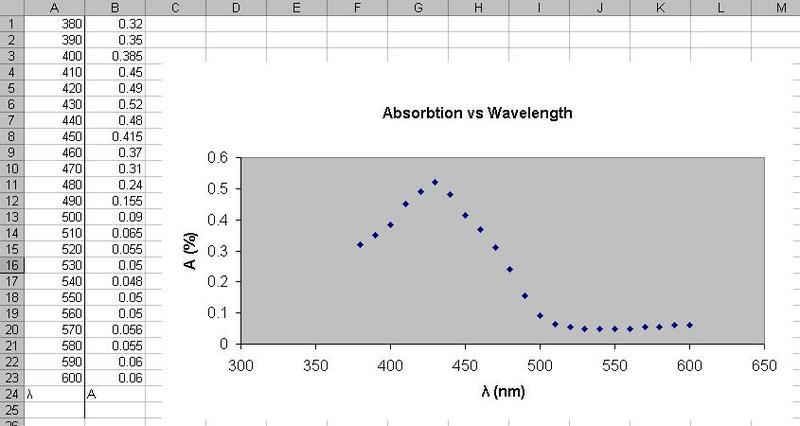
Recently I tried constructing an absorbance spectrum for chlorophyll in acetone. I took an unmeasured amount of cuttings from a plant in my room and put them in (hardware store bought) acetone. I used roughly 100mL.

I then made 2 cuvettes, 1 just acetone, and one the filtered liquid from the cuttings. I tried going through the range of wavelengths, recalibrating 0 absorbance each change of wavelength with the acetone cuvette and reading absorbance every 10 nm with the cuttings cuvette.

Question: some wavelengths I could not calibrate because the absorbance would never reach zero, even with the dial turned all the way (why?). I thus only have readings for 380-600 nm. This is disappointing because I think the wavelength of interest is 650+. From Beer's law it looks like a solution would be to dilute the acetone in both cuvettes, or use a smaller cuvette (which I don't have).

I plotted absorbance vs. wavelength in excel. It's a nice curve but it doesn't seem to mesh with other absorbance spectra I found kicking around on the net.
cgraph.jpg


Question: any interpretations of my graph? Is the peak near 430 why the solution fluoresces in black light?

I really appreciate any help.

edit: and I just realized I misspelled "absorption" on my graph...
 
  • Like
Likes   Reactions: rawad yahya
Chemistry news on Phys.org
black light = uv. UV is under ~380 nm so by definition something absorbing light below 380 will DO SOMETHING with it. What it will do depends on the nature of the compound and its environment. 430 is not UV but that doesn't prevent the molecule from absorbing light there and then emitting lower energy light. That is, a molecule can jump up several steps and then drop back down one-by-one. Energy of a light photon is proportional to its frequency, so UV is much more energetic than blue which is more energetic than red. I am not sure why you aren't getting anything above 600. That makes no sense to me. Something seems to be blocking the light (or perhaps the detector is broke?). If it were me, I'd try a couple of different things. First, red food coloring will obviously give you more absorption in the red. SO compare water with and without it.
Check to make sure your cuvettes are transparent in the visible...lol surely they are. I'd try the experiment a little differently. I'd run the complete spectrum with acetone, recording the values as I went up then back down. do it a few times WITHOUT disturging the cuvette. Now you have a pretty good average value. YOu should consider doing the same thing with an "empty" cuvette. And you will learn a lot about reproducibility by moving the cuvette in and out, changing the sides the light goes thru, and comparing cuvettes. But that can be a bit of a bore. After I had a good acetone spectrum, I'd do the same thing with the extract. That is, rather than recalibrating every so often, just take the whole spectra after calibrating once. (I'd calibrate with an empty cuvette, myself - I think). You need to think on the microscale. Every time you touch the cuvette you are shifting the path the light travels a bit. So, you don't want to do that. Make sure orientation with acetone and with sample is as near as possible to identical. After I'd recorded several sample spectra between 3 and 10, although 20 would be better and 100 would be wonderful (but waaaay too tedious, imho). You use excel to crunch the data. Subtract the average acetone value (at a given wavelength) to the average sample value.
If that doesn't work, I'd pop the hood and carefully 'dust off' all of the optics. Alignment is also an issue but beyond the scope of what you and I can discuss here. So. to sum up: 1. Confirm that SPec 20 is working in the red-orange. 2. Don't calibrate but once every couple of hours. 3. Try treating actone blank and sample as nearly identically as possible. 4. Use excel to do the math, not the spec 20! 5. Oh, and make sure you've let the thing warm up sufficiently (how can you tell? You check a cuvette or blank at 3-5 points waiting 10 minutes in between until it isn't changing anymore). 6.I've forgotten just what Spec 20's light source(s) are and whether it uses filters to control what the chamber is getting, but there is a possiblity that these components need servicing.. checking against a known UV-Visible spectra (all sorts available on line...you may need to use Excel to "blur" (running average) the spectras if they're higher resolution than what you can manage). Happy hunting!
"disturbing", not disturging oh and your spectra looks fine as far as it goes...consider 5 nm sampling - all wavelengths don't HAVE to have the same number of runs, use the more 'solid' values to adjust the ones with fewer sample points...if you know what I mean? If you take 5 at 10 and 20 and then one at 10, 15 and 20 then adust the 15 value based on the differences between that run's 10& 20 values and the average 10 & 20 value...Thank Goodness for excel!
Make sure room temperature is constant as much as possible. I assume the electrical supply is not varying too much? What's on that circuit that may be throwing spikes at the Spec 20?
Finally, before I sign off: the Spec20 detects the intensity of the light, not its absence. Tranmission rather than absorption is a more "natural" measurement unit. Can you measure in T? (Then use excel to crunch to get %Abs?)
 
Last edited:
Thanks for the tremendous tips. What happens at other wavelengths is that absorbance will not go to zero, even when the blank adjust (bottom right knob) is at an extreme. So it IS absorbing, I just can't calibrate a blank scale on the meter. I'm not sure if that matters, or if I could subtract it out somehow.

The acetone spectrum sounds good, I didn't realize that I should be letting things settle (but that makes perfect sense). I will try that and the other fantastic suggestions promptly.

edit: I tried diluting the acetone and seeing if A went to zero but it was still high. Even with just tap water it was too high at the redder (600+) wavelength.
 
Alright, should have checked this first. Even with a blank cuvette I can't calibrate to 100% T for those redder wavelengths. Something must be wrong inside the device.
 

Similar threads

  • · Replies 1 ·
Replies
1
Views
2K