- 12,179
- 186
In my battery-powered lawnmower there is a circuit breaker. I have replaced the breaker, and when I cut apart the old one I found a 68 Ω resistor in parallel with the breaker switch. My question is, what is the purpose of this resistor?
Here is the basic mower circuit:
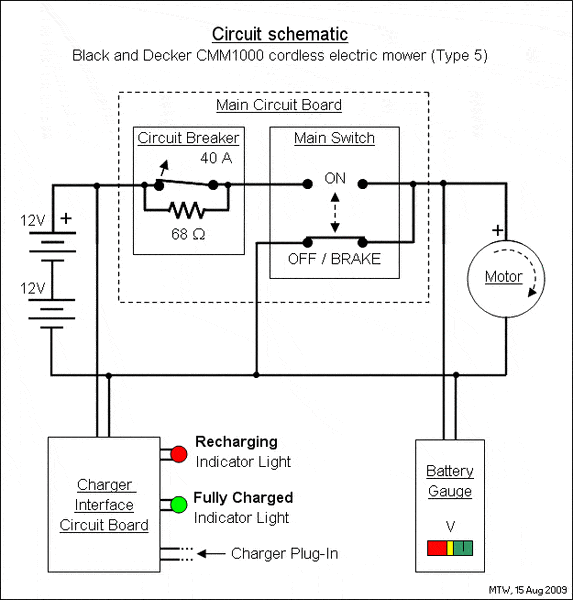 (Imagine that the Main Switch is in the "On" position when the circuit breaker opens.
I'm thinking the Charger Interface does not really interact with the circuit during normal operation, only when I'm charging the batteries.
The Battery Gauge is reading the motor voltage, and is a series combination of 680Ω, 16V Zener, and solenoid (to deflect a magnetic indicator needle):
The motor runs on 24 V DC, is the permanent magnet type, runs at 12A during normal operation or as high as 40 A to trip the breaker.
Mainly I want to know about the 68Ω because I just purchased some cheap breakers from an alternate supplier, to be ready for the next time this happens. I opened one up and these do not have the resistor, so I'm wondering if I should add a resistor in parallel if I use one of these in the future.
Oh, just taking an educated guess here: without the 68Ω, if the breaker opens then the motor, being an inductive load, would try to drive it's current through the Battery Gauge and fry one or more of its components. That's my guess but I'm interested in other opinions, especially if you have come across this yourself.
Thanks in advance!
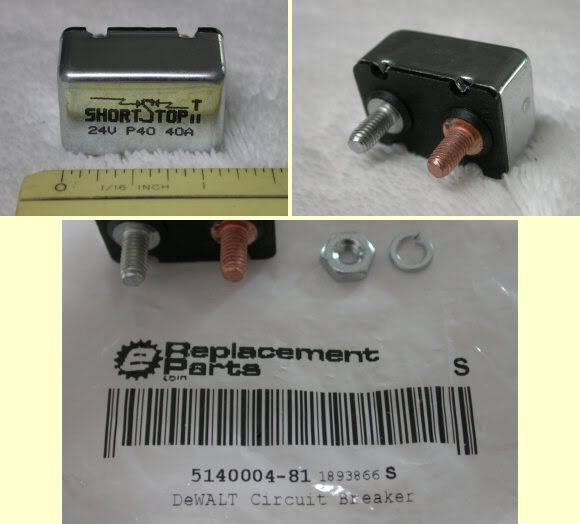
p.s. photo of the breaker:
Here is the basic mower circuit:
I'm thinking the Charger Interface does not really interact with the circuit during normal operation, only when I'm charging the batteries.
The Battery Gauge is reading the motor voltage, and is a series combination of 680Ω, 16V Zener, and solenoid (to deflect a magnetic indicator needle):
Code:
       \
(+) ---|<|-------(coil)-----/\/\/\/----- (-)
       \ 16V                 680Ω
The motor runs on 24 V DC, is the permanent magnet type, runs at 12A during normal operation or as high as 40 A to trip the breaker.
Mainly I want to know about the 68Ω because I just purchased some cheap breakers from an alternate supplier, to be ready for the next time this happens. I opened one up and these do not have the resistor, so I'm wondering if I should add a resistor in parallel if I use one of these in the future.
Oh, just taking an educated guess here: without the 68Ω, if the breaker opens then the motor, being an inductive load, would try to drive it's current through the Battery Gauge and fry one or more of its components. That's my guess but I'm interested in other opinions, especially if you have come across this yourself.
Thanks in advance!
p.s. photo of the breaker: