Clarification on the given PDE problem

  • Context: Graduate 
  • Thread starter Thread starter chwala
  • Start date Start date
  • Tags Tags
    Pde
Join the discussion
Ask a follow-up here, or get your own question answered by working scientists, mathematicians and engineers — people, not an autocomplete.
Real named experts · corrections over time · the nuance an AI answer skips
4 replies · 2K views
chwala
Gold Member
Messages
2,843
Reaction score
428
TL;DR
see attached.
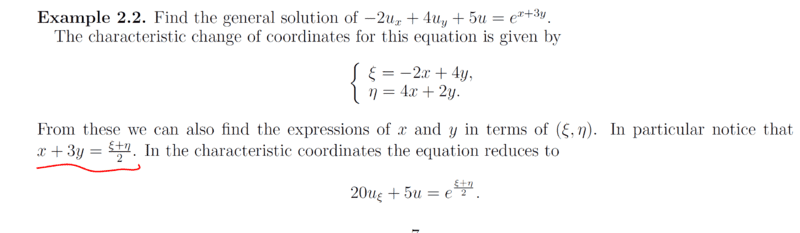
My interest is on the highlighted part only...my understanding is that one should use simultaneous equation... unless there is another way hence my post query.
1673170162078.png


In my working i have;

##y=\dfrac{2ξ+η}{10}## and ##x=\dfrac{2η-ξ}{10}## giving us;

##x+3y=\dfrac{2η-ξ+6ξ+3η}{10}=\dfrac{5ξ+5η}{10}=\dfrac{ξ+η}{2}## cheers guys.
 
Physics news on Phys.org
Why do you always have to question things like this? You have two equations for ## \xi## and ## \eta ## in ## x ## and ## y ## and you want to find two equations for ## x ## and ## y ## in ## \xi## and ## \eta ##: this is simultaneous equations by definition. You should do more thinking for yourself and not constantly seek assurance, this is not the way to develop confident problem solving skills.
 
Last edited:
Reply
  • Like
Likes   Reactions: Mark44 and MidgetDwarf
@pbuk noted mate :biggrin: :biggrin: ...am slowly developing confidence...the pde's can be intimidating at times...not for the faint of hearts. Cheers...
 
Last edited:
chwala said:
TL;DR Summary: see attached.

My interest is on the highlighted part only...my understanding is that one should use simultaneous equation... unless there is another way hence my post query.

View attachment 319956

I don't think this approach is the best approach to applying the method of characteristics.

Firstly I don't think it extends to non-constant coefficients, and secondly it leads to more complicated airthmetic in finding the integrating factor and solving the transformed PDE than does the approach of setting [tex] x_\xi = -2,\qquad y_\xi = 4[/tex] and then choosing [itex]x_\eta[/itex] and [itex]y_\eta[/itex] such that [itex]\eta[/itex] does not appear expressly in the transformed equation, leading to [tex] u_{\xi} + 5u = e^{10\xi + (x_\eta + 3y_\eta)\eta} = e^{10\xi}.[/tex] This approach also works for non-constant coefficient problems.
 
Reply
  • Like
Likes   Reactions: chwala
Thanks @pasmith ...i prefer the integrating factor method shown in the text for the time being... i need to try and study the approach that you are suggesting.
 
Last edited: