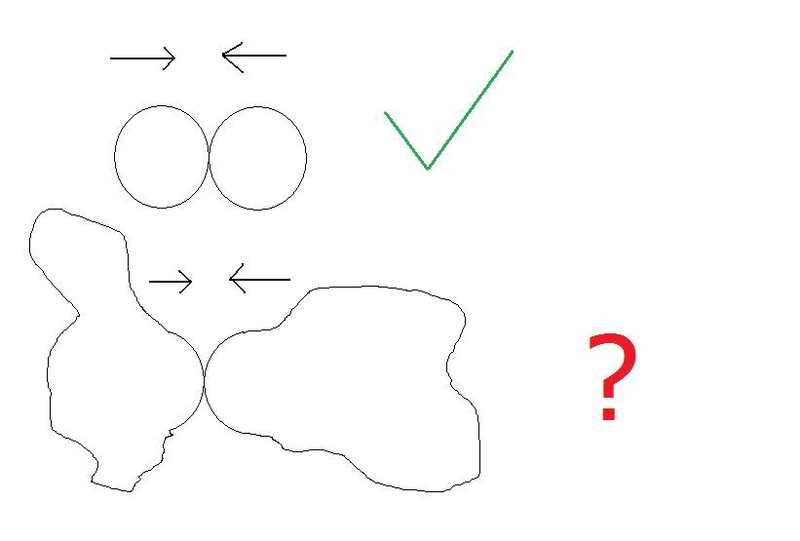
Collisions are complicated so it is usually difficult to get a simple answer ;)
The thing is that you keep adding extra bits to your question that also need to be addresed.
1. wether a collision is elastic or inelastic (and to what degree) does not depend on shape.
2. ... also does not depend on "hardness".
How elastic a particular collision is, is determined
entirely and
only on what happens to the kinetic energy of the bodies involved.
I have an air-track set-up using spring-fenders. The collisions are elastic to the limits of measurement available to the students. Clearly two springs colliding head-on are not "hard" impact surfaces. I have seen a demonstration of electrostatic repulsion between two objects moving on an air table - again, clearly not a hard-surface collision, also very elastic.
@Danger:
In the pool/snooker/billiards situation, the model is complicated by the fact the balls are rolling, and the cue ball is usually not struck (by the cue) through its center of mass. The resulting tangential component is what provides the "spin" on the balls and so the strange effects used in trick shots.
http://www.jimloy.com/billiard/phys.htm
Non-spherical objects also transfer angular momentum in collisions, and you can get much more varied responses since you get, in general, three spin axis. eg. Spin is stable about the longest or the shortest axis but unstable about the middle one: the object "tumbles".
http://www.ph.man.ac.uk/~mikeb/lecture/pc167/rigidbody/stability.html
Just to be clear:
any object may not be free to move in some way. You won't find an object that is not free to (for eg) rotate solely by virtue of it's shape. There will be something external restraining it.