Optical Compact Device For Measuring Speed of Light

Click For Summary
The discussion revolves around a proposed device to measure the speed of light using two curved mirrors, a laser, and a camera. The concept involves spinning the mirrors to create a horizontal shift in the light beam detected by the camera, which would theoretically allow for the calculation of light speed based on various parameters. However, participants highlight significant challenges, including the inherent definition of the speed of light and the impracticality of achieving sufficient reflectivity after multiple reflections. The calculations presented indicate that the expected deviation in the light beam would be too small to detect with standard equipment. Ultimately, the consensus leans towards the idea being infeasible due to the limitations of mirror reflectivity and measurement accuracy.
person123
Messages
326
Reaction score
52
TL;DR
An idea (which is likely not feasible) for measuring the speed of light using spinning mirrors with a laser and camera attached
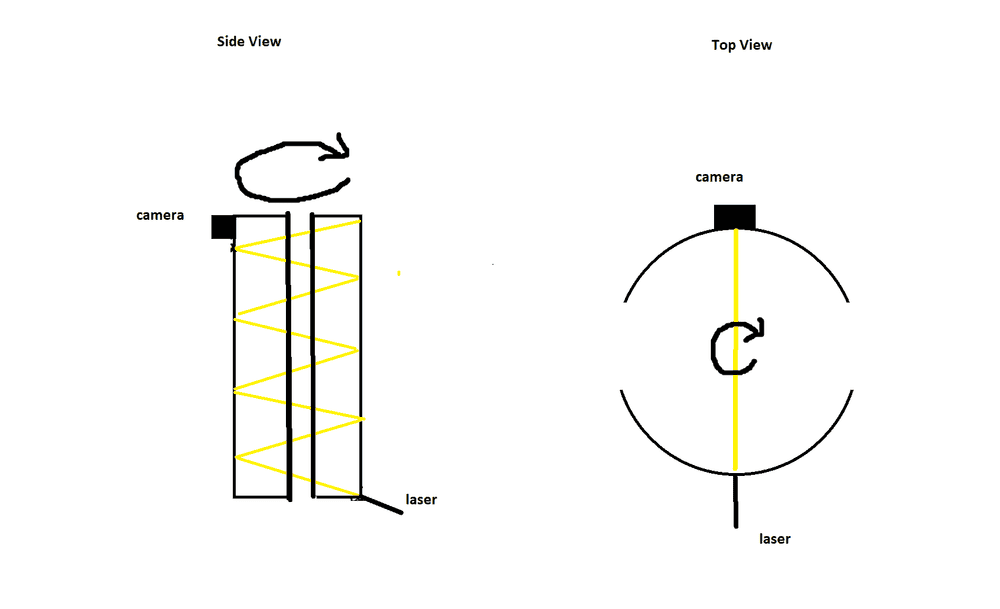
Hi. This is an idea which I just happened to think of, and I was curious if it would be at all feasible. Here's a quick sketch I drew:
spinny speed of light.png

The two curved mirrors should have a laser attached on one end and a video camera attached on the other. The laser would be tilted very slightly above horizontal (much less than shown in the sketch), so the light bounces up the mirrors and exits on the other side. I would imagine that the camera would pick up a vertical line of light. The mirrors should then be spun rapidly (with the laser and camera spinning with them). I would imagine that, because it takes time for the light to travel up the mirror, the line of light which the camera picks up on would be shifted very slightly horizontally. To measure the speed of light, you would have to know the tilt of the laser, the radius of the mirrors, the height of the mirrors, and the speed the mirrors are spinning.

Would this be at all possible?

Thank you!
 
Physics news on Phys.org
Anything is possible.
You need to put some numbers on the design. How big is it and how fast does it rotate?
Calculate how far sideways you expect the beam to swing. How many pixels will that be?

You cannot measure the speed of light because it is defined as 299792458 m/s.
So you are actually checking the accuracy of your measurements and construction.
 
Baluncore said:
Anything is possible.
You need to put some numbers on the design. How big is it and how fast does it rotate?
Calculate how far sideways you expect the beam to swing. How many pixels will that be?

You cannot measure the speed of light because it is defined as 299792458 m/s.
So you are actually checking the accuracy of your measurements and construction.

I'm going to use these numbers:
  • Height of cylinder (H): ##1m##
  • Angle of tilt of laser (##\theta##): ##0.1^{\circ}## (might be stretching it a bit)
  • Rotation speed of cylinder (##\omega##): ##100\frac{rad}{s}##
  • I'll use ##3*10^8 \frac{m}{s}## for ##c##
I'll then compute ##\alpha## or the angle the line deviates from the perspective of the camera.

So, the time it takes to go up the cylinder would be: $$t=\frac{H}{c\sin(\theta)}$$ This would be equal to the time the camera travels: $$t=\frac{\alpha}{\omega}$$. Solving for ##\alpha## would give: $$\alpha=\frac{H \omega}{c\sin\theta}=\frac{1(100)}{3*10^8*\sin(0.1^{\circ})}\frac{180}{\pi}=0.011 ^{\circ}$$

To convert that to pixels, (I'm not sure if these calculations are correct) I would multiply that angle by the total number of pixels (I'll say 1000 pixels) and divide by the range of the camera (I'll take it to be ##45 ^{\circ}##). This would give me $$n_{pixels}=\frac{0.011^{\circ}(1000)}{45^{\circ}}=0.244$$
Unfortunately, this seems like it wouldn't show up using this type of equipment.:frown:

The one other possibility I have would be to cap the top and bottom with horizontal mirrors so the light bounces up and down many times before dispersing. Then you might see a slight "smudge" of the light to the left or right when it is spun. If that did work though, I think it would just be qualitative; I don't see how you would get a value from that.
 
Last edited:
  • Like
Likes Baluncore
I don't quite follow what you are doing, but it seems that you are trying to create a path that involves many reflections. Perhaps 500. You will be surprised at how poorly real-life mirrors reflect. 75% is pretty good. The problem is that at 75%, no light is left after 500 reflections.

To get even a single photon through 500 reflections requires about 92% reflectivity. And of course you want more.

Next problem: an ordinary mirror reflects some light off the front, more light through the glass and back out the front, but some light reflects back from the glass and again from the silvering and out the front. And so on. Do this 500 times and you now have a long smear of arrival times rather than the sharp pulse you want.

You can improve this by using a front-silvered mirror (and improve the reflectivity at the same time), but it is no longerso cheap and is now quite fragile. You probably also want to go to silver. I still doubt it will work, because some of the non-reflected photons scatter instead of being absorbed, and risk overwhelming your tiny signal.

I think you are much better off using a shorter path and take advantage of the fact that time is easy to measure. A 1 meter box gives you 6ns difference between the source and reflected signal. Easy to measure.
 
  • Like
Likes person123
Vanadium 50 said:
I don't quite follow what you are doing, but it seems that you are trying to create a path that involves many reflections. Perhaps 500. You will be surprised at how poorly real-life mirrors reflect. 75% is pretty good. The problem is that at 75%, no light is left after 500 reflections.

To get even a single photon through 500 reflections requires about 92% reflectivity. And of course you want more.

Next problem: an ordinary mirror reflects some light off the front, more light through the glass and back out the front, but some light reflects back from the glass and again from the silvering and out the front. And so on. Do this 500 times and you now have a long smear of arrival times rather than the sharp pulse you want.

You can improve this by using a front-silvered mirror (and improve the reflectivity at the same time), but it is no longerso cheap and is now quite fragile. You probably also want to go to silver. I still doubt it will work, because some of the non-reflected photons scatter instead of being absorbed, and risk overwhelming your tiny signal.

I think you are much better off using a shorter path and take advantage of the fact that time is easy to measure. A 1 meter box gives you 6ns difference between the source and reflected signal. Easy to measure.
I didn't think of this. The many reflections gives another reason for my idea not being feasible.
 

Similar threads

  • · Replies 21 ·
Replies
21
Views
3K
  • · Replies 32 ·
2
Replies
32
Views
3K
  • · Replies 1 ·
Replies
1
Views
2K
  • · Replies 51 ·
2
Replies
51
Views
5K
  • · Replies 1 ·
Replies
1
Views
1K
Replies
7
Views
3K
  • · Replies 11 ·
Replies
11
Views
1K
  • · Replies 52 ·
2
Replies
52
Views
5K
  • · Replies 57 ·
2
Replies
57
Views
5K
  • · Replies 19 ·
Replies
19
Views
2K