Concave mirror: Reflected rays do not meet at one point

Click For Summary
SUMMARY

The discussion centers on the behavior of light rays reflecting off concave mirrors, specifically addressing why not all rays converge at a single point. It is established that only special geometries, such as elliptical cavities, allow for complete convergence of rays diverging from a point source. Spherical mirrors exhibit spherical aberration, causing rays to converge at a point only under specific conditions, such as when the object is placed at the center of curvature. The conversation highlights the importance of ray diagrams in understanding these optical phenomena.

PREREQUISITES
  • Understanding of concave mirrors and their properties
  • Familiarity with optical aberrations, specifically spherical aberration and coma
  • Knowledge of ray diagrams and their significance in optics
  • Basic principles of light behavior and reflection
NEXT STEPS
  • Study the principles of elliptical mirrors and their focusing properties
  • Research spherical aberration and its effects on image formation
  • Learn about ray tracing techniques for optical systems
  • Explore resources on optical aberrations and their corrections
USEFUL FOR

This discussion is beneficial for physics students, optical engineers, and anyone interested in the principles of optics and light behavior in concave mirrors.
simplescience
Messages
22
Reaction score
0
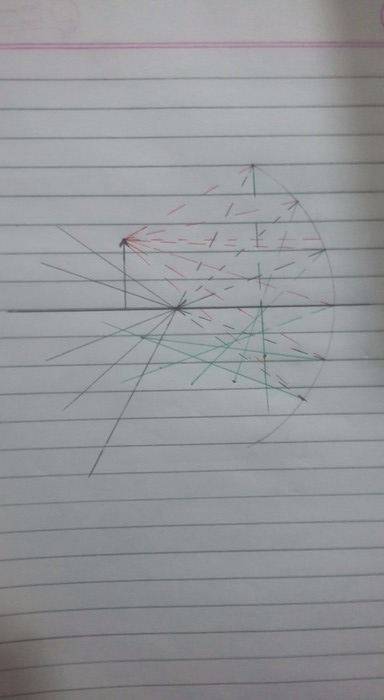
I have drawn a diagram of the incident and reflected rays of an object by the concave mirror. Red color shows the incident rays, black color shows the normals drawn from the center of curvature, while green color shows the reflected rays. Shouldn't all the reflected rays meet at one point.

Any suggestions are welcome.

26b0a48.jpg
 
Science news on Phys.org
It's only for special geometries that rays coming off of a curved mirror will converge on a single point, if they diverged from a point source.
In particular, an elliptical cavity has this special property that light rays diverging from one ficus will converge on the second focus.

Ellipse or no, there will be some focusing going on with a regular curved mirror. This is why, for example, it is highly inadvisable to have glass buildings with curved surfaces:

See for example:
 
Does this mean that...
1. My diagram is correct.
2. The rays will truly converge in the case of ellipse concave mirrors only.
3. In case of spherical mirrors, not all the rays will converge, but maximum will converge at one point. Parallel rays, rays passing though curvature, rays passing through focus point or rays directed to pole will converge exactly at one point.
?
 
Does this mean that...
1. My diagram is correct.
2. The rays will truly converge in the case of ellipse concave mirrors only.
3. In case of spherical mirrors, not all the rays will converge, but maximum will converge at one point. Parallel rays, rays passing though curvature, rays passing through focus point or rays directed to pole will converge exactly at one point.
?
jfizzix said:
It's only for special geometries that rays coming off of a curved mirror will converge on a single point, if they diverged from a point source.
In particular, an elliptical cavity has this special property that light rays diverging from one ficus will converge on the second focus.

Ellipse or no, there will be some focusing going on with a regular curved mirror. This is why, for example, it is highly inadvisable to have glass buildings with curved surfaces:

See for example:
 
Look up spherical aberration. A spherical mirror produces a point image of a point object only in the paraxial approximation, in which the rays don't make large angles to the optical axis, and we use only a small part of the spherical surface, close to the point where the optical axis intersects it.
 
jtbell said:
Look up spherical aberration. A spherical mirror produces a point image of a point object only in the paraxial approximation, in which the rays don't make large angles to the optical axis, and we use only a small part of the spherical surface, close to the point where the optical axis intersects it.
Is my diagram, actually showing "spherical aberration" in effect?
 
Yes.
 
jtbell said:
Yes.

Thanks now I know what to look for next.
 
Your diagram is illustrating coma, an aberration of an off-axis object.

If you put your object on the axis, you should get better convergence of the reflected rays.
 
  • #10
Right, it has both spherical aberration and coma. If the object and image are on-axis, you still get spherical aberration. Unless the object is at the center of curvature, in which case the image is also at the center of curvature... not a very useful situation!
 
  • #11
pixel said:
Your diagram is illustrating coma, an aberration of an off-axis object.

If you put your object on the axis, you should get better convergence of the reflected rays.
What is meant by putting an object on the axis? Does it mean that the principal axis bisect an object?
 
  • #12
We (pixel and I) are talking about point-objects. In your diagram, the tail of the arrow is on the optical axis of the mirror. All other points on the arrow, including the tip from which you drew your rays, are off axis.
 
  • #13
jtbell said:
We (pixel and I) are talking about point-objects. In your diagram, the tail of the arrow is on the optical axis of the mirror. All other points on the arrow, including the tip from which you drew your rays, are off axis.
Any good books or sites that can help me understand these phenomenons in a step by step manner? I think my textbook is not well planned.
 

Similar threads

  • · Replies 4 ·
Replies
4
Views
2K
  • · Replies 4 ·
Replies
4
Views
2K
  • · Replies 5 ·
Replies
5
Views
2K
  • · Replies 5 ·
Replies
5
Views
579
  • · Replies 15 ·
Replies
15
Views
4K
  • · Replies 4 ·
Replies
4
Views
2K
  • · Replies 1 ·
Replies
1
Views
3K
  • · Replies 1 ·
Replies
1
Views
3K
  • · Replies 1 ·
Replies
1
Views
2K
  • · Replies 3 ·
Replies
3
Views
9K