Conductivity and Integration over Fermi-Sphere?

Click For Summary
SUMMARY

The discussion centers on the integration process in solid-state physics as described in "An Introduction to Solid State Physics" by Ibach and Lüth. The integral for conductivity, represented as $$\sigma=\frac{e^2}{8\pi^3 \hbar} \int df_{E}dE \frac{v^2_x(\bf{k})}{v(\bf{k})} \tau(\bf{k}) \delta(E-E_F)$$, raises questions about the treatment of the wave vector $$k$$ during integration. It is clarified that $$k$$ remains a vector and does not simplify to $$k_F$$ due to the non-spherical nature of the Fermi surface. The notation for the surface element in k-space, specifically $$dS_E$$, is also discussed, highlighting its relationship with $$dS_k$$ and the implications for dimensional analysis.

PREREQUISITES
  • Understanding of solid-state physics principles
  • Familiarity with Fermi surfaces and their properties
  • Knowledge of delta functions in integration
  • Basic concepts of k-space and its geometry
NEXT STEPS
  • Study the derivation of the conductivity formula in solid-state physics
  • Learn about the implications of non-spherical Fermi surfaces on electronic properties
  • Explore the use of delta functions in quantum mechanics and statistical mechanics
  • Investigate the relationship between k-space and energy space in solid-state systems
USEFUL FOR

Students and researchers in solid-state physics, particularly those focusing on electronic properties and conductivity calculations in materials with complex Fermi surfaces.

Abigale
Messages
53
Reaction score
0
Hi,
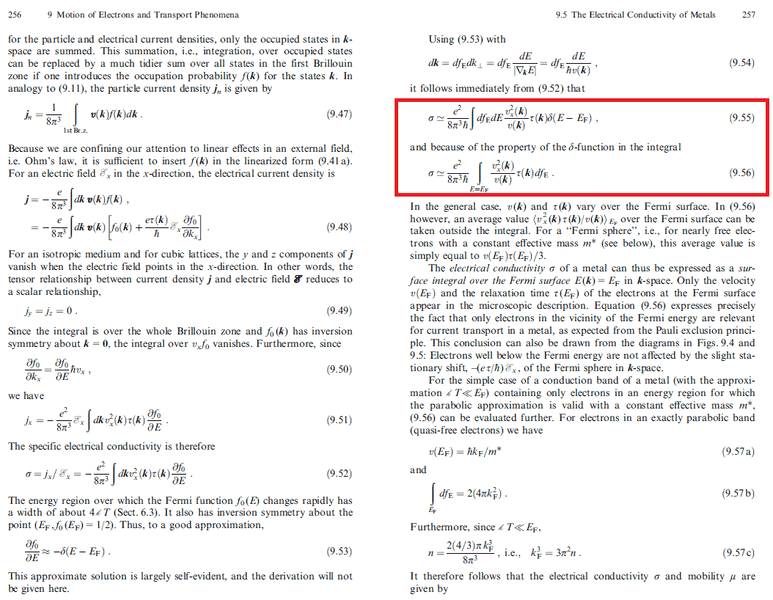
I am reading "An Introduction of Solid State Physics" from Ibach Lüth and don't understand the integration process.
They write $$\sigma=\frac{e^2}{8\pi^3 \hbar}
\int df_{E}dE \frac{v^2_x(\bf{k})}{v(\bf{k})} \tau(\bf{k}) \delta(E-E_F)
$$

$$
= \int_{E=E_F}^{}df_{E} \frac{v^2_x(\bf{k})}{v(\bf{k})} \tau(\bf{k})
$$

But why does ## k ## NOT become ##k_F## after the Integration of the Delta-function?

I would think that the integral becomes immedately after the dE-integration:
$$
= \int_{E=E_F}^{}df_{E} \frac{v^2_x(\bf{k_F})}{v(\bf{k_F})} \tau(\bf{k_F})
$$

THX
Abbi

I also add the pages
Versuch.png
 

Attachments

  • Versuch.png
    Versuch.png
    107.2 KB · Views: 606
Last edited:
Physics news on Phys.org
Yes, you are right, but this is only a matter of notation. k is still a vector and will have different length for different directions as long as the Fermi surface is not spherical.
 
I don't understand the notation ##dS_E##.
$$d\bf{k} = k^2 sin\theta d\theta d\phi dk$$
$$ = dS_k dk_\bot $$ This means a surface-element times a radial distance-element perpendicular to the surface-element. Both in k-space.

In the book instead of ##dS_k## the expression ##dS_E## is used. They say ##dS_k= dS_E dk_\bot ##

What means exactly ##dS_E##?
If I think at the notation $$ dS_k= k^2 sin\theta d\theta d\phi$$,
it should be $$dS_E=E({\bf k})^2 sin\theta d\theta d\phi$$

But then the units don't correspond anymore to k-space:
$$d{\bf k} =dS_E dk_\bot$$ which corresponds to $$ \frac{1}{m^3}=\frac{eV}{1}\frac{1}{m}$$
 
Last edited:

Similar threads

  • · Replies 3 ·
Replies
3
Views
2K
  • · Replies 2 ·
Replies
2
Views
2K
  • · Replies 1 ·
Replies
1
Views
2K
  • · Replies 0 ·
Replies
0
Views
2K
  • · Replies 8 ·
Replies
8
Views
2K
  • · Replies 8 ·
Replies
8
Views
2K
Replies
15
Views
3K
  • · Replies 25 ·
Replies
25
Views
3K
Replies
4
Views
2K