Confused about Newton's 3rd law of motion

  • Context: Undergrad 
  • Thread starter Thread starter Quanta
  • Start date Start date
  • Tags Tags
    Confused Law Motion
Click For Summary
SUMMARY

This discussion centers on the nuances of Newton's Third Law of Motion as presented in "Kleppner and Kolenkow, An Introduction to Mechanics." Participants clarify that the law applies to interaction forces between bodies but not to inertial forces, which are not true forces. The conversation highlights the importance of momentum conservation as a fundamental principle, suggesting that the Third Law is a consequence of this conservation rather than a standalone rule. Additionally, the implications of distance and time delays in force interactions, particularly in relativistic contexts, are explored.

PREREQUISITES
  • Understanding of Newton's Laws of Motion
  • Familiarity with concepts of inertial and non-inertial frames of reference
  • Basic knowledge of momentum conservation principles
  • Awareness of electromagnetic forces and their implications in physics
NEXT STEPS
  • Study the concept of "inertial forces" in classical mechanics
  • Explore momentum conservation in both Newtonian and relativistic frameworks
  • Investigate the role of electromagnetic fields in force interactions
  • Learn about the implications of time delays in force applications across distances
USEFUL FOR

Physics students, educators, and anyone interested in deepening their understanding of classical mechanics and the complexities of force interactions in various contexts.
Quanta
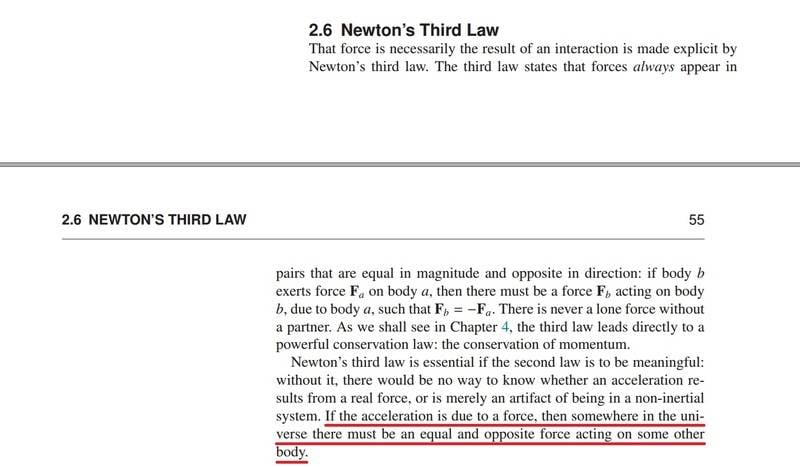
I have read section from "Kleppner and Kolenkow, An Introduction to Mechanics" about Newton's 3rd law of motion, What does red-lined sentence means ?
Why "somewhere in the universe ... on some other body" ?
Please explain.
qq.jpg
 
Last edited by a moderator:
Physics news on Phys.org
The first part says that if we observe an acceleration its due to us either being in a non-inertial frame of reference (ala our observation of falling objects as a result of the force of gravity because we are in a non-inertial frame of reference on the ground) or that some object is exerting a force on another object.

An example of the force of one object on another would the repulsion between two electrons. Electron A accelerates away from electron B due to the repulsive electrostatic force. We see that there a force pushing A away and there is also an equal force pushing B away in the opposite direction.
 
Quanta said:
I have read section from "Kleppner and Kolenkow, An Introduction to Mechanics" about Newton's 3rd law of motion, What does red-lined sentence mean ?
Why "somewhere in the universe ... on some other body" ?
Please explain.
View attachment 211896
The last paragraph basically says that the 3rd Law doesn't apply to inertial forces, only interaction forces between two bodies. But the key of the 3rd Law is the previous paragraph: conservation of momentum.
 
  • Like
Likes   Reactions: jedishrfu
A.T. said:
The last paragraph basically says that the 3rd Law doesn't apply to inertial forces, only interaction forces between two bodies. But the key of the 3rd Law is the previous paragraph: conservation of momentum.

Anyway something is unclear with that sentence, explain in detail please.
 
A.T. said:
The last paragraph basically says that the 3rd Law doesn't apply to inertial forces, only interaction forces between two bodies. But the key of the 3rd Law is the previous paragraph: conservation of momentum.

The whole concept of "inertial forces" is fraught with confusion. The terms thus named are not forces at all (that's why the third law does not apply to them), but rather some sort of mass x acceleration terms.

The part about "somewhere in the universe" simply means that we may not be readily able to locate the reaction force, but that it does in fact exist somewhere.
 
Quanta said:
Anyway something is unclear with that sentence
Seems clear to me.
 
I think it is saying that if a force is causing an acceleration on a body then whatever originated the force is repelled by the same amount.

Cheers
 
A.T. said:
The last paragraph basically says that the 3rd Law doesn't apply to inertial forces ...
Doing a web search for "inertial force", I find definitions such as: "a force opposite in direction to an accelerating force acting on a body and equal to the product of the accelerating force and the mass of the body" . Using this definition for "inertial force" Newton's third law applies. For example, a string exerts a force that accelerates a body in free space absent any other forces, the body exerts an equal and opposing force onto the string as a reaction to the acceleration.

The text from the book mentions "non-inertial systems", where apparent fictitious forces are related to the acceleration of the frame of reference, and in these cases, the fictitious force is not part of a Newton third law pair of forces.

Not all cases of Newton third law pairs involve reaction forces. Consider a pair of bodies circularly orbiting about a common center of mass in free space absent any other forces. The Newton third law pair is the gravitational forces towards the common center of mass experienced by each of the two bodies.
 
Last edited:
rcgldr said:
Doing a web search for "inertial force", I find definitions such as: "a force opposite in direction to an accelerating force acting on a body and equal to the product of the accelerating force and the mass of the body" . Using this definition for "inertial force" Newton's third law applies. For example, a string exerts a force that accelerates a body in free space absent any other forces, the body exerts an equal and opposing force onto the string as a reaction to the acceleration.
The forces in your example are contact forces.

rcgldr said:
The text from the book mentions "non-inertial systems", where apparent fictitious forces are related to the acceleration of the frame of reference, and in these cases, the fictitious force is not part of a Newton third law pair of forces.
That is the modern meaning of "inertial force".

rcgldr said:
Not all cases of Newton third law pairs involved reaction forces.
The "action/reaction" terminology is physicaly irrelevant.
 
  • #10
A.T. said:
That is the modern meaning of "inertial force".
There seems to be conflict in the definitions. In my previous post, I quoted the Merriam Webster definition:

https://www.merriam-webster.com/dictionary/inertial force

I've also seen Reynolds number defined as "inertial forces" / "viscous forces" :

https://physics.stackexchange.com/questions/80070/reynolds-number-and-inertial-force

However, Encyclopedia Britannica treats it as a synonym to fictitious force:

https://www.britannica.com/science/inertial-force
 
  • #11
rcgldr said:
There seems to be conflict in the definitions.
Which is not unusual.
 
  • #12
Quanta said:
I have read section from "Kleppner and Kolenkow, An Introduction to Mechanics" about Newton's 3rd law of motion, What does red-lined sentence means ?
Why "somewhere in the universe ... on some other body" ?
Please explain.
View attachment 211896
Well, in my opinion if it comes to interactions over distances, where interstellar distances ("somewhere in the universe") the Newtonian notion of forces is flawed right away. Then you have to think in terms of relativistic interactions, which are in our contemporary model realized by local (quantum) field theory, and the 3rd Law is simply subsumed into the general law of momentum conservation, i.e., spatial translation symmetry, from which of course also the 3rd Law within Newtonian physics with it's "action-at-a-distance forces" derives.
 
  • #13
Quanta said:
I have read section from "Kleppner and Kolenkow, An Introduction to Mechanics" about Newton's 3rd law of motion, What does red-lined sentence means ?
Why "somewhere in the universe ... on some other body" ?
Please explain.
View attachment 211896
Just to follow on what Vanhees and A.T. have already said, Newton's Third Law does not apply to forces between bodies separated by large distances.

The third law applies to bodies that interact either through contact or forces over a negligible distance. (There is really no such thing as "contact" at the molecular level since all inter-molecular forces are electrical). In this respect the third law is not fundamental. Rather the conservation of momentum is the fundamental principle and the third law can be viewed as a consequence of that principle for bodies interacting by contact or over negligible distances.

The authors say that if a body experiences acceleration due to a force, another body in the universe will be experiencing an equal and opposite force. What is missing from this statement is the concept of time. A body that absorbs a continuous stream of photons from a distant source will accelerate. Those photons may have been traveling from the distant source for years. The body that emitted those photons would have experienced an equal and opposite "force" when it emitted the photons. So there can be a significant time difference between the equal and opposite "forces". However, photons carry momentum and at all times, momentum (of both bodies and the emitted photons) is conserved.

So rather than put it the way the authors of your text do, I would say: that if a body experiences a change in its motion, there is another body in the universe that experiences an equal and opposite change in motion such that the changes in momentum of the respective bodies (as measured in the same inertial reference frame) are equal in magnitude and opposite in direction.

AM
 
Last edited:
  • #14
Andrew Mason said:
... A body that absorbs a continuous stream of photons from a distant source will accelerate...
How to understand this ?
 
  • #15
momentum conservation!
 
  • #16
Why the 3rd law of motion does not apply to forces between bodies over distance ?
 
  • #17
Quanta said:
Why the 3rd law of motion does not apply to forces between bodies over distance ?
In Relativity information cannot travel faster than c. Momentum is still conserved, when the fields are taken into account.
 
  • Like
Likes   Reactions: vanhees71
  • #18
Quanta said:
Why the 3rd law of motion does not apply to forces between bodies over distance ?

If we consider an object which emits a pulse of light towards another object at a significant distance (far enough that light-travel-time is appreciable) then we can say that the first object feels a force from the EM field which accelerates it in the opposite direction as the beam of light. Some time later, the 2nd object feels a force from the EM field which accelerates it in the same direction as the light, or away from the first object.

The problem here is that the 3rd law doesn't appear to allow for a time delay between the forces acting on one body and the forces acting on the other body. They are assumed to happen at the same time. We could try to say that the objects exert a force on the EM field, but that's very problematic. However, if we don't consider the 3rd law as fundamental, but instead consider conservation of momentum as more fundamental, then, as Andrew Mason said, everything works out just fine. The 3rd law can then be seen as arising from more fundamental conservation laws when the distance between objects is small enough.
 

Similar threads

  • · Replies 24 ·
Replies
24
Views
2K
  • · Replies 35 ·
2
Replies
35
Views
5K
  • · Replies 22 ·
Replies
22
Views
3K
  • · Replies 39 ·
2
Replies
39
Views
4K
  • · Replies 17 ·
Replies
17
Views
2K
Replies
5
Views
2K
  • · Replies 31 ·
2
Replies
31
Views
3K
  • · Replies 8 ·
Replies
8
Views
2K
  • · Replies 40 ·
2
Replies
40
Views
4K
  • · Replies 9 ·
Replies
9
Views
2K