Confused by Integration in Polar Coordinates: Why Use This Unfamiliar Method?

  • Context: Undergrad 
  • Thread starter Thread starter Abdul.119
  • Start date Start date
  • Tags Tags
    Confused Integration
Click For Summary

Discussion Overview

The discussion revolves around the use of integration in polar coordinates, specifically addressing the substitution methods applied during integration. Participants express confusion over the steps taken in a solution and explore different approaches to u-substitution in this context.

Discussion Character

  • Exploratory
  • Mathematical reasoning
  • Debate/contested

Main Points Raised

  • One participant questions how certain terms changed in a solution involving integration in polar coordinates, indicating unfamiliarity with the method.
  • Another participant seeks clarification on the differential of ##\sin \theta## and relates it to the definition of differentials in calculus.
  • Several participants discuss the substitution rule for integration, presenting different forms of u-substitution, specifically comparing using ##u = \sin \theta## versus ##u = \cos \theta##.
  • One participant suggests that using ##u = \sin \theta## and ##du = \cos \theta d\theta## avoids complications related to sign changes.
  • Another participant challenges the notion of what constitutes "the regular u-substitution," asserting that both forms of substitution are valid for integrating expressions involving ##\sin(\theta)## and ##\cos(\theta)##.

Areas of Agreement / Disagreement

Participants express differing opinions on the preferred method of u-substitution, with no consensus on which approach is standard or more effective. The discussion remains unresolved regarding the best practices for integration in polar coordinates.

Contextual Notes

Participants do not fully agree on the definitions and applications of u-substitution in this context, and there are unresolved questions about the implications of sign changes in the integration process.

Abdul.119
Messages
73
Reaction score
2
So I was reading a solution of a problem that has to do with integration in polar coordinates, and in one of the steps it did this
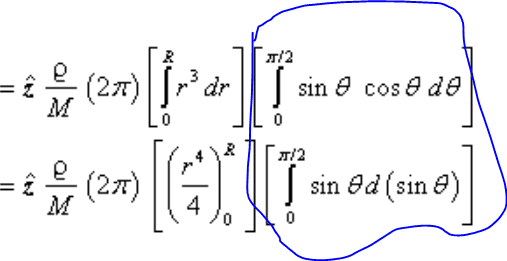
2yukcw1.png

How did these terms (circled in blue) change like that? I've never seen a step like that before..
 
Physics news on Phys.org
Abdul.119 said:
So I was reading a solution of a problem that has to do with integration in polar coordinates, and in one of the steps it did this

2yukcw1.png

How did these terms (circled in blue) change like that? I've never seen a step like that before..
What is the differential of ##\sin \theta##?

If y = f(x), the differential of y is defined as dy = f'(x) dx
 
The substitution rule says
##\int f(x) \, \frac{du}{dx} \, dx = \int f(u(x)) \, du(x)##
Hence, ##\theta = x##, ##\frac{du}{dx} = \cos\theta## and ##u = \sin \theta## gives
##\int f(\theta) \, cos(\theta) \, d\theta = \int f(\theta) \, d(\sin(\theta))##
 
pwsnafu said:
The substitution rule says
##\int f(x) \, \frac{du}{dx} \, dx = \int f(u(x)) \, du(x)##
Hence, ##\theta = x##, ##\frac{du}{dx} = \cos\theta## and ##u = \sin \theta## gives
##\int f(\theta) \, cos(\theta) \, d\theta = \int f(\theta) \, d(\sin(\theta))##

Why didn't they use the regular u-substitution, where u = cos(θ) , and du = -sin(θ) dθ ?
 
u = sin(θ) , and du = cos(θ) dθ avoids the complication of sign change.
 
Abdul.119 said:
Why didn't they use the regular u-substitution, where u = cos(θ) , and du = -sin(θ) dθ ?
I'm not sure why you call that "the regular u-substitution". To integrate something like \int sin(\theta) cos(\theta) d\theta either u= cos(\theta), du= -sin(\theta)d\theta or u= sin(\theta), du= cos(\theta)d\theta will work. And, I suspect that most people would use the latter since, as mathman said, it avoids the negative sign.
 

Similar threads

  • · Replies 4 ·
Replies
4
Views
2K
  • · Replies 3 ·
Replies
3
Views
2K
  • · Replies 11 ·
Replies
11
Views
2K
  • · Replies 5 ·
Replies
5
Views
4K
  • · Replies 5 ·
Replies
5
Views
2K
  • · Replies 4 ·
Replies
4
Views
3K
  • · Replies 4 ·
Replies
4
Views
2K
  • · Replies 2 ·
Replies
2
Views
3K
  • · Replies 1 ·
Replies
1
Views
3K
  • · Replies 1 ·
Replies
1
Views
3K