Confusion Over Hydraulic Gradient, L parameter

Click For Summary
SUMMARY

The discussion clarifies the distinction between two interpretations of the variable L in the hydraulic gradient equation Δh/L. The first interpretation considers L as the parallel distance along the datum, while the second defines L as the length along the pipe, which is the correct approach for calculating the hydraulic gradient in scenarios involving permeable layers. The Dupuit-Forchheimer assumption, which simplifies flow in unconfined aquifers to horizontal, further supports this interpretation. Additionally, the concept of tortuosity is acknowledged, emphasizing that actual flow paths may differ from straight-line measurements.

PREREQUISITES
  • Understanding of hydraulic gradients and their equations
  • Familiarity with groundwater flow concepts
  • Knowledge of the Dupuit-Forchheimer assumption
  • Basic principles of aquifer types, particularly unconfined aquifers
NEXT STEPS
  • Research the Dupuit-Forchheimer assumption in groundwater modeling
  • Study the effects of tortuosity on hydraulic flow paths
  • Explore the characteristics of unconfined aquifers and their behavior
  • Learn about hydraulic gradient calculations in various geological contexts
USEFUL FOR

Hydrologists, civil engineers, environmental scientists, and students studying groundwater flow dynamics will benefit from this discussion.

Typhon4ever
Messages
51
Reaction score
0
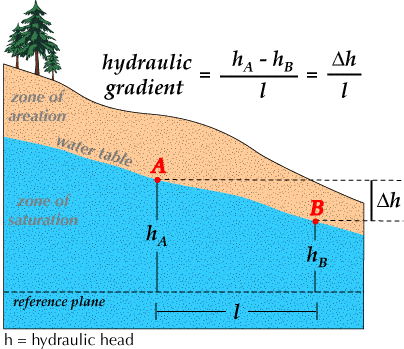
I've come across two different approaches to quantifying what l is in the equation for hydraulic gradient Δh/L. In this first picture L is the parallel distance along the datum across the reference plane
71429c97a14e30ee91d20995d1f506c2.jpg


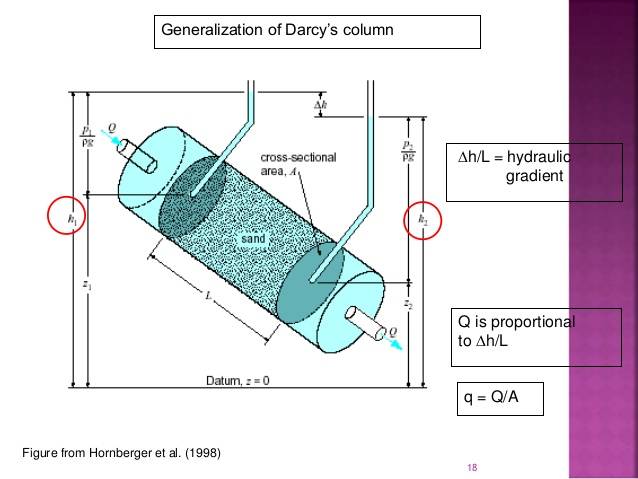
But in this second picture L is the length along the pipe
darcys-law-chezys-law-18-638.jpg


Why are the two L's different? I'm asking because there's a picture in a book of a sloping sand layer sandwiched between clay layers and L is taken to be like in the first image but the idea of a permeable sand layer between two effectively impermeable clay layers looks like the 2nd pipe image.
 
The correct interpretation is that of the second figure: the length to compute the gradient is that "travelled" by the water. After all, the hydraulic gradient is the spatial rate at which head (energy per unit weight of water) is lost or dissipated; basically: how many meters of head are lost per meter of distance travelled?

The first figure shows an unconfined aquifer in which the vertical scale is distorted or exaggerated; in most cases, the slope of unconfined aquifers is very flat, so that if one measures L in the horizontal, the difference with the actual distance traveled is negligible (because cosine of a small angle tends to 1, so that the horizontal distance will be almost equal to the length of the hypotenuse of the triangle).

Indeed, the Dupuit-Forchheimer assumption used to solve many groundwater and well problems assumes that flow is horizontal in unconfined aquifers, neglecting the small vertical component of the flow (by the way, note the irony: Dupuit means "of the well" in French).

Note that I wrote "travelled" between quotation marks above, because the actual distance takes the tortuosity of the flow paths into account, and we are not doing that here: our distances are measured assuming that there are no solid particles continuously deflecting the flow at the small scale.

Hope this helps,

Claudio Meier
 
  • Like
Likes   Reactions: Chestermiller

Similar threads

Replies
0
Views
2K
  • · Replies 35 ·
2
Replies
35
Views
4K
  • · Replies 48 ·
2
Replies
48
Views
5K
  • · Replies 31 ·
2
Replies
31
Views
4K
  • · Replies 25 ·
Replies
25
Views
5K
  • · Replies 3 ·
Replies
3
Views
3K
  • · Replies 2 ·
Replies
2
Views
23K
  • · Replies 1 ·
Replies
1
Views
4K
  • · Replies 8 ·
Replies
8
Views
6K
  • · Replies 1 ·
Replies
1
Views
4K