Conservation of energy question -

Click For Summary

Homework Help Overview

The discussion revolves around a conservation of energy problem involving a cylindrical container of water, focusing on calculating potential and kinetic energy at various stages. The subject area includes concepts from mechanics and energy conservation principles.

Discussion Character

  • Mixed

Approaches and Questions Raised

  • Participants are examining the calculations for potential energy, questioning the mass and height values used in the original poster's work. There are discussions about the average height of the water and its impact on potential energy calculations. Some participants express uncertainty about the accuracy of the answers provided, particularly for parts A, D, and E.

Discussion Status

The discussion is ongoing, with participants seeking clarification on the original poster's calculations and encouraging a more detailed presentation of the work. There is acknowledgment of some correct answers, but also significant questioning of the methodology and assumptions made.

Contextual Notes

Participants note issues with the clarity of the original post, including the presentation of answers and the potential use of book answers rather than original calculations. There is a concern regarding the accuracy of the mass and height values used in the potential energy calculations.

KieronB
Messages
1
Reaction score
0
A cylindrical container of water has a diameter of 7.98 m and a perpendicular height of 2 m. It is filled with water (1000 kg = 1000 l) and placed on top of a 4 m stand. Calculate the:
A) potential energy of the water
B) kinetic energy of 20 kg of water just before it reaches the ground, if the container over flows.
C) velocity when the 20kg reaches the ground.
D) potential energy of the top half of the water.
E) potential energy of the bottom half of the water.

Answers:
A) 4.901 MJ
B) 1176 J ------->I was able to solve this one
C) 10.844 m/s ---->I was able to solve this one aswell
D) 2.696 MJ
E) 2.696 MJ

Thank you :oldsmile:
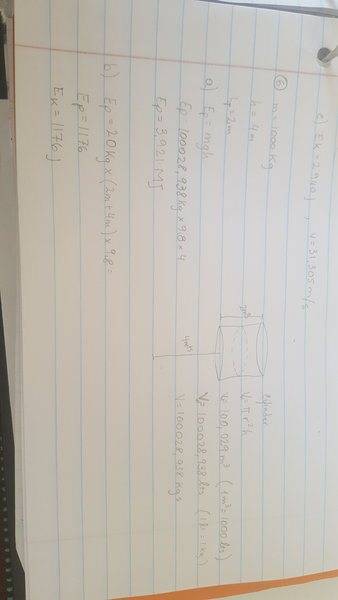
15175833766741676587289.jpg


Attachments

  • 15175833766741676587289.jpg
    15175833766741676587289.jpg
    15.7 KB · Views: 670
Physics news on Phys.org
It is hard to read your work, can you type it out?

Your potential energy seems way off. It looks like you inserted a very large number in for the mass and I'm not sure where that came from. Also, you used 4m as the height of the water. The problem is that much of the water is higher than 4m above the ground. The correct distance will be the average high of the water.

I think part B is ok.

I don't see your work for the following parts.
 
Hello Kieron, :welcome:

Please don't delete the template. See PF guidelines

Also: post your work in detail, not just the answers (or are these the book answers ?)

Then: what is your question ?

@NFuller claims PE 4.9 MJ is way off; I 'think' it's still low :smile: [edit] correct but with too many decimals.

[edit] from you r D and E I'd say they are at the same height. Strange :rolleyes:
 
As others have remarked, the image is too faint, and it is unclear whether the answers listed are your own or from the book.
For A, I agree with the 4.9MJ answer posted, but in the image you seem to have a lower number as a result of using the wrong average height. The working seems to include a mass value something like 100028, but perhaps I am misreading it.
The D answer posted is consistent with the A answer, but E is not. Maybe you looked at the wrong number when typing the post?
 

Similar threads

  • · Replies 4 ·
Replies
4
Views
2K
  • · Replies 5 ·
Replies
5
Views
2K
  • · Replies 5 ·
Replies
5
Views
2K
  • · Replies 7 ·
Replies
7
Views
2K
Replies
55
Views
6K
  • · Replies 6 ·
Replies
6
Views
3K
  • · Replies 4 ·
Replies
4
Views
990
  • · Replies 14 ·
Replies
14
Views
2K
Replies
6
Views
2K
Replies
6
Views
1K
