Conservative force pairs

Join the discussion
Ask a follow-up here, or get your own question answered by working scientists, mathematicians and engineers — people, not an autocomplete.
Real named experts · corrections over time · the nuance an AI answer skips
4 replies · 1K views
Hajarmq
Messages
8
Reaction score
1
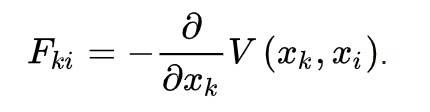
Let F_ki be the force applied by a point mass i on a point mass k. This force depends on the variables x_k and x_i which are the position vectors of respectively k and i (to simplify let´'s consider this in 1 dimension). Suppose this force is conservative. Then, according to my course and wikipedia, it can be written as:
Unbenannt.jpg
My question is: why is the partial derivative with respect to x_k, the coordinate of the point mass the force is applied on? Why not x_i, or both x_i and x_k, since the potential depends on both of them?
 
Last edited by a moderator:
on Phys.org
By definition the force on a particle is, for a conservative force, given as the gradient of a potential wrt. the position of that particle.

If you have a socalled two-body force, the potential for a system of ##N## point particles is given by
$$V(\vec{x}_1,\ldots,\vec{x}_2)=\sum_{j<k} V_{jk}(\vec{x}_j,\vec{x}_k).$$
The force on the ##i##-th particle then is
$$\vec{F}_i=-\vec{\nabla} V(\vec{x}_1,\ldots,\vec{x}_N)=-\sum_{k \neq i} \vec{\nabla}_i V_{ik}(\vec{x}_i,\vec{x}_k).$$
 
vanhees71 said:
By definition the force on a particle is, for a conservative force, given as the gradient of a potential wrt. the position of that particle.

If you have a socalled two-body force, the potential for a system of ##N## point particles is given by
$$V(\vec{x}_1,\ldots,\vec{x}_2)=\sum_{j<k} V_{jk}(\vec{x}_j,\vec{x}_k).$$
The force on the ##i##-th particle then is
$$\vec{F}_i=-\vec{\nabla} V(\vec{x}_1,\ldots,\vec{x}_N)=-\sum_{k \neq i} \vec{\nabla}_i V_{ik}(\vec{x}_i,\vec{x}_k).$$
I think the answer is a bit more subtle. In two-body forces one body is at the "source" (primed) coordinates and the other is at the "field" (unprimed) coordinates. Then one writes,$$V[(\vec{x}_1-\vec{x}'_1),\ldots,(\vec{x}_N-\vec{x}'_N)]=\sum_{j<k} V_{jk}[(\vec{x}_j-\vec x'_j),(\vec{x}_k-\vec x'_k)].$$In order to find the force on the ##i##th particle, derivatives need to be taken with respect to the unprimed field coordinates where the particle is.

In OP's equation ##x_k## is the field coordinate and ##x_i## the source coordinate. If this equation is in OP's course notes and Wikipedia (reference?), the meaning of the coordinates must have been given.
 
Hajarmq said:
why is the partial derivative with respect to x_k, the coordinate of the point mass the force is applied on? Why not x_i, or both x_i and x_k, since the potential depends on both of them?
As mentioned above this is basically how ##V## is defined. To motivate that definition, let’s think about what we want ##V## to do.

We want the potential to tell us the work done on a particle. The work done on a given particle is given by ##\vec F \cdot \Delta\vec x## where ##\vec F## is a force acting on the given particle and ##\Delta\vec x## is the displacement of that particle.

So the work done on a particle is given by the force on that particle and the displacement of that particle. Therefore, the partial derivative in the definition of ##V## should be with respect to the position of the particle that the force is acting on, which is ##x_k##
 
  • Like
Likes   Reactions: Hajarmq
kuruman said:
I think the answer is a bit more subtle. In two-body forces one body is at the "source" (primed) coordinates and the other is at the "field" (unprimed) coordinates. Then one writes,$$V[(\vec{x}_1-\vec{x}'_1),\ldots,(\vec{x}_N-\vec{x}'_N)]=\sum_{j<k} V_{jk}[(\vec{x}_j-\vec x'_j),(\vec{x}_k-\vec x'_k)].$$In order to find the force on the ##i##th particle, derivatives need to be taken with respect to the unprimed field coordinates where the particle is.

In OP's equation ##x_k## is the field coordinate and ##x_i## the source coordinate. If this equation is in OP's course notes and Wikipedia (reference?), the meaning of the coordinates must have been given.
There are ##N## point particles, and the forces in Newtonian mechanics only depend on the positions of these ##N## point particles. What should thus the primed position vectors mean?

Of course you are right. Taking Galilei invariance of Newtonian spacetime into account the two-body forces must be central forces, i.e.,
$$V_{jk}(\vec{x}_j,\vec{x}_k)=V_{jk}(|\vec{x}_j-\vec{x}_k|)$$
due to homogeneity and isotropu of space. That the ##V_{jk}## also don't depend on ##t## is due to time-translation invariance.
 
  • Like
Likes   Reactions: Hajarmq