Consider the lines & find an equation of a plane [Cal III]

  • Thread starter Thread starter BoonBoon
  • Start date Start date
  • Tags Tags
    Lines Plane
Click For Summary
SUMMARY

The discussion centers on finding the intersection point and the equation of a plane containing two given lines in three-dimensional space. The lines are defined by the vector equations r = <2, 3, 0> + t<3, -3, 1> and r = <5, 0, 1> + s<-3, 3, 0>. The intersection point is confirmed to be (5, 0, 1), and the equation of the plane is established as x + y = 5, which is parallel to the z-axis. The confusion arose from misinterpreting the plane's representation in three dimensions.

PREREQUISITES
  • Understanding of vector equations of lines in 3D space
  • Knowledge of plane equations in three dimensions
  • Familiarity with the concept of intersection of lines
  • Basic comprehension of geometric representations in R3
NEXT STEPS
  • Study the derivation of the vector equation of a line in 3D space
  • Learn how to derive the equation of a plane from two intersecting lines
  • Explore the implications of coefficients in plane equations, particularly when they equal zero
  • Investigate the geometric interpretation of planes parallel to axes in three-dimensional space
USEFUL FOR

Students of calculus, particularly those studying multivariable calculus, as well as educators and tutors who assist learners in understanding three-dimensional geometry and vector equations.

BoonBoon
Messages
5
Reaction score
0
Consider the Lines Below:

r
= <2, 3, 0> + t<3, -3, 1>

r = <5, 0, 1> + s<-3, 3, 0>

A.) Find the point at which the given lines intersect.
B.) Find an equation of the plane that contains these lines.

Homework Equations


[/B]
The vector equation of a line is given by r = r0 - tv

The equation of a plane is given by N . (r - r0)

The Attempt at a Solution


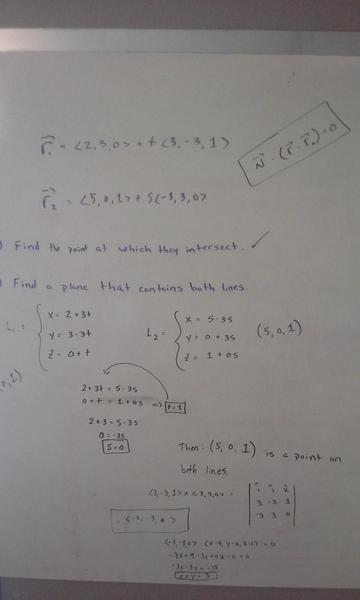
I worked everything to the best of my ability but I ended up getting an equation of a line as opposed to the equation of a plane... Did I do something wrong? Here is a picture of my work:
jtnnCwd.jpg
 
Physics news on Phys.org
BoonBoon said:
Consider the Lines Below:

r
= <2, 3, 0> + t<3, -3, 1>

r = <5, 0, 1> + s<-3, 3, 0>

A.) Find the point at which the given lines intersect.
B.) Find an equation of the plane that contains these lines.

Homework Equations


[/B]
The vector equation of a line is given by r = r0 - tv

The equation of a plane is given by N . (r - r0)

The Attempt at a Solution


I worked everything to the best of my ability but I ended up getting an equation of a line as opposed to the equation of a plane... Did I do something wrong? Here is a picture of my work:

jtnnCwd.jpg
I don't see anything wrong with your work. The two lines intersect at (5, 0, 1) (I checked), and the equation of the plane is indeed x + y = 5. In three dimensions this is a plane.
 
Mark44 said:
I don't see anything wrong with your work. The two lines intersect at (5, 0, 1) (I checked), and the equation of the plane is indeed x + y = 5. In three dimensions this is a plane.

Thank you so much. I think I figured out the error in my way of thinking. For some reason I was thinking of my answer as looking like a cube in R3. But since x + y = 5 is a line in R2, I could just scale the Z value infinitely in either direction in R3, as long as I'm restricted to that line. Thus, I would have a plane. Interesting. Thanks so much for your response!
 
You say " I ended up getting an equation of a line" but that is not true. A line cannot be written as a single equation in 3 dimensions. What you have is a plane in which the coefficient of z happens to be 0. That simply means that the plane is parallel to the z-axis. You can think of it as the line defined by x+ y= 5 in the xy-plane extended parallel to the z-axis.
 
HallsofIvy said:
You say " I ended up getting an equation of a line" but that is not true. A line cannot be written as a single equation in 3 dimensions. What you have is a plane in which the coefficient of z happens to be 0. That simply means that the plane is parallel to the z-axis. You can think of it as the line defined by x+ y= 5 in the xy-plane extended parallel to the z-axis.

Yes, you are absolutely right. Having 0 as the coefficient of Z is what scared me. My professor hadn't covered what that meant very well, so I was confused. Thank you very much for your input.
 
Last edited:

Similar threads

Replies
1
Views
1K
  • · Replies 3 ·
Replies
3
Views
2K
  • · Replies 2 ·
Replies
2
Views
1K
  • · Replies 1 ·
Replies
1
Views
2K
Replies
5
Views
2K
  • · Replies 3 ·
Replies
3
Views
2K
  • · Replies 3 ·
Replies
3
Views
2K
Replies
5
Views
2K
  • · Replies 5 ·
Replies
5
Views
2K
  • · Replies 23 ·
Replies
23
Views
3K