Construction Materials Coursework: Stiffness Calculation Help

Click For Summary

Discussion Overview

The discussion revolves around a question from a Construction Materials coursework related to calculating stiffness in beam bending problems, specifically for simply supported beams with a central load. Participants explore the necessary data and properties required for these calculations, including the role of material properties such as Young's modulus.

Discussion Character

  • Homework-related
  • Technical explanation
  • Debate/contested

Main Points Raised

  • One participant expresses uncertainty about calculating stiffness due to the lack of obtainable data in a hypothetical scenario.
  • Another participant seeks clarification on solving beam bending problems, specifically for a simply supported beam with a central load.
  • Some participants mention having previously calculated stiffness for existing steel and timber beams using maximum load and deflection data from testing.
  • Concerns are raised about the need for Young's modulus values for steel and timber, with a suggestion that these values are readily available in textbooks or online.
  • It is noted that the mechanical properties of wood can vary significantly by species and moisture content, complicating the calculations.
  • One participant points out that wood is an orthotropic material, which affects how load application influences strength properties.
  • A suggestion is made to use rough representative values for material properties to facilitate calculations, with an expectation that stiffness will differ greatly between steel and timber beams.

Areas of Agreement / Disagreement

Participants do not reach a consensus on the best approach to the problem, and multiple competing views regarding the necessary data and methods for calculating stiffness remain evident.

Contextual Notes

Limitations include the variability of wood properties based on species and moisture content, as well as the orthotropic nature of wood affecting strength properties. There is also uncertainty regarding the availability of specific data needed for calculations.

Kieran Mclean
Messages
2
Reaction score
0
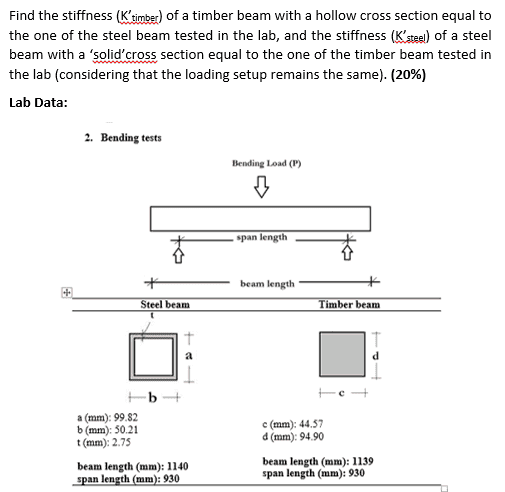
Stuck on a question in my Construction Materials coursework. Not asking for anyone to solve it for me but would be grateful if someone could point me in the right direction:
Untitled.png


As far as i was aware, stiffness = force/deflection, data which is not obtainable in a hypothetical circumstance.
 
Physics news on Phys.org
Kieran Mclean said:
Stuck on a question in my Construction Materials coursework. Not asking for anyone to solve it for me but would be grateful if someone could point me in the right direction:

View attachment 94170

As far as i was aware, stiffness = force/deflection, data which is not obtainable in a hypothetical circumstance.
Do you know how to solve a beam bending problem for a beam that is simply supported with a load applied at the middle of the beam?
 
Chestermiller said:
Do you know how to solve a beam bending problem for a beam that is simply supported with a load applied at the middle of the beam?
Regarding stiffness,yes, I have already calculated the stiffness of the existing steel and timber beams for previous questions, using further data acquired from testing (max load, max deflection)
 
Kieran Mclean said:
Regarding stiffness,yes, I have already calculated the stiffness of the existing steel and timber beams for previous questions, using further data acquired from testing (max load, max deflection)
Are you saying that you need to know the Young's modulus for steel and timber to solve this problem, or is there something else that is missing? Of course Young's modulus for these materials is readily available on line or in your textbook.

Chet
 
Chestermiller said:
Are you saying that you need to know the Young's modulus for steel and timber to solve this problem, or is there something else that is missing? Of course Young's modulus for these materials is readily available on line or in your textbook.

Chet
To be sure, the mechanical properties of wood vary by species, moisture content, etc. Simply specifying that one of the beams is made of "timber" doesn't really help.
Wood is also an orthotropic material, unlike steel, and the manner in which the load is applied affects which strength properties should be used.

This article describes the mechanical properties of wood:

http://www.fpl.fs.fed.us/documnts/fplgtr/fplgtr113/ch04.pdf
 
SteamKing said:
To be sure, the mechanical properties of wood vary by species, moisture content, etc. Simply specifying that one of the beams is made of "timber" doesn't really help.
Wood is also an orthotropic material, unlike steel, and the manner in which the load is applied affects which strength properties should be used.

This article describes the mechanical properties of wood:

http://www.fpl.fs.fed.us/documnts/fplgtr/fplgtr113/ch04.pdf
Thanks SteamKing. I knew these things. But, if I were in the OP's situation, I would choose some very rough representative values of the properties to make the calculations (maybe as high a value as I could find for wood, and as low a value as I could fine for steel). I'm guessing that the stiffnesses are going to have to come out vastly different between the steel beam and the wooden beams.
 

Similar threads

  • · Replies 0 ·
Replies
0
Views
2K
  • · Replies 2 ·
Replies
2
Views
3K
  • · Replies 1 ·
Replies
1
Views
2K
  • · Replies 3 ·
Replies
3
Views
2K
Replies
2
Views
5K
  • · Replies 9 ·
Replies
9
Views
2K
  • · Replies 8 ·
Replies
8
Views
3K
Replies
11
Views
3K
  • · Replies 9 ·
Replies
9
Views
2K
Replies
3
Views
2K