PainterGuy
- 938
- 73
Hi,
It said that constructive interference has taken place between two waves if the combined amplitude for two waves at a certain time is more than their individual amplitudes. Likewise, in case of destructive interference, the combined amplitude is less than the individual amplitudes of either waves.
Moreover, when total or complete constructive interference takes places between two waves, the combined amplitude is sum of individual amplitudes and the waves are totally in phase. For complete or total destructive interference, the combined amplitude is zero and the waves are totally out of phase with each other.
I hope that what I said above is correct.
Question 1:
I'm sure any two waves would always interfere with each other; sometimes constructively and other times destructively. But would they always happen to interfere totally destructively or constructively?
Question 2:
This one is related to Question 1.
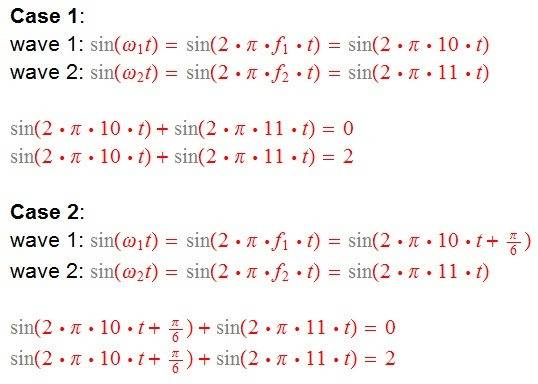
I'm also trying to find a way to see at what time total destructive and constructive interference takes place. In Case 1 only frequencies are different and for Case 2 in addition to frequencies being different wave #1 is also 30 degrees phase shifted.
How do I proceed?
Thank you for the help.
It said that constructive interference has taken place between two waves if the combined amplitude for two waves at a certain time is more than their individual amplitudes. Likewise, in case of destructive interference, the combined amplitude is less than the individual amplitudes of either waves.
Moreover, when total or complete constructive interference takes places between two waves, the combined amplitude is sum of individual amplitudes and the waves are totally in phase. For complete or total destructive interference, the combined amplitude is zero and the waves are totally out of phase with each other.
I hope that what I said above is correct.
Question 1:
I'm sure any two waves would always interfere with each other; sometimes constructively and other times destructively. But would they always happen to interfere totally destructively or constructively?
Question 2:
This one is related to Question 1.
I'm also trying to find a way to see at what time total destructive and constructive interference takes place. In Case 1 only frequencies are different and for Case 2 in addition to frequencies being different wave #1 is also 30 degrees phase shifted.
How do I proceed?
Thank you for the help.
