Converge or Diverge? Proving I & II Limits

  • Context:
  • Thread starter Thread starter Umar
  • Start date Start date
Join the discussion
Ask a follow-up here, or get your own question answered by working scientists, mathematicians and engineers — people, not an autocomplete.
Real named experts · corrections over time · the nuance an AI answer skips
2 replies · 2K views
Umar
Messages
36
Reaction score
0
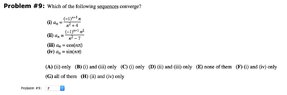
So I have this question here from one of my assignments. I got the right answer, which is F, but I got it through eliminating other options (cos(n\pi)) diverges while sin(n\pi) obviously converges. I was thinking the only option would be IV, but the options for the answers included I and IV, or II and IV. The thing is I'm not sure how you would prove either of those to be convergent or divergent. For instance, in both of the numerators, there is (-1)^(n+1). This gives you [1,-1,1,-1...] meaning it's limit D.N.E (does not exist). The denominators are similar but different slightly. So how exactly would you go about showing that option I converges and II diverges (ie. lim as n --> infinity of those sequences)

Your help is greatly appreciated! :)

Attached is the link to the picture of the question:

Imgur: The most awesome images on the Internet

View attachment 6354
 

Attachments
  • zlOZFCO.jpg
    zlOZFCO.jpg
    28.4 KB · Views: 146
Last edited by a moderator:
on Phys.org
Umar said:
So I have this question here from one of my assignments. I got the right answer, which is F, but I got it through eliminating other options (cos(n\pi)) diverges while sin(n\pi) obviously converges. I was thinking the only option would be IV, but the options for the answers included I and IV, or II and IV. The thing is I'm not sure how you would prove either of those to be convergent or divergent. For instance, in both of the numerators, there is (-1)^(n+1). This gives you [1,-1,1,-1...] meaning it's limit D.N.E (does not exist). The denominators are similar but different slightly. So how exactly would you go about showing that option I converges and II diverges (ie. lim as n --> infinity of those sequences)

Your help is greatly appreciated! :)

Attached is the link to the picture of the question:

Imgur: The most awesome images on the Internet

Hi Umar! ;)

Typically we try to rewrite a fraction so that it becomes clear whether it converges or not.

For (i):
$$a_n = \frac{(-1)^{n+1}n}{n^2+4} = \frac{(-1)^{n+1}}{n+\frac 4 n} \to \frac{\pm 1}{\infty + 4\cdot 0} = 0$$
So $a_n$ converges.

For (ii):
$$a_n = \frac{(-1)^{n+1}n^2}{n^2-7} = \frac{(-1)^{n+1}}{1-\frac 7 {n^2}} \to \frac{\pm 1}{1 - 7\cdot 0} = \pm 1$$
So $a_n$ diverges.
 
I like Serena said:
Hi Umar! ;)

Typically we try to rewrite a fraction so that it becomes clear whether it converges or not.

For (i):
$$a_n = \frac{(-1)^{n+1}n}{n^2+4} = \frac{(-1)^{n+1}}{n+\frac 4 n} \to \frac{\pm 1}{\infty + 4\cdot 0} = 0$$
So $a_n$ converges.

For (ii):
$$a_n = \frac{(-1)^{n+1}n^2}{n^2-7} = \frac{(-1)^{n+1}}{1-\frac 7 {n^2}} \to \frac{\pm 1}{1 - 7\cdot 0} = \pm 1$$
So $a_n$ diverges.

Hey! Sorry for not replying earlier but thank you so much for your help!