Cooling Hot Water: Find a Solution in 10-15 mins

Click For Summary
SUMMARY

The discussion centers on cooling 25 liters of water from 50°C to 30°C within 10-15 minutes using a water chiller. Initial attempts with a standard water chiller unit failed due to inadequate control over the water flow across the cooling coils. Experts recommend enhancing the cooling setup by either slowing the water flow or increasing the surface area of the cooling coils. A proposed solution involves replacing the immersed coil heat exchanger with condenser fins and spraying water over them to improve heat transfer efficiency.

PREREQUISITES
  • Understanding of heat transfer principles
  • Familiarity with water chiller specifications and performance metrics
  • Knowledge of fluid dynamics and flow control
  • Experience with experimental setups in thermal management
NEXT STEPS
  • Research advanced cooling techniques using condenser fins
  • Learn about the design and operation of heat exchangers
  • Investigate the specifications and performance of various water chiller units
  • Explore methods for controlling fluid flow in cooling systems
USEFUL FOR

Engineers, thermal management specialists, and hobbyists involved in water cooling projects or seeking to optimize heat exchange processes.

Assim
Messages
3
Reaction score
1
I have a project which i need to cool down certain quantity of hot water.

I need to cool down water of around 25 litres at 50 Degree celsius to 30 Degree celsius, Static water, not flowing. (or incoming 50 Degrees - Outgoing 30 Degrees with approx 1.5 gallons per minute flow rate)
time available to cool down the water -10 to 15 mins

I imagined I will be able to cool down the water with a regular water chiller unit with compressor and immersed coil arrangement (pics below). I conducted that experiment but it failed. The cooling doesn't works as expected

I am an armature with water cooling and such physics.
Cold anybody suggest me some method for the above problem.

Thanks

my experiment arrangement
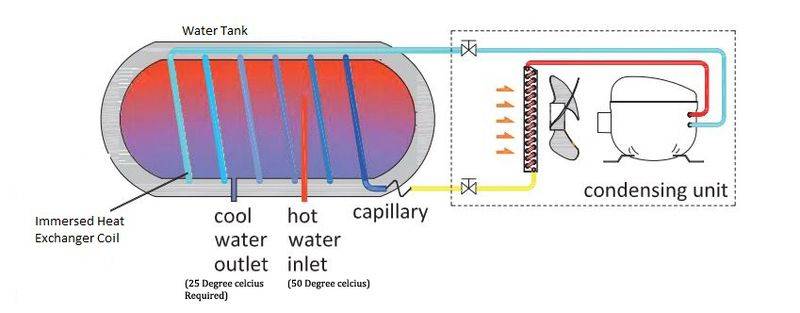
2637vcl.jpg
 
Last edited by a moderator:
Physics news on Phys.org
A heat exchanger needs a controlled flow of fluid past the low temp surfaces. The way you have this drawn, it looks like you pump water in and let it flow out of its own volition without taking any pre-determined path over the chilling coils. This won't provide a very predictable cooling for the water.

If you are controlling the flow over the coils, you either need more time for the water to dump heat (slow down the flow or add length to the path against the coils), or you need to lower the temp of the coils.
 
  • Like
Likes   Reactions: bsheikho
I calculate that the chiller has to remove about 2.1MJ of energy in 10 mins which works out at about 3.5KW.

What do you mean by a "regular water chiller" ?

PS: I can only see one of the three images you posted.
 
Last edited:
@Grinkle - thank you very much for the info. i was reading similar info about the chilling towers and I am trying to do an experimental setup to make the liquid flow over a cooling surface.
for the experiment, How about replacing the immersed coil heat exchanger with condensor fins and spray water to it at top and allow water to flow down.
see the figure below. do you think this is a good idea ?

need suggestions please. or if you have any better idea kindly help

2yux3io.jpg


@CWatters : by Regular Chiller i meant the generic water dispenser chiller unit used for drinking water. Those have the coil immersed arrangement. but they only cool the water at normal temp. in my case its hot water.
also there is only 1 pic. no 3 pictures.
 
What's the spec on the cooler? Eg does it have the power and COP to shift 3.5kW?
 
That looks a bit more controllable to me. Something else you might consider that is still pretty simple is laying the cooling coils flat on a water-right surface and letting water run over the top of it, controlling the flow rate by changing the incline of the cooling coil.

One main goal of your design should be to be able to control and adjust the flow rate. IMO its not likely that you will calculate your way to exactly what you want, you are going to have to assess and adjust.
 

Similar threads

  • · Replies 66 ·
3
Replies
66
Views
4K
  • · Replies 5 ·
Replies
5
Views
8K
Replies
9
Views
2K
  • · Replies 2 ·
Replies
2
Views
2K
Replies
17
Views
3K
  • · Replies 9 ·
Replies
9
Views
3K
  • · Replies 3 ·
Replies
3
Views
3K
  • · Replies 9 ·
Replies
9
Views
3K
  • · Replies 5 ·
Replies
5
Views
3K
  • · Replies 1 ·
Replies
1
Views
2K