Coriolis force in rotating space station

Click For Summary

Discussion Overview

The discussion centers around the Coriolis force in the context of a car driving on a rotating space station. Participants explore the implications of rotational motion on forces acting on the car, particularly focusing on the conditions under which the normal force becomes zero.

Discussion Character

  • Technical explanation
  • Debate/contested
  • Mathematical reasoning

Main Points Raised

  • One participant calculates the Coriolis force and centrifugal force acting on a car driving on a rotating space station, suggesting that the normal force becomes zero when the centrifugal force equals the Coriolis force.
  • Another participant argues that the rotational motion of the car must be accounted for, stating that in a rotating reference frame, the normal force cannot be zero if the car is moving in a circle, as it requires a net centripetal force.
  • The second participant emphasizes the importance of consistency in reference frames when analyzing the forces involved.
  • A third participant expresses appreciation for the clarification provided in the discussion.

Areas of Agreement / Disagreement

Participants do not reach a consensus; there are competing views regarding the conditions under which the normal force can be zero and the role of reference frames in the analysis.

Contextual Notes

The discussion highlights potential limitations in the initial calculations, particularly regarding the assumptions made about the reference frames and the dynamics of the car's motion on the rotating station.

f todd baker
Messages
61
Reaction score
22
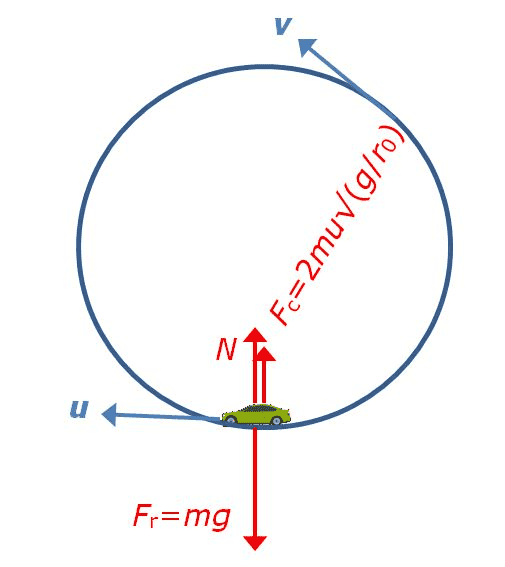
There is a car driving with speed u opposite the direction of the rotation of the space station. ω=√(g/R) so artificial Earth gravity at R. Resulting tangential speed of station is v=√(gR) and centrifugal force is therefore mg radially out. Coriolis force is 2muxω radially in, magnitude 2mu√(g/R). The normal force thus becomes zero when centrifugal force magnitude = coriolis force magnitude or u=½v. My gut tells me it should be u=v. Is this just a case of coriolis force is not always intuitive?
upload_2016-4-28_15-53-14.png
 
Physics news on Phys.org
You forgot to account for the rotational motion of the car in the rotating reference frame. Bear with me...

The trick is to be careful to do all your maths in one reference frame at a time.

You want to know how fast the car has to go around the station for the normal force at the wheels to be zero.

Take the situation that the car was never spun up with the station in the first place

... in the inertial frame
- there is no normal force, no gravity, no initial speed - that's easy: it stays put.

... in the rotating frame
(Since the normal force is a real force, it will still be the same value (zero) in the rotating frame: which is the condition you want to investigate.)
- the car is acted on by (pseudo)gravity (centrifugal effect) ##F_{pg}## yet it goes in a circle at tangential speed ##v## (which means your intuition is correct): so there must be a net centripetal force ##F_{c}## too. ##F_{c} = F_{cor}-F_{pg}## ... you should be able to work it from there.

The situation you calculated, the car still goes in a circle in the rotating frame, so the normal force cannot be zero - with coriolis and centrifugal forces cancelling, the Normal force is required to provide the centripetal acceleration.

Also see:
https://en.wikipedia.org/wiki/Centrifugal_force#An_equatorial_railway
 
  • Like
Likes   Reactions: f todd baker
Beautiful! Thank you!
 

Similar threads

  • · Replies 53 ·
2
Replies
53
Views
7K
  • · Replies 28 ·
Replies
28
Views
6K
  • · Replies 4 ·
Replies
4
Views
1K
  • · Replies 10 ·
Replies
10
Views
2K
  • · Replies 1 ·
Replies
1
Views
2K
  • · Replies 8 ·
Replies
8
Views
5K
  • · Replies 14 ·
Replies
14
Views
4K
  • · Replies 1 ·
Replies
1
Views
2K
  • · Replies 10 ·
Replies
10
Views
7K
  • · Replies 3 ·
Replies
3
Views
1K