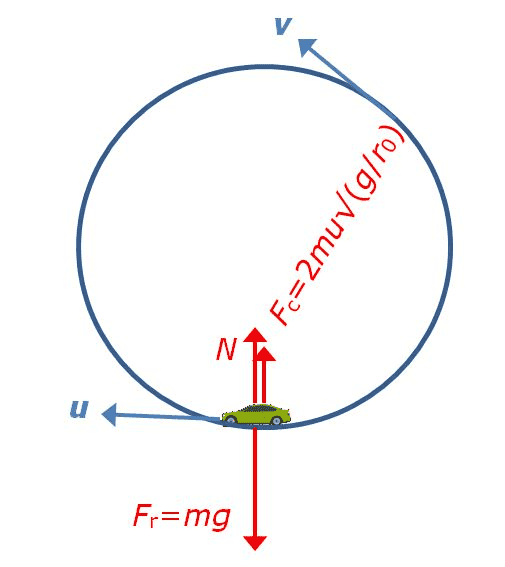
You forgot to account for the rotational motion of the car in the rotating reference frame. Bear with me...
The trick is to be careful to do all your maths in one reference frame at a time.
You want to know how fast the car has to go around the station for the normal force at the wheels to be zero.
Take the situation that the car was never spun up with the station in the first place
... in the inertial frame
- there is no normal force, no gravity, no initial speed - that's easy: it stays put.
... in the rotating frame
(Since the normal force is a real force, it will still be the same value (zero) in the rotating frame: which is the condition you want to investigate.)
- the car is acted on by (pseudo)gravity (centrifugal effect) ##F_{pg}## yet it goes in a circle at tangential speed ##v## (which means your intuition is correct): so there must be a net centripetal force ##F_{c}## too. ##F_{c} = F_{cor}-F_{pg}## ... you should be able to work it from there.
The situation you calculated, the car still goes in a circle in the rotating frame, so the normal force cannot be zero - with coriolis and centrifugal forces cancelling, the Normal force is required to provide the centripetal acceleration.
Also see:
https://en.wikipedia.org/wiki/Centrifugal_force#An_equatorial_railway