Correcting Integration of tan^5x: Differentiating and Verifying the Solution

  • Thread starter Thread starter youmei0426
  • Start date Start date
  • Tags Tags
    Integration
Click For Summary
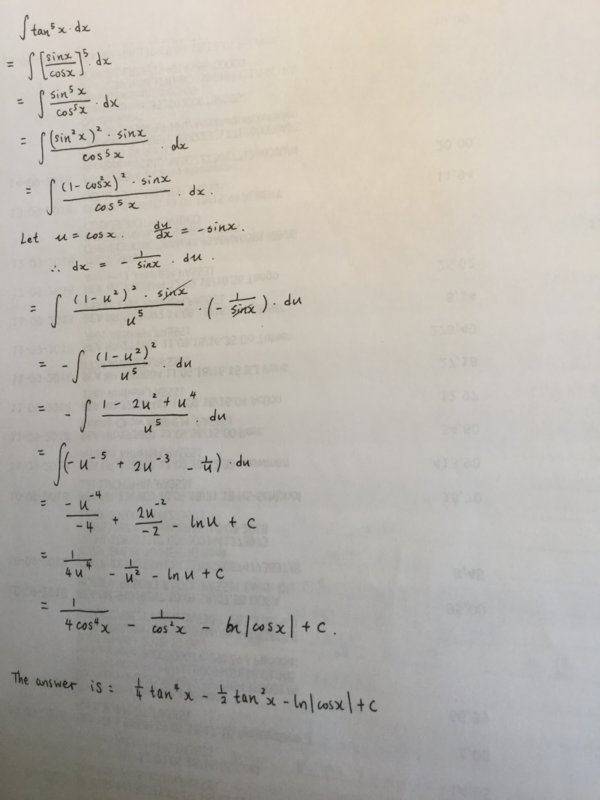
The discussion focuses on correcting the integration of tan^5x and verifying the solution through differentiation. The original poster presented their working out and the correct answer, seeking clarification on their method. Responses confirm that the poster's answer is indeed correct, differing only by a constant when using the identity sec^2(x) = tan^2(x) + 1. The verification process involves differentiating the answer to ensure it matches the original integrand. Overall, the conversation emphasizes the importance of understanding integration methods and verification techniques.
youmei0426
Messages
18
Reaction score
0
Homework Statement
find the integration of (tanx)^5
Relevant Equations
-
This is my working out, and I also included the correct answer in the last line. The answer used a different method, however, what did I do wrong with my method? Thanks for the help!
241797
 

Attachments

  • 1555173603524.png
    1555173603524.png
    2.3 KB · Views: 320
Physics news on Phys.org
##1 = \cos^2(x) + \sin^2(x)##
 
youmei0426 said:
This is my working out, and I also included the correct answer in the last line. The answer used a different method, however, what did I do wrong with my method?
Your answer is also correct. You can verify that your answer is correct by differentiating it, which should result in the original integrand.

You should write your answer as ##\frac 1 4 \sec^4(x) - \sec^2(x) - \ln|\cos(x)| + C##
If you use the identity ##\sec^2(x) = \tan^2(x) + 1## on your answer, you should see that your answer and the posted answer differ only by a constant.
 
Mark44 said:
Your answer is also correct. You can verify that your answer is correct by differentiating it, which should result in the original integrand.

You should write your answer as ##\frac 1 4 \sec^4(x) - \sec^2(x) - \ln|\cos(x)| + C##
If you use the identity ##\sec^2(x) = \tan^2(x) + 1## on your answer, you should see that your answer and the posted answer differ only by a constant.
Aah i see now, thanks a lot!
 
Question: A clock's minute hand has length 4 and its hour hand has length 3. What is the distance between the tips at the moment when it is increasing most rapidly?(Putnam Exam Question) Answer: Making assumption that both the hands moves at constant angular velocities, the answer is ## \sqrt{7} .## But don't you think this assumption is somewhat doubtful and wrong?

Similar threads

  • · Replies 10 ·
Replies
10
Views
2K
  • · Replies 9 ·
Replies
9
Views
1K
  • · Replies 4 ·
Replies
4
Views
1K
Replies
9
Views
2K
Replies
11
Views
2K
  • · Replies 7 ·
Replies
7
Views
2K
  • · Replies 2 ·
Replies
2
Views
1K
  • · Replies 8 ·
Replies
8
Views
1K
Replies
2
Views
1K
  • · Replies 19 ·
Replies
19
Views
2K