Coupling Magnetic Fields: Does Orientation Change Strength?

Click For Summary

Discussion Overview

The discussion centers around the coupling of magnetic fields in the context of a tool holder designed for a drill press, specifically examining how the orientation of magnets affects their holding strength when attached to a steel surface. Participants explore various configurations and theoretical implications related to magnet placement and orientation.

Discussion Character

  • Exploratory
  • Technical explanation
  • Debate/contested

Main Points Raised

  • One participant inquires whether placing two magnets in the same orientation (N-S and N-S or S-N and S-N) is stronger than placing them in opposite orientations (one N-S and the other S-N) when attached to iron.
  • Another participant suggests that the relative arrangement of the magnets is crucial and questions whether both sides of the bar should be magnetic.
  • There is a proposal that the strongest magnetic force would occur with a closed magnetic path, suggesting the addition of a steel backing to enhance the holding force.
  • Some participants discuss the practicality of adding a steel sheet or bar to the setup, weighing the benefits against the additional work required.
  • One participant mentions that while the orientation may have some effect, the magnetic return paths are primarily in air when the magnets are spaced apart, indicating limited impact on strength.
  • Another participant suggests testing the magnets' strength by comparing their attachment directly to iron in different orientations.

Areas of Agreement / Disagreement

Participants express differing views on the impact of magnet orientation on holding strength, with no consensus reached on the optimal configuration. Some believe that opposite orientations may provide slightly more pull, while others argue that the effect is minimal without a closed magnetic path.

Contextual Notes

Participants acknowledge that the effectiveness of the magnetic coupling may depend on additional factors such as the presence of a steel backing and the specific arrangement of the magnets, but these aspects remain unresolved in the discussion.

RichFoster
Messages
16
Reaction score
2
TL;DR
Multiple magnets in close proximity. Magnetic fields combine?
Magnetic fields coupling question.

I had to make a small tool holder for my drill press, it hangs on side of press using N52 cylinder magnets.

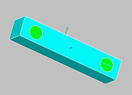
The holder is 4" long x 3/4 x 3/4" AL bar. With a spacing of 3", two 1/2" holes are bored to accept the 1/2 x 1/2 N52's, which will be epoxied in. I now have two options for inserting the magnets into the AL bar. I can place them in same orientation, N-S and N-S (or S-N S-N, etc), or, one N-S and the other S-N. Question is, does placing them into the AL bar as N-S and S-N make them hold stronger onto steel/iron?
 
Physics news on Phys.org
Last edited:
Sure, pic attached. Very simple.
Only one side holds onto the press, the exposed end of the magnets, etc. The bore is only 1/2" deep in a 3/4" AL bar, etc.

But see, I can orient the magnets in same polar direction, or have one flipped. Does having one magnet N and one magnet S attached to iron make the holding force stronger, vs two N's or two S's stuck to the iron??
 

Attachments

  • bar.png
    bar.png
    11.7 KB · Views: 153
RichFoster said:
Summary:: Multiple magnets in close proximity. Magnetic fields combine?

I had to make a small tool holder for my drill press, it hangs on side of press using N52 cylinder magnets.
Sorry, even with the drawing, I'm not understanding what you want to do. Do you just want to stick the Al bar to the side of the Drill Press? Is the Al bar the tool? Or is the Al bar just a mechanical support for the magnets that you will stick other tools to?
 
Forget the "tool" part, I just want to stick this 3/4 x 3/4 AL bar to a hunk of flat iron. Two magnets are in the AL bar as the pic shows.

Which orientation of the two magnets creates more holding force of this bar to the iron?
 
RichFoster said:
Forget the "tool" part, I just want to stick this 3/4 x 3/4 AL bar to a hunk of flat iron. Two magnets are in the AL bar as the pic shows.

Which orientation of the two magnets creates more holding force of this bar to the iron?
Strongest magnetic force is generated when you have a closed magnetic path. So the strongest would be if you could laminate a steel sheet/bar on the back of the Al bar and have reversed orientation of the two cylindrical magnets. Can that work?
 
  • Like
Likes   Reactions: DaveE
I could add steel over my AL bar (over the magnets?? you mean on the opposite side?), but that's more work. And... I don't need "more" force, just asking if flipping the polarity of the two (relative to each other) makes them pull to the iron with more force?

As-is in my pic, it's basically just two magnet ends sticking to the iron. If one stuck as S-iron and the other N-iron, 3" apart from one another, that makes it harder to pull a magnet off? Isn't this the same as adding a steel bar over the magnets?
 
RichFoster said:
I could add steel over my AL bar (over the magnets?? you mean on the opposite side?), but that's more work. And... I don't need "more" force
Yes, to get the most force from your two cylindrical magnets, you would make the holes in the Al bar go all the way through, and put a somewhat thinner steel bar on the backside. You would then put the 2 magnets in their holes with opposite poles sticking out. When you stick that to your metal Drill Press (or whatever), that forms a closed magnetic path.

But if you don't need that extra sticking force, then it doesn't matter much which way you orient the two magnets 3" apart. The magnetic return paths are mostly in the air for each magnet.

EDIT -- You might still get slightly more pull with the two magnets in the Al bar (but without any steel return backing bar) in opposite orientations, but I think it won't be much more.

I did a Google Images search for images of a cylindrical magnet stuck to a steel surface, and actually found an old PhysicsForums thread!

https://www.physicsforums.com/threads/mounting-fire-smoke-alarms-with-magnets.982023/

1630613306208.png
 
Ahhhh. TY for the link.

Edit (for your edit): I did place them opposite. With the info you provided I can always add a iron backer if needed, although there will still be a ~1/4" gap between magnet end and iron backer plate. These 1/2 x 1/2 N52's are decently strong w/o making the horseshoe.

For clarity, this AL bar has various threadings & holes in it so I can attach other tool items.

TY for the help.
 
Last edited:
  • Like
Likes   Reactions: berkeman
  • #10
Since the cylinders are simple bar magnets, you could drill the bar at the edge from the side. Then the cylinders would stick on their side to the iron which would better close the magnetic field. You can test that without the aluminium, just stick a cylinder on end or on side and compare.

Alternatively, drill the hole over-size so you can mount the cylinder magnet in a steel sleeve with clearance at one end only. That would make a coaxial circular pole with a opposite pole at the centre.

Take a look at welding clamp magnets to see how the magnetic circuit is closed.
 

Similar threads

  • · Replies 1 ·
Replies
1
Views
1K
  • · Replies 22 ·
Replies
22
Views
2K
  • · Replies 15 ·
Replies
15
Views
3K
  • · Replies 11 ·
Replies
11
Views
3K
  • · Replies 5 ·
Replies
5
Views
2K
  • · Replies 1 ·
Replies
1
Views
1K
  • · Replies 5 ·
Replies
5
Views
3K
  • · Replies 2 ·
Replies
2
Views
3K
  • · Replies 42 ·
2
Replies
42
Views
3K
  • · Replies 7 ·
Replies
7
Views
3K