Curl of the curl of E or B field

  • Context: Graduate 
  • Thread starter Thread starter DoobleD
  • Start date Start date
  • Tags Tags
    B field Curl Field
Click For Summary

Discussion Overview

The discussion revolves around the mathematical derivation of the electromagnetic wave equation from Maxwell's equations, specifically focusing on the rationale behind taking the curl of the curl of the electric (E) and magnetic (B) fields. Participants explore the implications of this operation and its necessity in deriving wave equations.

Discussion Character

  • Technical explanation
  • Conceptual clarification
  • Debate/contested
  • Mathematical reasoning

Main Points Raised

  • One participant questions the justification for taking the curl of the curl of the fields, seeking a deeper understanding beyond it being a mathematical operation.
  • Another participant suggests that the analysis is valid regardless of motivation, referring to the use of an ansatz as an accepted mathematical approach.
  • It is noted that to derive a wave equation, an additional derivative is required, and for a vector wave equation, a vector operator like curl is appropriate.
  • Participants discuss the coupling of the curl equations in Maxwell's equations, suggesting that decoupling them could lead to second-order partial differential equations for each field.
  • A specific example involving the motion of a charged particle in a magnetic field is provided to illustrate the process of decoupling first-order coupled differential equations.
  • One participant expresses a desire to combine Maxwell's equations into a single equation with one unknown, indicating an interest in formalizing this idea.

Areas of Agreement / Disagreement

Participants express varying levels of agreement on the validity of the mathematical operations discussed, but there is no consensus on the deeper motivations or implications of taking the curl of the curl of the fields. The discussion remains exploratory with multiple viewpoints presented.

Contextual Notes

Participants acknowledge the complexity of the operations involved and the need for further clarification on the motivations behind these mathematical steps. There are references to the necessity of additional derivatives and vector operators in the context of wave equations.

DoobleD
Messages
259
Reaction score
20
A modern standard way of deriving the EM wave equation from Maxwell's equations seems to be by taking the curl of curl of E and B field respectively, and use some vector identity. See for instance on wikipedia.

So, I have a basic understanding of the curl of a vector field. Defined as the closed loop line integral divided by the infinitesimal area it encloses, curl is a vector field itself, offering some "rotation related" information of the vector field from which it is derived.

For a velocity field, the curl of the field at a point would be proportional to the field angular velocity at this point. For a force field, it would be proportional to the angular acceleration of the field at this point.

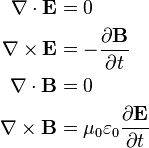
So far so good. Now, what means taking the curl of the curl of a force field ? Why is this justified when deriving EM waves ? Let's say you never looked at the EM wave equation derivation, and you just know what the curl of a field is. You stare at Maxwell's equation in their differential form, in vacuum.
70176e1329230d639c3012b1cbfbd0fb.png


Why would you take the curl of the curl of the fields ? What's the reason behind that move ? Can't just be a random idea.

The only logical interpretation I can see is that the curl of the curl of say the E field, is the rate at which the angular acceleration of the field changes at the given point. But that doesn't tell me why one would be interested with that.
 
Physics news on Phys.org
DoobleD said:
Why would you take the curl of the curl of the fields ? What's the reason behind that move ? Can't just be a random idea.
Why can't it just be a random idea? Regardless of the motivation, the analysis is valid.

Often they call this an ansatz, which is basically an educated guess. It is a standard and accepted approach to math.
 
DaleSpam said:
Why can't it just be a random idea? Regardless of the motivation, the analysis is valid.

Often they call this an ansatz, which is basically an educated guess. It is a standard and accepted approach to math.

Well that's true it can actually be a random try. I just thought there was a particular reason or clue I wasn't aware of. Thanks for answering.
 
It can be random, but in this case it's not entirely random. If you want a wave equation, you need another derivative. If you want a vector wave equation, you need a vector operator. So curl is a good starting point.
 
Vanadium 50 said:
If you want a wave equation, you need another derivative. If you want a vector wave equation, you need a vector operator.

Makes sense.
 
The two curl equations in Maxwell equations are coupled first order partial differential equations. So you can wonder if we can decouple them and write second order PDEs for each of the fields, by using the standard method of differentiating one of them again and then substituting from the other. For a more elementary example, for a charged particle in a magnetic field, moving in the xy plane, with the magnetic field along the z-axis:

dv/dt = (q/m) (v x B)

This is two first order coupled differential equations:

dvx/dt = (q/m) vy B (1)
dvy/dt = - (q/m) vxB (2)

To decouple these, differentiate (1) again wrt t, giving the first derivative of vy on the right. Now substitute for this from (2), and that gives you a de-coupled second order differential equ. for vx.
 
  • Like
Likes   Reactions: EmilyRuck
Chandra Prayaga said:
The two curl equations in Maxwell equations are coupled first order partial differential equations. So you can wonder if we can decouple them and write second order PDEs for each of the fields, by using the standard method of differentiating one of them again and then substituting from the other. For a more elementary example, for a charged particle in a magnetic field, moving in the xy plane, with the magnetic field along the z-axis:

dv/dt = (q/m) (v x B)

This is two first order coupled differential equations:

dvx/dt = (q/m) vy B (1)
dvy/dt = - (q/m) vxB (2)

To decouple these, differentiate (1) again wrt t, giving the first derivative of vy on the right. Now substitute for this from (2), and that gives you a de-coupled second order differential equ. for vx.

Nice! At some point I was thinking one could maybe think using the curl of curl in order to "combine" Maxwell's equations to get equations with a single unknown (E or B). But I couldn't express this idea with enough formalism. You did just that, thank you. :D
 
  • Like
Likes   Reactions: EmilyRuck

Similar threads

  • · Replies 5 ·
Replies
5
Views
2K
  • · Replies 54 ·
2
Replies
54
Views
4K
  • · Replies 4 ·
Replies
4
Views
3K
  • · Replies 1 ·
Replies
1
Views
2K
  • · Replies 2 ·
Replies
2
Views
1K
  • · Replies 5 ·
Replies
5
Views
2K
  • · Replies 1 ·
Replies
1
Views
1K
  • · Replies 5 ·
Replies
5
Views
2K
  • · Replies 4 ·
Replies
4
Views
4K
  • · Replies 8 ·
Replies
8
Views
5K