Current Divider Circuit (Find a Resistance)

Join the discussion
Ask a follow-up here, or get your own question answered by working scientists, mathematicians and engineers — people, not an autocomplete.
Real named experts · corrections over time · the nuance an AI answer skips
3 replies · 1K views
johnsmith7565
Messages
13
Reaction score
4
Homework Statement
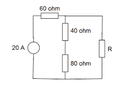
Find The Value Of R That Will Carry a 4 A Of Current To Flow Through The 80 Ohm Resistor In The Circuit Shown.
Relevant Equations
Parallel Circuit rules and Series circuit rules, i0 = (R1)/(R1+R2)is, where “is” is the source current, R1 and R2 are the resistances, and i0 is the current across a resistor.
The resistors are all in series , with exception of R, so I added them together and then used the current divider equation to solve for R, and I got 720 ohms. The textbook says R should be 30 ohms. I’m completely lost.
 

Attachments
  • 285DD4B0-B51F-4C16-96F9-F54B057404D6.png
    285DD4B0-B51F-4C16-96F9-F54B057404D6.png
    2 KB · Views: 190
  • 4E7696D5-01D9-451C-B138-C2E864DA1768.jpeg
    4E7696D5-01D9-451C-B138-C2E864DA1768.jpeg
    20.4 KB · Views: 171
Physics news on Phys.org
Hi @johnsmith7565 ,

Welcome to Physics Forums.

Note that the ##60 Ω## resistor is not in series with the ##40 Ω## and ##80 Ω## resistors; The existence of the resistor ##R## precludes that.

What you can say is that 20 A enters the top node from the direction of the source, and that it must divide between the two parallel branches. Write your current division expression so that it divides the 20 A as required using only the three resistors of the parallel branches.
 
Reply
  • Like
Likes   Reactions: johnsmith7565
gneill said:
Hi @johnsmith7565 ,

Welcome to Physics Forums.

Note that the ##60 \Ohm## resistor is not in series with the ##40 \Ohm## and ##80 \Ohm## resistors; The existence of the resistor ##R## precludes that.

What you can say is that 20 A enters the top node from the direction of the source, and that it must divide between the two parallel branches. Write your current division expression so that it divides the 20 A as required using only the three resistors of the parallel branches.
I still don’t understand. So the 40 ohm resistor and the 80 ohm one are in series so I add them, and now my equation is 4=(20)(120/R+120) and R is still too large.
 
johnsmith7565 said:
I still don’t understand. So the 40 ohm resistor and the 80 ohm one are in series so I add them, and now my equation is 4=(20)(120/R+120) and R is still too large.
I think you'll want to take a closer look at the current divider expression. Let's say you have two parallel resistances A and B with some total current ##I## being split between them. Then you can write:

##I_A = I \cdot \frac{B}{A + B}##

##I_B = I \cdot \frac{A}{A + B}##

Make sure that you get your numerator correct!
 
Reply
  • Like
Likes   Reactions: Greg Bernhardt, DaveE and johnsmith7565