Current Division Rule: Solving for Currents

  • Thread starter Thread starter jra12222
  • Start date Start date
  • Tags Tags
    Current Division
Click For Summary
SUMMARY

The discussion centers on the application of the current division rule in electrical circuits, specifically when calculating currents through parallel branches. The user initially attempted to use Ohm's Law (V=IR) and the current division rule but found discrepancies in their results. It was clarified that the current division rule requires accurate impedance calculations for capacitors and inductors, and the user ultimately identified a substitution error in their calculations. The correct approach involves determining the voltage drop across parallel branches and using V=I/Z for accurate current values.

PREREQUISITES
  • Understanding of Ohm's Law (V=IR)
  • Knowledge of the current division rule in electrical circuits
  • Familiarity with calculating impedance for capacitors and inductors
  • Ability to analyze parallel circuits
NEXT STEPS
  • Study the current division rule in detail with practical examples
  • Learn how to calculate impedance for capacitors and inductors
  • Explore advanced circuit analysis techniques for parallel circuits
  • Review common mistakes in electrical calculations and how to avoid them
USEFUL FOR

Electrical engineering students, circuit designers, and professionals involved in circuit analysis and troubleshooting who seek to enhance their understanding of current calculations in complex circuits.

jra12222
Messages
17
Reaction score
6
Hi all,

I was working the following example:
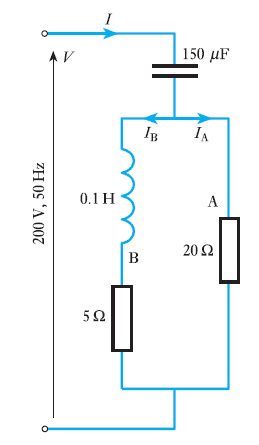
upload_2018-12-2_5-57-40.png

where I need to find the currents. I tried solving using the traditional V=IR => I=V/R,
and then I tried with the current division rule. However with the current division rule the answers don't match.
Also according to the answers on the book the correct answer is the first one.
Are there some conditions when using the current division rule?
 

Attachments

  • upload_2018-12-2_5-57-40.png
    upload_2018-12-2_5-57-40.png
    2.5 KB · Views: 734
Engineering news on Phys.org
I don't know what the first one is since you didn't tell us. However, you have more than resistance in this circuit. Do you know how to get the impedance for a capacitor and an inductor?
 
Oh no the first is the traditional one, I basically found voltage drop across the the parallel branches and then found the current using V=I/Z.
Yes inductive and capacitive resistances are correct
 
OH never mind I just noticed I was making a mistake in the substitution of the values! I've been trying to figure it out for the past hour :(
Sorry for this!
Consider this thread closed
Thanks :)
 
  • Like
Likes   Reactions: berkeman and Tom.G
That's why we like people to post their working.
 
  • Like
Likes   Reactions: jim hardy

Similar threads

  • · Replies 26 ·
Replies
26
Views
3K
  • · Replies 14 ·
Replies
14
Views
3K
  • · Replies 2 ·
Replies
2
Views
1K
Replies
13
Views
2K
  • · Replies 12 ·
Replies
12
Views
5K
  • · Replies 10 ·
Replies
10
Views
2K
  • · Replies 8 ·
Replies
8
Views
1K
  • · Replies 6 ·
Replies
6
Views
8K
  • · Replies 1 ·
Replies
1
Views
5K
Replies
7
Views
2K