Barloud
- 16
- 0
[itex][/itex]Hello,
I have an issue with the problem below.
I have a series connection of two variable capacitances [itex]C_{1}(t)[/itex] and [itex]C_{2}(t)[/itex]. I want to establish the differential equation between the current i and voltage V on the ports of the series connection.
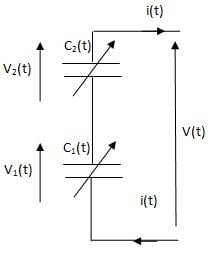
The capacitance of the series connection of the two capacitors is:
The charges on the electrodes of [itex]C_{s}[/itex] are ±[itex]C_{s}V[/itex] and the current i is then
I use the dot superscript for the time derivative. Using the expression of [itex]C_{s}[/itex] given above, I get the differential equation relating the voltage and current, which is what I am looking for:
However, because the problem I describe is just a step in a more complex system that I am studying, I need to understand the method to obtain Eq.1 without knowing in advance that the equivalent series capacitance of [itex]C_{1}[/itex] and [itex]C_{2}[/itex] is equal to [itex]C_{1}C_{2}/(C_{1}+C_{2})[/itex]. To do that, I first express the charge on the top electrode of [itex]C_{2}[/itex] as:
and the charge on the bottom electrode of [itex]C_{1}[/itex] as:
For the current, I get:
And I get stuck here. I am unable to get back to Eq.1 from Eq.2, even by introducing [itex]V=V_{1}+V_{2}[/itex]. Any ideas of how I can do that?
I have an issue with the problem below.
I have a series connection of two variable capacitances [itex]C_{1}(t)[/itex] and [itex]C_{2}(t)[/itex]. I want to establish the differential equation between the current i and voltage V on the ports of the series connection.
The capacitance of the series connection of the two capacitors is:
[itex]C_{s}=\frac{C_{1}C_{2}}{C_{1}+C_{2}}[/itex]
The charges on the electrodes of [itex]C_{s}[/itex] are ±[itex]C_{s}V[/itex] and the current i is then
[itex]i=\dot{(C_{s}V)}=\dot{C_{s}}V+C_{s}\dot{V}[/itex]
I use the dot superscript for the time derivative. Using the expression of [itex]C_{s}[/itex] given above, I get the differential equation relating the voltage and current, which is what I am looking for:
[itex]i=\frac{C_{1}^{2} \dot{C_{2}}+C_{2}^{2} \dot{C_{1}}}{(C_{1}+C_{2})^{2}}V+\frac{C_{1}C_{2}}{C_{1}+C_{2}}\dot{V} \; \; \; \; \; \; \; \;Eq.1[/itex]
However, because the problem I describe is just a step in a more complex system that I am studying, I need to understand the method to obtain Eq.1 without knowing in advance that the equivalent series capacitance of [itex]C_{1}[/itex] and [itex]C_{2}[/itex] is equal to [itex]C_{1}C_{2}/(C_{1}+C_{2})[/itex]. To do that, I first express the charge on the top electrode of [itex]C_{2}[/itex] as:
[itex]Q=C_{2}V_{2}[/itex]
and the charge on the bottom electrode of [itex]C_{1}[/itex] as:
[itex]-Q=-C_{1}V_{1}[/itex]
For the current, I get:
[itex]i=C_{2}\dot{V_{2}}+V_{2}\dot{C_{2}}=-C_{1}\dot{V_{1}}-V_{1}\dot{C_{1}} \; \; \; \; \; \; \; \;Eq.2[/itex]
And I get stuck here. I am unable to get back to Eq.1 from Eq.2, even by introducing [itex]V=V_{1}+V_{2}[/itex]. Any ideas of how I can do that?