Cylinder rolling due to magnetic force

Click For Summary
SUMMARY

The discussion centers on the dynamics of a cylinder rolling due to magnetic forces, specifically analyzing the forces acting on the cylinder and the resulting motion. The participants derive the acceleration and final velocity of the cylinder using the work-energy theorem and discuss the implications of rotational kinetic energy. Key equations include the net force equation, \( F = F_B - f \), and the final velocity equation \( v = \sqrt{\frac{4IdBL}{3m}} \). The conversation highlights the importance of considering both translational and rotational kinetic energy in such analyses.

PREREQUISITES
  • Understanding of Newton's laws of motion
  • Familiarity with the work-energy theorem
  • Knowledge of rotational dynamics, including moment of inertia
  • Basic concepts of magnetic forces and their applications in mechanics
NEXT STEPS
  • Study the derivation of the work-energy theorem in rotational dynamics
  • Learn about the implications of rotational kinetic energy in rolling motion
  • Explore the effects of magnetic forces on different shapes and materials
  • Investigate advanced applications of Laplace forces in engineering contexts
USEFUL FOR

Physics students, mechanical engineers, and anyone interested in the dynamics of rolling objects and the effects of magnetic forces on motion.

archaic
Messages
688
Reaction score
214
Homework Statement
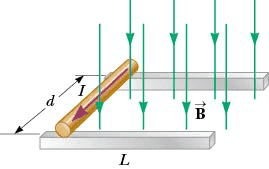
The apparatus in the figure is a distance ##h## from the ground. The cylinder of radius ##r## rolls without slipping. I am asked to find the total horizontal distance that will be travelled until the rod reaches the ground.
Relevant Equations
$$\mathbf{F_B}=I\mathbf L\times\mathbf B$$$$\tau_{net}=I\alpha$$
Hello!
28-4-op-017-ctx.png

The magnetic force is to the right. ##I_c## is the moment of inertia of the cylinder.
For the net force on the centre of mass, I have the frictional and magnetic forces ##F=F_B-f##. I know that ##F_B## is ##IdB##.
I also know that ##rf=I_c\alpha=I_c\frac ar##, so that ##f=I_c\frac{a}{r^2}=\frac{ma}{2}## (because ##I_c=\frac12mr^2##), which gives me ##ma=IdB-\frac{ma}{2}\Leftrightarrow a=\frac{2IdB}{3m}\Leftrightarrow F=\frac{2IdB}{3}##.
Using the work energy theorem, I get ##\frac12mv^2=\frac23IdBL\Leftrightarrow v=\sqrt{\frac{4IdBL}{3m}}##, which is the horizontal speed when the rod enters free-fall.
The vertical position when the cylinder touches the ground is such that ##0=h-\frac12g(\Delta t)^2\Leftrightarrow\Delta t=\sqrt{\frac{2h}{g}}##.
The total range would be ##L+v\Delta t=L+\sqrt{\frac{8IdBLh}{3mg}}##
Correct?
Thank you. :)
 
Last edited:
Physics news on Phys.org
Your work looks correct to me. Instead of using the work-energy theorem, you could have used the kinematic equation ##v^2 = v_0^2 +2 a \Delta x## to find the speed at the start of free-fall.

In your application of the work-energy theorem, someone might ask why you didn't include the rotational KE of the rod. But, your work is correct.
 
  • Like
Likes   Reactions: etotheipi
TSny said:
In your application of the work-energy theorem, someone might ask why you didn't include the rotational KE of the rod. But, your work is correct.

If I'm not mistaken, this is because if the net force on the rod is ##\vec{F} = \sum \vec{F}_i = m\ddot{\vec{x}}_{\text{cm}}##, a quantity ##\tilde{W}## defined by$$\begin{align*}\tilde{W} = \int_{\vec{x}_{\text{cm},1}}^{\vec{x}_{\text{cm},2}} \vec{F} \cdot d\vec{x}_{\text{cm}} = \int_{\vec{x}_{\text{cm},1}}^{\vec{x}_{\text{cm},2}} m\ddot{\vec{x}}_{\text{cm}} \cdot d\vec{x}_{\text{cm}} &= \int_{t_1}^{t_2} m \ddot{\vec{x}}_{\text{cm}} \cdot \dot{\vec{x}}_{\text{cm}} dt \\

&= \int_{t_1}^{t_2} \frac{d}{dt} \left( \frac{1}{2} m \dot{\vec{x}}_{\text{cm}}^2 \right) dt \\

&= \Delta \left( \frac{1}{2} m \dot{\vec{x}}_{\text{cm}}^2 \right) = \Delta T_{\text{cm}}

\end{align*}$$which is the change in 'kinetic energy of the centre of mass' only, and not the total change in kinetic energy ##\Delta T = \Delta T^* + \Delta T_{\text{cm}}## where, in this case, ##\Delta T^*## is the change in rotational kinetic energy [i.e. in the centre of mass frame].

The total work done by the Laplace force on all individual mass elements of the rod whilst the rod is rolling along the ramp will be the total change in kinetic energy ##W = \Delta T##, and this'll be different to the ##\tilde{W}## from before (which we obtained by multiplying the Laplace force + friction force by the displacement of the centre of mass of the rod). Because the total work done will actually be something like$$W = \sum_i \int_{\vec{x}_1}^{\vec{x}_2} \vec{F}_i \cdot d\vec{x}_i$$where ##\vec{F}_i## is the Laplace force on a small element ##m_i## of the rod somewhere, and ##d\vec{x}_i## the displacement of that small element. E.g the points of the rod currently in contact with the rails have ##\dot{\vec{x}}_i = \vec{0}## and the Laplace force has zero power on them, but the points of the rod currently at the top of the cycle have maximum speed, etc. It would be interesting to see if, if we did the double integral over mass elements in the rod, the total work done by the Laplace force would indeed give us the total change in kinetic energy [including rotational]!
 
Last edited by a moderator:
  • Like
Likes   Reactions: TSny
etotheipi said:
It would be interesting to see if, if we did the double integral over mass elements in the rod, the total work done by the Laplace force would indeed give us the total change in kinetic energy [including rotational]!
I don't think it would be very hard to show this. The net work done by all of the elementary Laplace forces (i.e., magnetic forces) acting on the mass elements will turn out to be just the total magnetic force times the distance that the center of mass moves: ##IdBL##. And you can check that this equals the total change in translational plus rotational KE of the rod.
 
  • Like
Likes   Reactions: etotheipi
@TSny thank you very much for your confirmation! I actually forgot about the rotational KE... Glad that it works.
From my textbook, ##IdB## is the force on the whole wire, so I basically thought of the whole cylinder as a point.
Thank you for mentioning that, @etotheipi. I have also asked myself the same question after having read TSny's post.
 
  • Like
Likes   Reactions: etotheipi

Similar threads

  • · Replies 97 ·
4
Replies
97
Views
6K
  • · Replies 21 ·
Replies
21
Views
1K
  • · Replies 13 ·
Replies
13
Views
2K
Replies
3
Views
629
Replies
12
Views
2K
Replies
39
Views
3K
  • · Replies 13 ·
Replies
13
Views
1K
  • · Replies 59 ·
2
Replies
59
Views
5K
  • · Replies 23 ·
Replies
23
Views
5K
  • · Replies 24 ·
Replies
24
Views
5K