Dead Tree Full of Acorns: What's Placing Them There?

  • Thread starter Thread starter phyzguy
  • Start date Start date
  • Tags Tags
    Tree
Join the discussion
Ask a follow-up here, or get your own question answered by working scientists, mathematicians and engineers — people, not an autocomplete.
Real named experts · corrections over time · the nuance an AI answer skips
4 replies · 6K views
Messages
5,317
Reaction score
2,400
While we were hiking in California, we came upon this dead tree. The tree was full of holes, presumably made by woodpeckers, and in most of the holes something had placed an acorn. Has anyone ever seen this? What places the acorns there? Woodpeckers? Squirrels? Something else?
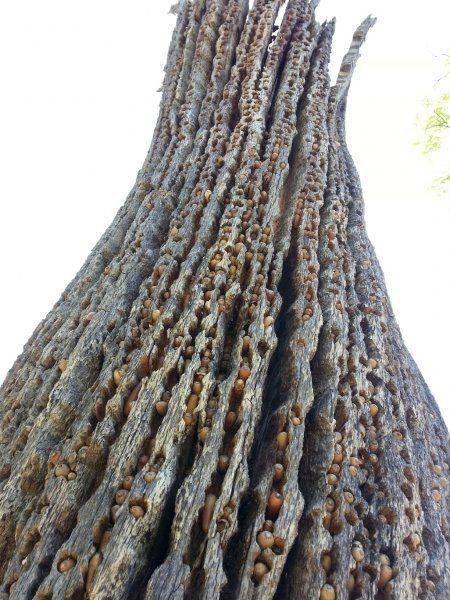
20150401_141838.jpg
 
  • Like
Likes   Reactions: Evo
Biology news on Phys.org
phyzguy said:
While we were hiking in California, we came upon this dead tree. The tree was full of holes, presumably made by woodpeckers, and in most of the holes something had placed an acorn. Has anyone ever seen this? What places the acorns there? Woodpeckers? Squirrels? Something else?
View attachment 81428
I've heard of this before, it's the acorn woodpecker. So glad you took a picture!

Acorn woodpeckers, as their name implies, depend heavily on acorns for food. In some parts of their range (e.g., California), the woodpeckers create granaries or "acorn trees" by drilling holes in dead trees, dead branches, telephone poles, and wooden buildings. The woodpeckers then collect acorns and find a hole that is just the right size for the acorn. As acorns dry out, they are moved to smaller holes and granary maintenance requires a significant amount of the bird's time. They also feed on insects, sap, and fruit.

http://en.wikipedia.org/wiki/Acorn_woodpecker#Food_and_homes
 
Not long ago the following was posted to one of my bird list-servs. Do have a look at the vid. :D

In my [a poster to the Michigan birding list-serv] industry the Acorn Woodpeckers have made a name for themselves as “microwave-path attenuators”. In this video that some of you have probably seen before, a gradual but continuous increase in “path-loss” prompted some diagnostics. All the hardware was within standards and the dishes and horns were all still within alignment limitations. The usual culprit is feed line failure and water/moisture infiltration. In this case, the attenuation of the communication signals were accomplished in an entirely different manner…