Definition of isolation and pulse response time for a 3-way power splitter

Click For Summary
SUMMARY

The discussion focuses on the definitions of isolation and pulse response time in a 3-way power splitter. Isolation is defined as the power difference between output ports, specifically isolation 1-2, which indicates the input power required to achieve a specific output power at another port. Higher isolation values, such as 16dB, correlate to better power balance and lower power imbalance, while pulse response times of 400/10 and 800/400 indicate different rise and fall times, with the former suggesting faster response but potentially higher power dissipation. Understanding these parameters is crucial for optimizing performance in power splitter applications.

PREREQUISITES
  • Understanding of power splitter specifications and datasheets
  • Knowledge of dB (decibel) calculations and logarithmic scales
  • Familiarity with pulse response time metrics in electronic components
  • Basic principles of signal reflection and power balance in RF applications
NEXT STEPS
  • Research "Calculating power imbalance from isolation values" for practical applications
  • Study "Power splitter isolation measurements" to understand testing methods
  • Explore "Pulse response time in RF components" for deeper insights into performance metrics
  • Learn about "Reflection coefficients and their impact on signal integrity" in RF design
USEFUL FOR

Engineers and technicians working with RF components, specifically those involved in the design and optimization of power splitters and related devices.

Jiho
Messages
20
Reaction score
4
I will use 3 way power splitter and power detector.
upload_2019-1-14_12-31-36.png

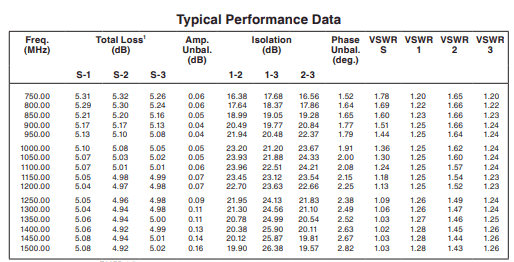
1. This is power splitter data sheet. In this data sheet, there are different isolation values. What does it mean?? Also in that point, I wonder definition of isolation at power splitter.
upload_2019-1-14_12-37-5.png

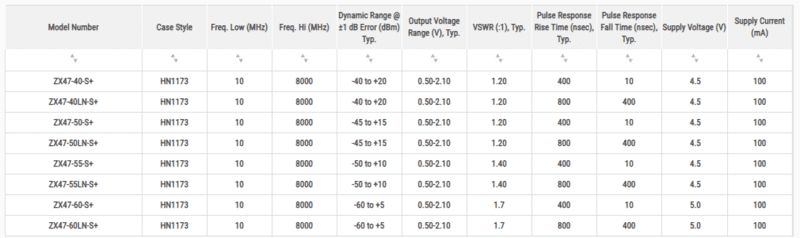
2. This is power detector data sheet. In this data sheet, Each pulse response rise/fall time are 400/10 or 800/400. What is difference between 400/10 and 800/400? What does it mean?
 

Attachments

  • upload_2019-1-14_12-31-36.png
    upload_2019-1-14_12-31-36.png
    12.6 KB · Views: 832
  • upload_2019-1-14_12-37-5.png
    upload_2019-1-14_12-37-5.png
    17.8 KB · Views: 597
Physics news on Phys.org
Regarding isolation, isolation is defined between each pair of output ports. It may matter if you have significant reflection at outputs - in this case imbalance of isolation is converted into imbalance of transmission.
Regarding pulse response, listed time is the 10%-90% transition time at output if rising or falling step input is applied. Fast response on falling edge likely indicate circuit difference (no pmos or zero-recovery diodes) - may be at cost of higher power dissipation.
 
  • Like
Likes   Reactions: Jiho
Thank you for your answer. But I have three questions.

1.What does isolation 1-2 in the data sheet? I can't catch meaning of number(1-2).
2.What happen if isolation becomes higher or lower??
3.Does fast response on falling edge mean small number of fall time? If I want to get low power dissipation, then 800/400 is better than 400/10??
 
Jiho said:
Thank you for your answer. But I have three questions.

1.What does isolation 1-2 in the data sheet? I can't catch meaning of number(1-2).
1-2 mean isolation between output ports 1 and 2
Jiho said:
2.What happen if isolation becomes higher or lower??
higher isolation mean better power balance. 16dB isolatiom realistically mean about 0.05dB power imbalance off the specs at worst -10dB output reflection
Jiho said:
3.Does fast response on falling edge mean small number of fall time? If I want to get low power dissipation, then 800/400 is better than 400/10??
yes, fall time at output is faster in 400/10 device
yes, 800/400 likely mean device with lower power dissipation
 
  • Like
Likes   Reactions: Jiho
Thank you. I absolutely understand about pulse response time. But I still have two question.

1.What does isolation between output ports 1 and 2 mean? Is ratio of isolation between port 1 and port 2? Would you kindly explain me isolation 1-2?? I know isolation mean -10log(Pout/Pin). But I confuse what 'isolation 1-2' means. What are output power and input power at 'isolation 1-2'??

2.How can I calculate power imbalance off 0.05dB from 16dB of isolation. Does table exist??
 
Jiho said:
Thank you. I absolutely understand about pulse response time. But I still have two question.

1.What does isolation between output ports 1 and 2 mean? Is ratio of isolation between port 1 and port 2? Would you kindly explain me isolation 1-2?? I know isolation mean -10log(Pout/Pin). But I confuse what 'isolation 1-2' means. What are output power and input power at 'isolation 1-2'??

2.How can I calculate power imbalance off 0.05dB from 16dB of isolation. Does table exist??
Isolation 1-2 is the power of input 2 needed to produce 0 dBm power at output 1
Regarding reflection to imbalance calculation, it is not on standard tables. No short explanation here, you need to understand the conversion of logarithmic (dB) scale.
In linear scale
imbalance=(delta(loss)+delta(isolation)*delta(reflection))/loss
where delta is worst-case discrepancy between ports
for example, delta(loss) for 750 MHz at table 1 is
10-5.26/10-10-5.32/10=0.00409=-23.9dB
 
Jiho said:
What does isolation between output ports 1 and 2 mean?
Here is an alternative / additional view:
I am assuming that you can handle dBs ok.
If the ports are not totally isolated from each other, any power entering one port will result in some power from the other port. If one port is mis terminated then the reflected power will end up mixing with the wanted signal from the other. The only way to quantify this is to show the isolation. That, of course, doesn't tell the whole story because the relative phases could be anything - the vector sum or difference being the maximum possible error.
 
  • Like
Likes   Reactions: trurle

Similar threads

  • · Replies 9 ·
Replies
9
Views
792
  • · Replies 4 ·
Replies
4
Views
1K
  • · Replies 11 ·
Replies
11
Views
6K
  • · Replies 15 ·
Replies
15
Views
2K
  • · Replies 15 ·
Replies
15
Views
3K
  • · Replies 5 ·
Replies
5
Views
2K
  • · Replies 69 ·
3
Replies
69
Views
16K
  • · Replies 10 ·
Replies
10
Views
2K
  • · Replies 93 ·
4
Replies
93
Views
6K
  • · Replies 10 ·
Replies
10
Views
2K