Deflection vs. Bending in a Beam

Click For Summary

Discussion Overview

The discussion revolves around the relationship between material properties of a metal, specifically 6061-T6 aluminum, and the deflection limits of a beam before it undergoes permanent bending. Participants explore the relevant equations and concepts related to bending moments, stresses, and the conditions under which a beam behaves elastically versus plastically.

Discussion Character

  • Technical explanation
  • Mathematical reasoning
  • Exploratory

Main Points Raised

  • One participant seeks to understand the equation that relates material properties to deflection limits, mentioning two equations but expressing uncertainty about their applicability to bending rather than axial loads.
  • Another participant clarifies that the equations cited pertain to axial forces and emphasizes the need to calculate bending moments and stresses for loads applied perpendicular to the beam.
  • There is a discussion about the maximum bending moment occurring at the first pin support and how to calculate the maximum bending stress from that moment.
  • A participant shares a link to beam deflection formulae and expresses readiness to tackle relevant calculations, indicating prior knowledge of calculus.
  • Further exchanges involve attempts to clarify the relationship between moment, area, and stress, with participants discussing the need for a better understanding of bending moments and stresses.
  • One participant suggests searching for resources on Strength of Materials to aid in self-study before formal classes begin.
  • Another participant explains the application of Hooke's law and the flexure formula, noting the distinction between elastic and plastic behavior of materials and the importance of the proportional limit.
  • Finally, one participant expresses gratitude for the assistance received and indicates that they have gained clarity on the topic.

Areas of Agreement / Disagreement

Participants generally agree on the need to understand bending moments and stresses in the context of beam deflection, but there is no consensus on the specific equations or methods to apply, as various approaches and interpretations are presented.

Contextual Notes

Some discussions involve assumptions about the applicability of certain equations and the conditions under which materials behave elastically or plastically. There are also references to specific beam configurations and loading conditions that may not be universally applicable.

Who May Find This Useful

This discussion may be useful for individuals studying materials science, structural engineering, or mechanics, particularly those interested in beam deflection and material properties in practical applications.

Axecutioner
Messages
31
Reaction score
0
Problem:
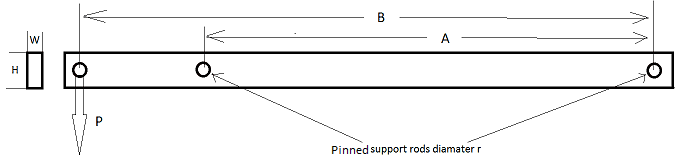
7wpLP.png


What is the equation that relates properties of a metal (modulus of elasticity, yield strength, elongation, etc) to how far it can deflect before permanently being bent. I can calculate how far a beam will deflect under different loading and support but I just don't know what the limit is until it won't bounce back to it's original state again. I'm looking at 6061-T6 aluminum.

I've found two different equations online:

σ = F/A
F = EI∏^2 / (KL)^2

I want to say it's σ = F/A but I would think that orientation of the beam would matter. It would be easier to bend it about it's width than it's height. I would also think that in this case, if B was longer it would require a smaller P value to bend the beam.

I'm trying to teach myself this stuff for a project and I won't be learning it in college classes until Fall quarter so any help will be appreciated! Thanks
 
Physics news on Phys.org
Those equations you cite apply to axial forces and stresses, and critical buckling loads. Axial loads act along the direction of the beam, and either elongate or compress it. But you don't have axial loads, you have loads applied perpendicular to the beam, causing bending moments and bending stresses and beam deflections. you'll have to learn how to calculate the max bending moment in the beam, and from that, the max stress in the beams outer fibers. the beam will be slightly permanently deformed when the max stress reaches the yield stress of the given material. Calculating the max deflwection is a bit more difficult, because it involves the use of calculus or 'beam' tables. You don't learn these things overnight.
 
I have the beam tables, and I've gone through Calc 4 so throw anything relevant my way and I'll see if I can get it.

Here's what I have: http://uploading.com/files/ab5m1512/Beam_Deflection_Formulae.pdf/
 
I can't open your file, but it likely should indicate that the max moment is at the first pin support and equal to P (B - A) in your example. So knowing the max moment, what is the max bending stress?
 
Sorry, here: http://i.imgur.com/jfqU6.png

P(B-A), the area would be WH but there is more moment at the edges of the beam than towards the center, so it would be:

P(B-A)(H/2) but then it would be on a line of material and not an area. So P(B-A)(H/2)/(W) ? Moment of force P on the outer fibers per length?
 
Axecutioner said:
None of those tables apply for your particular case, and they don't give the maximum moment anyway.
P(B-A), the area would be WH but there is more moment you mean bending stress[/color]at the edges of the beam than towards the center, so it would be:

P(B-A)(H/2) but then it would be on a line of material and not an area. So P(B-A)(H/2)/(W) ? Moment of force P on the outer fibers per length?
You need a better understanding of how to calculate bending moments, and then, how to calculate bending stresses. As in max stress in outer fibers = (max moment)(c)/I.

You need to grasp the basics before using tables.
 
PhanthomJay said:
You need to grasp the basics before using tables.

And how/where could I do that? I'd like to teach myself before taking the class because I'll need to use this stuff before then.
 
Try a web search on Strength of Materials.
 
What you are looking for is a combination of Hooke's law and the flexure formula for elastic bending. The application of Hooke's law to a beam is only valid when the beam behaves elastically, meaning that following the removal of forces, the beam will return to its original shape and position. Knowing this, the beam only will behave elastically in a region below what is called the proportional limit which is the maximum normal stress/strain for the elastic region. Anywhere above this is considered the plastic region where Hooke's law doesn't apply because Hooke's law relies on the linear relationship between stress and strain in the beam. Typically, published values of the proportional limit are hard to come by, however the proportional limit is generally approximately equal to the yield strength of the material, which published values are easily available. So essentially you are looking for the yield strength of 6061-T6 Al, which I can find as 35,000 psi (241 MPa). If you set this equal to the stress in the flexure formula, σ = Mc/I, you can solve for the maximum moment allowed. However, since you are looking at a simply supported beam, the bending moment is variable across the beam as described by a second order differential equation with the initial conditions being specified by both the supports and loading. The tables you have listed are only specified for simply supported beams with the supports at the end points, meaning you will have to solve the differential equation yourself.
 
  • #10
Thank you cmmcnamara, that was extremely helpful. I got it figured out now. All starting to make sense. http://cache.gtpla.net/forum/images/smilies/thumbsup.gif
 
Last edited by a moderator:

Similar threads

Replies
1
Views
2K
Replies
62
Views
24K
Replies
6
Views
4K
  • · Replies 3 ·
Replies
3
Views
3K
  • · Replies 5 ·
Replies
5
Views
4K
  • · Replies 1 ·
Replies
1
Views
8K
  • · Replies 46 ·
2
Replies
46
Views
15K
  • · Replies 4 ·
Replies
4
Views
2K
  • · Replies 3 ·
Replies
3
Views
3K
  • · Replies 5 ·
Replies
5
Views
4K