Derivation of Surface Area and Torque for a Helical Plate Attached to a Shaft

  • Context: Graduate 
  • Thread starter Thread starter BALU E GEORGE
  • Start date Start date
  • Tags Tags
    Area Surface
Click For Summary
SUMMARY

The discussion focuses on deriving the surface area of a helical plate with a single turn, characterized by its pitch (p), diameter (D), and shaft diameter (d). The area increases with pitch and is compared to a circular disc without a radial gap. The conversation also touches on the torque equation related to the surface when entering a material with shear strength (s) or frictional coefficient (μ). A theoretical helicoid surface area formula is provided, emphasizing the mathematical relationship between the parameters involved.

PREREQUISITES
  • Understanding of helical geometry and its properties
  • Familiarity with calculus, particularly integration techniques
  • Knowledge of material mechanics, including shear strength and friction
  • Experience with mathematical modeling of surfaces
NEXT STEPS
  • Study the derivation of surface area for helical structures using calculus
  • Research torque calculations in mechanical systems involving friction and shear strength
  • Explore the properties of helicoids and their applications in engineering
  • Learn about the implications of pitch and diameter on mechanical performance
USEFUL FOR

Mechanical engineers, materials scientists, and students studying mechanical design or applied mathematics will benefit from this discussion, particularly those interested in the mechanics of helical structures and their applications in engineering systems.

BALU E GEORGE
Messages
2
Reaction score
0
Hello.
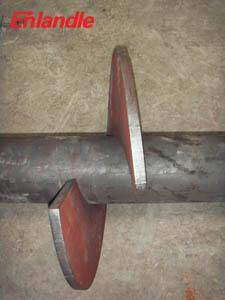
I would like to know the derivation of surface area of the helical plate, of single turn with a pitch p, diameter D, attached to a shaft of d. It will look like a circle in plan
Also, I would like to get the equation relating the torque resisted by the surface, if it is made to enter a material of shear strength s or frictional coefficient μ.
Thankyou
sectional_flight_helical_plate_helix_or_helixes.jpg

Thankyou in advance
 
Physics news on Phys.org
The plate shown appears to have been produced by splitting a flat annular disk. If so, the area will be the same as when it was flat. The plan view (as it is, mounted on the shaft) would not be a complete disk. There would be a small radial gap at the split, due to the strain from the shaft.
If your question really concerns a helical flange (like a screw thread) extending over multiple turns then the area will be a bit larger.
 
Yes sir,
My question concerns the helical flange. But it is a sungle turn. So the area will be a bit larger, as compared to a circular disc and there is no radial gap at the split. This area will increase as th pitch increases. So i was looking for a relation connecting the pitch and the radius to the area.
 
BALU E GEORGE said:
Yes sir,
My question concerns the helical flange. But it is a sungle turn. So the area will be a bit larger, as compared to a circular disc and there is no radial gap at the split. This area will increase as th pitch increases. So i was looking for a relation connecting the pitch and the radius to the area.
The pictured flange cannot be continued into an arbitrary number of turns. If you look at either straight edge and project it back through the shaft you will see that it meets the flange on the other side. If it were truly just one turn out of a continuing thread, like a spiral staircase, that would not happen. Instead, the line would be perpendicular to the axis of the shaft. Its continuation through the shaft would come out on the other side half way between two passes of the flange/thread.
This is why I remain convinced that it has been formed from a flat washer, split, then forced onto the shaft. The radial gap I infer would be very small. It might be hard to detect it by eye because of parallax. Whether there's a measurable gap or not, the difference between the actual area and its original area before being mounted on the shaft would be minute. Just treat it as flat.
 
If you want the surface area formula for a theoretical helicoid of the form$$
\vec r(t) = \langle r\cos t, r\sin t , kt\rangle~~0\le t \le a,~~0\le r\le b$$it is easy enough$$
A =\int_0^a\int_0^b \sqrt{k^2+r^2}~drdt$$
[Edit:] Corrected typo.
 
Last edited:
LCKurtz said:
If you want the surface area formula for a theoretical helicoid
Sure, but the pictured flange is clearly not like that.
Also, I guess you mean ##A =\int_0^a\int_{r_0}^{r_1} \sqrt{k^2+r^2}~drdt##
 
haruspex said:
Sure, but the pictured flange is clearly not like that.
Also, I guess you mean ##A =\int_0^a\int_{r_0}^{r_1} \sqrt{k^2+r^2}~drdt##
Yes.
 

Similar threads

  • · Replies 5 ·
Replies
5
Views
5K
  • · Replies 104 ·
4
Replies
104
Views
12K
  • · Replies 4 ·
Replies
4
Views
2K
  • · Replies 19 ·
Replies
19
Views
4K
  • · Replies 10 ·
Replies
10
Views
2K
Replies
4
Views
2K
  • · Replies 15 ·
Replies
15
Views
3K
  • · Replies 1 ·
Replies
1
Views
2K
  • · Replies 2 ·
Replies
2
Views
5K
Replies
5
Views
4K