Discussion Overview
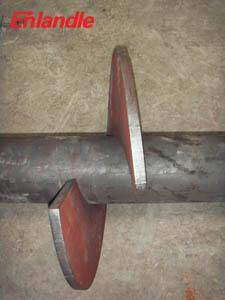
The discussion revolves around the derivation of the surface area of a helical plate with a single turn, characterized by its pitch and diameter, as well as the equation relating to the torque resisted by the surface when interacting with a material defined by shear strength or frictional coefficient. The scope includes theoretical derivations and geometric considerations.
Discussion Character
- Exploratory
- Technical explanation
- Debate/contested
Main Points Raised
- One participant seeks a derivation of the surface area for a helical plate with specific parameters, including pitch and diameter.
- Another participant suggests that the area of the helical plate may be equivalent to that of a flat annular disk, noting potential gaps due to the mounting on a shaft.
- A participant clarifies that their inquiry pertains specifically to a helical flange with a single turn, asserting that the area will be larger than that of a circular disc and will increase with pitch.
- Further elaboration indicates that the helical flange cannot extend into multiple turns without intersecting itself, reinforcing the idea that it has been formed from a flat washer.
- One participant provides a theoretical formula for the surface area of a helicoid, presenting an integral expression while another questions its applicability to the specific flange in question.
- There is a correction regarding the limits of integration in the proposed formula for surface area.
Areas of Agreement / Disagreement
Participants express differing views on the geometry of the helical plate and its surface area. While some agree on the need for a formula, others contest the applicability of certain theoretical models to the specific case being discussed. No consensus is reached on the exact nature of the helical flange or the appropriate surface area calculation.
Contextual Notes
There are unresolved assumptions regarding the geometry of the helical flange, including the presence of any radial gaps and the implications of treating it as flat versus a true helicoid. The mathematical expressions proposed may depend on specific definitions and interpretations of the helical structure.