Describing path of the object in an xy plane

  • Thread starter Thread starter member 731016
  • Start date Start date
  • Tags Tags
    Path Plane
Click For Summary
SUMMARY

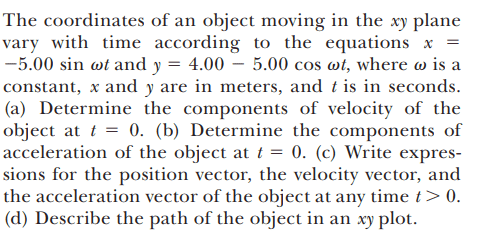
The discussion focuses on the mathematical representation of an object's motion in a circular path within an xy plane, specifically a circle with a radius of 5.00m centered at (0, 4.00m). The equation of a circle, given by (x - x0)² + (y - y0)² = r², is utilized to derive the position functions x = -5sin(ωt) and y - 4 = -5cos(ωt). The participants confirm that substituting these functions into the circle's equation validates the circular motion described.

PREREQUISITES
  • Understanding of circular motion and its equations
  • Familiarity with trigonometric identities, specifically sin²x + cos²x = 1
  • Basic knowledge of parametric equations in physics
  • Ability to manipulate algebraic expressions and equations
NEXT STEPS
  • Study the derivation of parametric equations for circular motion
  • Learn about the applications of trigonometric identities in physics
  • Explore the concept of angular frequency (ω) in circular motion
  • Investigate the relationship between circular motion and harmonic motion
USEFUL FOR

Students and educators in physics or mathematics, particularly those focusing on circular motion and trigonometric applications in kinematics.

member 731016
Homework Statement
Please see below
Relevant Equations
Please see below
For part(d) of this problem,
1676517142176.png

The solution is,
1676517195998.png

However, how did they know that the object moves in a circle of radius 5.00m centered at (0,4.00m)?

Many thanks!
 
Physics news on Phys.org
What is the equation of a circle centered at ##(x_0,y_0)##?
 
  • Like
Likes   Reactions: member 731016
The coordinates satisfy the equation of such a circle. This is how they know.
 
  • Like
Likes   Reactions: member 731016
Thank you for your replies @kuruman and @nasu!

The equation of a circle centered at ##(x_0, y_0)## is ##(x - x_0)^2 + (y - y_0)^2 = r^2##

Many thanks!
 
Can you bring what you have in that form? Remember that ##~\sin^2x+\cos^2x=1.##
 
  • Like
Likes   Reactions: member 731016
kuruman said:
Can you bring what you have in that form? Remember that ##~\sin^2x+\cos^2x=1.##
Thank you for your reply @kuruman !

Here is what I got:

##x^2 + y^2 = r^2 ##
##(-5.00sin\omega t)^2 + (4.00 - 5cos\omega t)^2 = r^2 ##
##25sin^2\omega t + 16 - 40cos\omega t +25cos^2\omega t = r^2 ##
##25(sin^2\omega t + cos^2\omega t) +16 - 40cos\omega t = r^2 ##
## 41 - 40cos\omega t = r^2 ##

EDIT: I'm now thinking that I should put the individual position function in the x-components in the y-components in the circle formula I posted.

Many thanks!
 
Callumnc1 said:
Here is what I got:
Don't try to prove that way ...
Callumnc1 said:
EDIT: I'm now thinking that I should put the individual position function in the x-components in the y-components in the circle formula I posted.
Yes.
We know that ##x=-5sinωt## and ##y-4=-5cosωt## so we have:
##x^2+(y-4)^2=25sin^2ωt+25cos^2ωt=25## and we know that ##x^2+(y-4)^2=5^2## is equation of a circle with ##r=5## that is centered at ##(0,4)##.
 
  • Like
Likes   Reactions: member 731016
MatinSAR said:
Don't try to prove that way ...

Yes.
We know that ##x=-5sinωt## and ##y-4=-5cosωt## so we have:
##x^2+(y-4)^2=25sin^2ωt+25cos^2ωt=25## and we know that ##x^2+(y-4)^2=5^2## is equation of a circle with ##r=5## that is centered at ##(0,4)##.
Thank you for your reply @MarinSAR! I see now :)
 
  • Like
Likes   Reactions: MatinSAR

Similar threads

  • · Replies 5 ·
Replies
5
Views
7K
  • · Replies 38 ·
2
Replies
38
Views
3K
  • · Replies 8 ·
Replies
8
Views
2K
  • · Replies 1 ·
Replies
1
Views
1K
  • · Replies 18 ·
Replies
18
Views
2K
Replies
40
Views
3K
  • · Replies 30 ·
2
Replies
30
Views
2K
Replies
8
Views
2K
  • · Replies 45 ·
2
Replies
45
Views
4K
  • · Replies 3 ·
Replies
3
Views
1K