Designing ECG Measurement & Calculations

  • Thread starter Thread starter samaaa
  • Start date Start date
  • Tags Tags
    Measuring Signals
Click For Summary

Discussion Overview

The discussion revolves around the design and calculation methods for ECG (electrocardiogram) measurements, specifically focusing on the calculation of six leads (I, II, III, aVR, aVL, and aVF) using a digital to analog converter (DAC) and MATLAB. Participants explore the feasibility of this method compared to classical approaches, addressing technical considerations and safety concerns.

Discussion Character

  • Technical explanation
  • Debate/contested
  • Experimental/applied

Main Points Raised

  • One participant proposes using a DAC connected to a PC for measuring voltages from three electrodes (RA, LA, LL) to calculate the six leads mathematically.
  • Another participant corrects the initial claim, stating that an ADC (analog to digital converter) should be used instead of a DAC, emphasizing the need for preamplification between the ECG pads and the ADC inputs.
  • Concerns are raised about patient safety, with suggestions to use instrumentation amplifiers and battery power for the ECG system to prevent electrical hazards.
  • There is a discussion about the nature of ECG measurements, with one participant noting that only potential differences can be measured and highlighting the importance of proper shielding and preamplification due to the small voltages involved.
  • Another participant mentions that the calculations for I, II, and III depend on the linearity of the reference points, suggesting variability in measurements between patients.
  • One participant expresses confusion regarding a previous comment about potential differences, indicating a need for clarification.

Areas of Agreement / Disagreement

Participants express differing views on the method proposed for ECG calculations, with some supporting the use of a DAC and others advocating for an ADC. There is no consensus on the best approach, and safety considerations are a point of contention.

Contextual Notes

Participants highlight the need for careful consideration of patient safety and the variability in human physiology, which may affect the consistency of ECG measurements across different individuals.

samaaa
Messages
48
Reaction score
0
Hi guys:I have a project to design ECG

i want to calculate the six leads(I,II,III,aVR,aVL and aVF) by this method:
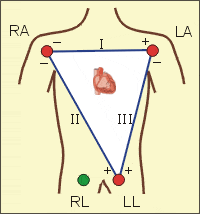
A013_Einthovens_triangle.gif

i will measure the voltage of three probe or electrode(RA,LA and LL) RL as a reference
by using DAC(digital to analog converter) the DAC connected to PC computer,
and then calculate(I,II,III,aVR,aVL and aVF) mathematically(by using matlab) according to these equations:
I=LA-RA,II=LL-RA,III=LL-LA,aVR=-((I+II)/2),aVL=I-(II/2) and aVF=II-(I/2)

so,what's your opinion about this method versus classical method(other methods)?
 
Engineering news on Phys.org
samaaa said:
Hi guys:I have a project to design ECG

i want to calculate the six leads(I,II,III,aVR,aVL and aVF) by this method:

A013_Einthovens_triangle.gif

i will measure the voltage of three probe or electrode(RA,LA and LL) RL as a reference
by using DAC(digital to analog converter) the DAC connected to PC computer,
and then calculate(I,II,III,aVR,aVL and aVF) mathematically(by using matlab) according to these equations:
I=LA-RA,II=LL-RA,III=LL-LA,aVR=-((I+II)/2),aVL=I-(II/2) and aVF=II-(I/2)

so,what's your opinion about this method versus classical method(other methods)?

I believe you mean "ADC". A DAC is an output device, and an ADC is an input device.

You will need to do some preamplification between the ECG pads and the ADC inputs. Instrumentation amplifiers are traditionally used for this function...

You also need to consider patient safety in such a design. UL544 is the applicable standard in the US, for example:

http://ulstandardsinfonet.ul.com/tocs/tocs.asp?fn=0544.toc

You have to be very careful not to let any bias voltages show up between pads on a patient -- they have very low impedance access to the patient's body.
 
Last edited by a moderator:
I hope I didn't understand...

You have already realized that only potential differences can be measured, have you?

For instance, you can measure I, II and III. These voltages are tiny and must be shielded properly before careful preamplification.
 
berkeman said:
I believe you mean "ADC". A DAC is an output device, and an ADC is an input device.
yes i mean ADC


berkeman said:
You will need to do some preamplification between the ECG pads and the ADC inputs. Instrumentation amplifiers are traditionally used for this function...
i will use AD620a for preamplification .
 
Enthalpy said:
I hope I didn't understand...
why:smile:

Enthalpy said:
You have already realized that only potential differences can be measured, have you?
i don't understand what you mean,can you explain more?
 
Enthalpy said:
I hope I didn't understand...

You have already realized that only potential differences can be measured, have you?

samaaa, this was a trick question and you flunked.
 
Last edited by a moderator:
he can just reference each to ground guys don't give him a hard time
 
Listen to Berkeman's advice. To protect the body against all faults, no matter how unlikely, it is common and prudent practice to run the instrumentation amplifier from a battery and couple it to the rest of the system through an opto-isolator. Then if your PC power supply shorts, or a meteor hits your computer and it melts down putting 110V onto your ECG amplifier, the human subject cannot be shocked. This is particularly important since ECG gel electrodes are designed to provide a low resistance connection to the body, thus vastly lowering the electrocution threshold.
 
Carl Pugh , my english is not strong enough to understand trick question

trini and marcusl thank you for your advice
 
  • #10
As I read this RL is the Reference - A Relatively neutral point on the Body - regarding Heart function.
The calculation of I, II and III are highly dependent on these points being linear, between RA and LA for example. So this - while technically valid, is probably not very consistent patient to patient - which is important. In the US this is EKG - I have seen have 6 to 8 electrodes - MANY very smart people have tried to simplify this but the subject is too variable - Humans vary too much to make more assumptions).
 

Similar threads

  • · Replies 5 ·
Replies
5
Views
3K
  • · Replies 2 ·
Replies
2
Views
3K
  • Poll Poll
  • · Replies 1 ·
Replies
1
Views
5K
  • · Replies 3 ·
Replies
3
Views
2K
  • · Replies 14 ·
Replies
14
Views
2K
  • · Replies 1 ·
Replies
1
Views
5K
  • · Replies 4 ·
Replies
4
Views
3K
  • · Replies 13 ·
Replies
13
Views
4K
  • · Replies 8 ·
Replies
8
Views
6K
  • · Replies 18 ·
Replies
18
Views
4K