Instrument amplifier or just operational amplifier?

Click For Summary

Discussion Overview

The discussion revolves around the design of an ECG system, specifically the choice between using an instrumentation amplifier versus an operational amplifier for signal amplification. Participants explore various aspects of the design, including safety considerations, signal processing methods, and regulatory compliance.

Discussion Character

  • Technical explanation
  • Debate/contested
  • Experimental/applied

Main Points Raised

  • One participant suggests using instrumentation amplifiers due to historical lessons in medical instrumentation, emphasizing the need for protection against high voltage and isolation from patient connections.
  • Another participant proposes running both methods (instrumentation and operational amplifiers) in parallel to gather evidence and compare their performance.
  • Safety regulations such as UL601 and UL544 are mentioned as critical considerations for any device intended for patient use, highlighting the importance of current limiting impedance and galvanic isolation.
  • Additional recommendations include implementing substantial notch filtering, bandpass limiting, and transient protection to safeguard the input lines and amplifiers from induced voltages.

Areas of Agreement / Disagreement

Participants express differing opinions on the best approach to amplifying ECG signals, with no consensus on whether to use instrumentation amplifiers or operational amplifiers. The discussion includes various safety and regulatory considerations, indicating a shared concern for patient safety but differing methods of achieving it.

Contextual Notes

Participants note the importance of safety approvals and the need for isolation in medical devices, but there are unresolved questions regarding the specific implementation of the proposed methods and the effectiveness of each approach.

Who May Find This Useful

This discussion may be useful for individuals involved in biomedical engineering, medical device design, or those interested in ECG signal processing and safety considerations in medical instrumentation.

mamod
Messages
2
Reaction score
0
Hi:
i have a project to design ECG system:
read ECG signal by using (DAQ)data aquestion and the Signal processing(bandpass& notch filter) will be done by using MATLAB program.

I was Intended to use instrument amplifier to obtain I,II or III signals
as this figure:
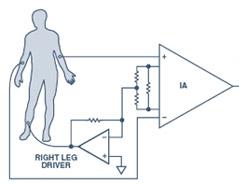
ecg_chain.jpg


but my supervisor told me:
amplify each lead separately (LA,RA or LL , and RL as reference) and read it by DAQ
then inside MATLAB we can obtain I,II and III signals, mathematically according to these equations:
I=LA-RA,II=LL-RA and III=LL-LA

so,what's your opinion about this method(of my supervisor), can succeed??
should i use instrument amplifier or just operational amplifier?
 
Engineering news on Phys.org
I'd use instrumentation amplifiers.

You're probably aware of the lessons learned in late 60's by early medical instrument manufacturers, but i'll mention two of them just in caes...

1. If your machine is connected to a patient who is also connected to one of those defibrillators with the high voltage paddles to get a stopped heart going, it's apt to fry your input amplifiers. Provide protection.

2. Isolate all your input leads, even the "common", from the electronic amplifiers by at least a megohm and preferably ten.
Reason is an electrical fault inside your machine must not reach out and touch the patient.
That's the reason hospitals have separate grounds for instuments and , say, vacuum cleaners. You don't want a defective vacuum cleaner to electrocute a patient through your ECG machine.

Analog Devices was a leader in developing isolated op-amps for the medical instrument industry. Their Peter Zicko was at the forefront back around 1973.
Intronics is another name brand, do some searching on "isolated input amplifier"

end of nagging


old jim
 
thank you "jim hardy"
 
Tough call.

Whatever the boss is, he's always the boss. It's generally better to gather evidence than argue.

Time allowing, I'd run both methods in parallel. Then, give a short effort towards the op amp method, record some notes regarding it's behavior, and then, if neccesary use your fall back circuit.

If your manager wants to commercialize this circuit, he'll have to deal with UL601 or equivalent. No repectable hospital or clinic will allow your device in without the precious safety agency sticker. They'll require that the connections have a current limiting impedance and be galvanically isolated from other circuits and of course, power.

For simple experiments, an isolated laptop is your best friend. Operating it from the battery with no external connections (i.e. Ethernet line, USB devices, etc...) allows you to have a power source (via USB) and signal processor. It's best to clear it of all possible connections to ensure that no one is tempted to charge it etc...
 
Please also review UL544 for this project. As mentioned, you will need to get safety approvals if you want to actually attach this to any person. Even if this is a simulation-only project, you need to research the safety considerations (and immunity issues that Jim brings up), in order to write a complete project report.
 
In addition to what has already been said, I'd like to suggest that you provide substantial notch filtering, bandpass limiting and transient protection to your input lines and amplifiers. Touch the probe of an oscilloscope to see how high an induced power line voltage could be on the input leads. This could easily drive your amps to either rail preventing amplification of the signal.
 

Similar threads

  • · Replies 9 ·
Replies
9
Views
5K
Replies
5
Views
3K
Replies
7
Views
6K
  • · Replies 2 ·
Replies
2
Views
3K
Replies
3
Views
39K
Replies
6
Views
4K
  • · Replies 2 ·
Replies
2
Views
2K
  • · Replies 1 ·
Replies
1
Views
1K
  • · Replies 1 ·
Replies
1
Views
3K
  • · Replies 4 ·
Replies
4
Views
3K